Quick answer
Choose the Nieuport 17 (set 2997) if you want a colorful WWI fighter with a famous ace pilot connection and a slightly larger display presence. Pick the Focke-Wulf FW 190 F-8 (set 5871) if you prefer a compact WWII ground-attack aircraft and want to spend less.
Era and subject matter: WWI vs WWII
The Nieuport 17 C.1 represents a French sesquiplane fighter from World War I, famously flown by Georges Guynemer. The Focke-Wulf FW 190 F-8 is a German WWII ground-attack variant. Your choice often comes down to which era you find more compelling. WWI aircraft tend to have lighter, more fragile structures, while WWII fighters like the FW 190 are heavier and more powerful. These historical differences can influence the building experience and the story the model tells on your shelf.
Scale and size: 1:48 vs unspecified
The Focke-Wulf FW 190 F-8 is explicitly stated to be in 1:48 scale, which gives you a good idea of its size relative to other 1:48 models. The Nieuport 17's scale is not provided in the catalog data, so we can't directly compare dimensions. If scale consistency with other 1:48 kits matters to you, the FW 190 is the safer bet. Otherwise, the Nieuport's size remains a mystery until you check the box or product page.
Piece count and build complexity
The catalog doesn't list piece counts for either set, so we can't say which is more complex. However, the subject matter offers clues: WWI biplanes like the Nieuport often involve rigging and struts that can be fiddly, while WWII monoplanes like the FW 190 have simpler airframes but may include more internal detail. Without official numbers, we recommend checking the piece count on the product page if that's a deciding factor for you.
Price and value
At catalog prices, the FW 190 is the more affordable option (USD 20.69 vs USD 29.19 for the Nieuport). Both are discounted from their comparison prices, but the FW 190's lower absolute price makes it a budget-friendly entry into COBI aircraft. The Nieuport costs more, but that may be justified by its larger size or unique subject—just keep in mind that the scale is not specified, so you're paying for the era and pilot story as much as the plastic.
Trade-offs to weigh
- Historical era: WWI (Nieuport) vs WWII (FW 190). Pick the era you find more interesting; each offers a distinct story and design philosophy.
- Scale and size: FW 190 is 1:48 scale; Nieuport's scale is not specified. If you need known dimensions, the FW 190 is the clear choice. Check the Nieuport's actual size if display space is tight.
- Price: FW 190 is cheaper at USD 20.69 vs USD 29.19 for the Nieuport. Consider whether the Nieuport's larger size or subject justifies the extra cost.
- Build experience: Piece counts are not provided. WWI biplanes often have rigging; WWII monoplanes are simpler. Read reviews or check the box for piece count if complexity matters.
Product facts
-
COBI Focke-Wulf FW 190 F-8 Fighter : Set #5871: 1:48 scale model of the Focke-Wulf Fw 190 F-8, a German WWII ground-attack fighter. The stated scale helps you plan shelf space and compare with other 1:48 models.
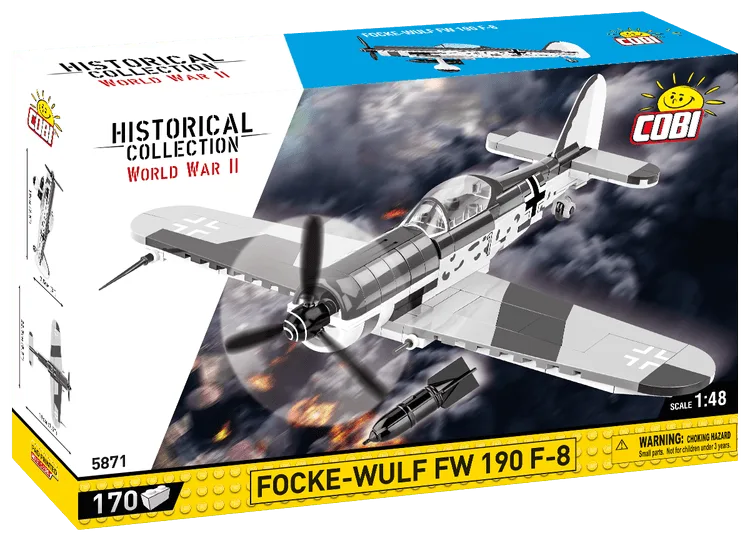
COBI Focke-Wulf FW 190 F-8 Fighter : Set #5871
-
COBI Nieuport 17 C.1 Sesquiplane Fighter : Set #2997: Model of the Nieuport 17 C.1, the WWI fighter flown by ace Georges Guynemer. The historical pilot connection adds display interest for fans of early aviation.
COBI Nieuport 17 C.1 Sesquiplane Fighter : Set #2997
COBI Nieuport 17 C.1 Sesquiplane Fighter : Set #2997
Which should you build?
Best for
- History fans who prefer WWI aviation and the story of ace Georges Guynemer
- Builders who want a slightly larger, more colorful display model (based on price and typical subject size)
Not for
- Those on a tight budget or who need a known 1:48 scale model
- Builders who dislike rigging or fiddly struts common in WWI biplanes