What the Colorful Crystal Lab Kit Includes
The Ooze Labs: Colorful Crystal Lab is a complete crystal growing kit designed for children ages 6 and up. It comes with a lab base station that serves as the headquarters for all your experiments, plus beakers, test tubes, a petri dish, tweezers, a centrifuge, a display dome, and more. You'll also receive three different crystal-forming chemicals: monopotassium phosphate, ammonium dihydrogen phosphate, and potassium aluminium sulfate. With 11 experiments to try, this kit offers a hands-on introduction to crystal formation and chemistry.
Kit Specifications at a Glance
-
Ooze Labs: Colorful Crystal Lab: Ages: 6+ The kit is designed for young scientists, with safe, non-toxic materials and simple instructions suitable for elementary-age children.
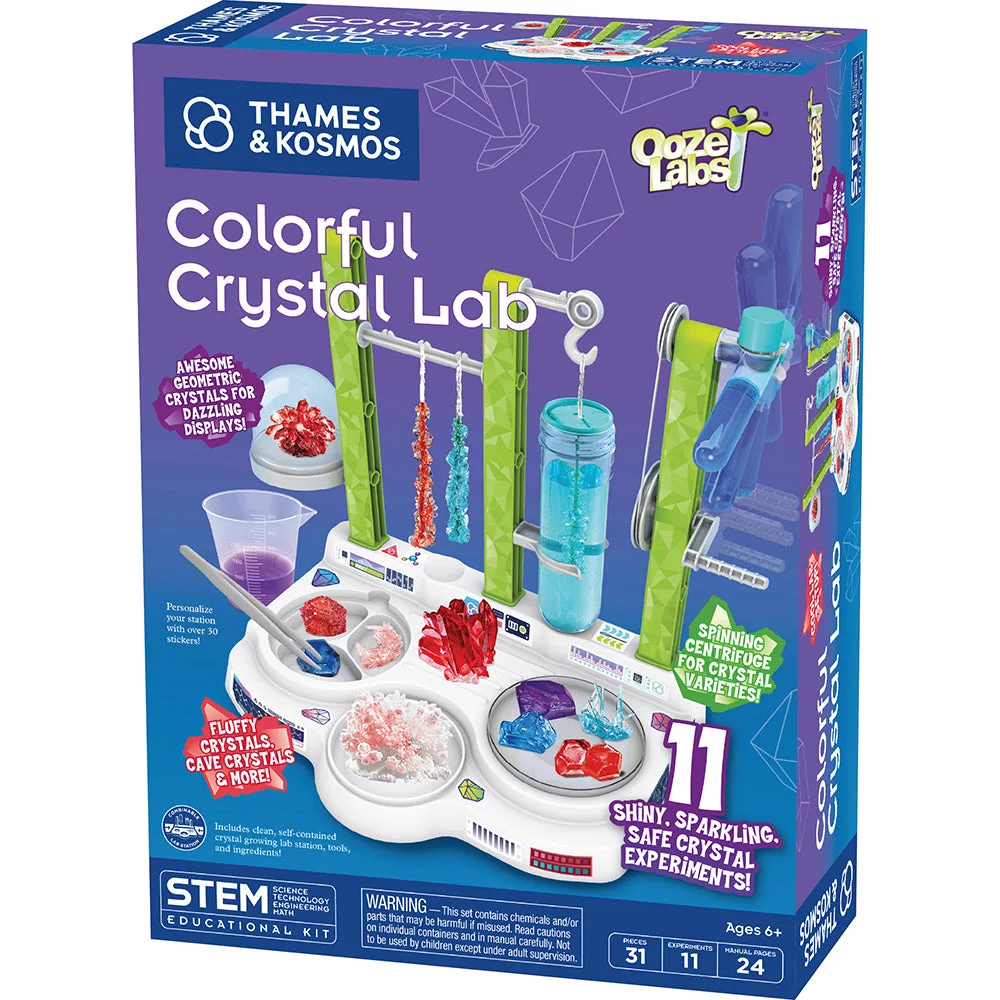
Ooze Labs: Colorful Crystal Lab
-
Ooze Labs: Colorful Crystal Lab: Experiments: 11 Multiple experiments let kids explore different crystal shapes, colors, and formation methods, deepening their understanding of crystal growth.
-
Ooze Labs: Colorful Crystal Lab: Piece Count: 32 A substantial set of equipment provides a realistic lab experience and encourages repeated use beyond the included experiments.
-
Ooze Labs: Colorful Crystal Lab: Product Weight: 1.7 lb The kit is lightweight and portable, making it easy to store or take to a kitchen table or classroom.
How to Grow Your First Crystal: A Practical Sequence
Follow these steps to grow your first crystal using the Colorful Crystal Lab. The exact timing and temperatures depend on the specific chemical and method you choose, so refer to the included manual for precise instructions.
- Set up your lab base station: Unpack the kit and assemble the base station. Arrange the beakers, test tubes, petri dish, and other tools so they are easy to reach. This central workspace will keep your experiments organized.
- Choose your first crystal-growing method: The kit supports several methods: growing crystals in a petri dish by evaporation, on a string dangling in solution, or by cooling a supersaturated solution. For beginners, the evaporation method in a petri dish is straightforward.
- Prepare the crystal solution: Select one of the three supplied chemicals (monopotassium phosphate, ammonium dihydrogen phosphate, or potassium aluminium sulfate). Dissolve the recommended amount in warm water according to the manual's instructions. Use the centrifuge to mix your own colors — red, pink, blue, purple, or clear are possible.
- Set up the crystal growth environment: Pour the solution into the petri dish or test tube. If using a string, suspend it in the solution. Place the setup in a safe, undisturbed spot where it won't be bumped or moved.
- Observe and wait for crystals to form: Crystals may appear within hours or days, depending on the method and chemical. Check your setup periodically and note the shapes and colors that develop. The manual provides guidance on what to expect.
- Display your finished crystal: Once crystals have fully grown, carefully remove them from the solution using tweezers. Place them in the display dome for a finished, museum-like presentation.
What You Can Learn from the Experiments
Each experiment in the Colorful Crystal Lab teaches a different aspect of crystal formation. You can make a crystal volcano by growing fast-forming crystals on a paper cone, watch long spindly crystals appear on a rock, and compare the different shapes produced by the three chemicals. The kit also explains how crystals form in nature, connecting the lab work to real-world geology and chemistry. After completing the included experiments, you can continue using the lab station and equipment with common household materials like table salt and alum salt.
Practical Tips for Success
For best results, work in a clean, well-lit area and follow the manual's measurements carefully. Mix colors in the centrifuge to achieve your desired shade before adding the chemical. Keep your growing setup away from drafts or direct sunlight, which can affect evaporation rates. If a crystal doesn't form as expected, try a different method or chemical — each one behaves differently. The kit is designed for repeated use, so don't be discouraged if the first attempt isn't perfect.