Choosing Between Commercial and Laser Mirrors
The main difference between commercial and laser mirrors is the intended wavelength range and performance demands. Commercial mirrors use a general-purpose aluminum coating for visible and near-UV light, while laser mirrors are built for higher precision, specific wavelengths, and durability under intense beams. This guide compares two product families from Esco Optics to help you decide which type fits your setup.
Commercial Mirror vs Laser Mirror: Key Differences
- Coating and Reflectance: Commercial mirrors are front-surface coated with aluminum over-coated with silicon monoxide (Al-SiO), providing greater than 85% average reflectance from 350-800nm. Laser mirrors like the UV Enhanced Aluminum on fused silica offer Ravg > 90% from 250-450nm. The MAX R coating on Borofloat 33 is designed for nearly complete reflection at a specific laser wavelength (e.g., 532 nm) with negligible absorption.
- Substrate Material: Commercial mirrors use Soda-lime Float Glass, a cost-effective material. Laser mirrors use Fused Silica (for UV performance) or Borofloat 33 (for thermal stability). The substrate affects thermal expansion, surface quality, and suitability for high-power applications.
- Surface Accuracy: Commercial mirrors have a commercial polish on the rear surface and fine ground beveled edges. Laser mirrors are polished to 1/10 wave surface accuracy (for the fused silica variant) with a 40/20 scratch-dig specification, meeting tighter tolerances required for laser beam steering and imaging.
Product Evidence at a Glance
-
Mirrors, Commercial Quality Square: Esco manufactures commercial quality flat mirrors from Soda-lime Float Glass, front surface-coated with aluminum over-coated with silicon monoxide, providing greater than 85% average reflectance from 350-800nm. This coating is suitable for general-purpose reflection in visible light and near-UV applications where broad wavelength coverage and low cost are priorities.
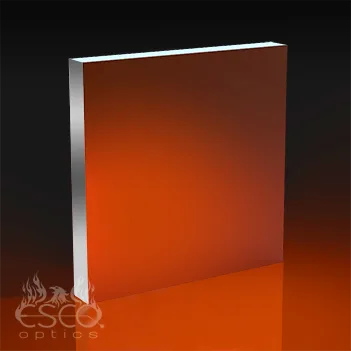
Mirrors, Commercial Quality Square
-
Fused Silica Precision Quality Flat Mirrors, UV Enhanced Aluminum: Fused Silica Precision Quality Flat Mirrors are coated with UV Enhanced Aluminum providing Ravg > 90% from 250-450nm, polished to 1/10 wave surface accuracy and 40/20 scratch-dig over an 85% aperture. The higher reflectance and tighter surface accuracy make these mirrors appropriate for UV laser systems and precision optical setups where beam quality is critical.
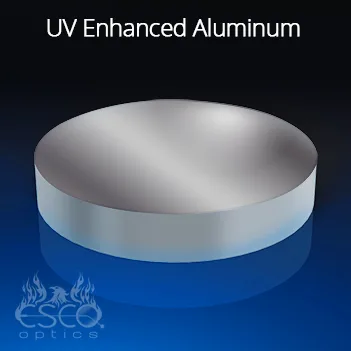
Fused Silica Precision Quality Flat Mirrors, UV Enhanced Aluminum
-
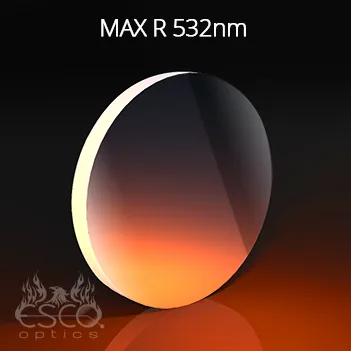
Borofloat 33 Mirror, MAX R 532 nm: Borofloat 33 Mirror with MAX R 532 nm coating provides nearly complete reflection at the specific laser wavelength, designed to meet MIL durability requirements. For laser applications at a fixed wavelength (e.g., 532 nm), this mirror minimizes energy loss and handles higher power densities better than a broadband coating.
Practical Selection Advice
If your application uses a broadband light source (e.g., a white light lamp or an LED) and does not require extreme surface flatness, a commercial mirror offers a cost-effective solution. The square and circular variants from Esco Optics cover common sizes; please refer to the product instructions for available dimensions.
For laser-based systems, choose a laser mirror with a coating matched to your laser wavelength. The UV Enhanced Aluminum mirror on fused silica is ideal for UV lasers (250-450 nm). For a fixed visible laser like 532 nm, the MAX R Borofloat 33 mirror provides higher reflectivity and durability, though at a higher cost and with increased polarization sensitivity.
Consider the substrate: fused silica handles thermal stress better than soda-lime glass, and its surface accuracy (1/10 wave) is essential for maintaining wavefront quality in interferometry or beam-steering applications.