Quick answer
Most planter damage comes from four habits: watering on a fixed schedule, choosing a pot far larger than the root ball, skipping drainage, and treating cache pots like planting pots. Fix those and you prevent the root rot, soggy soil, and stalled growth that send people hunting for new planters.
Plant problems rarely start with the plant. They start with the pot, the soil, and a watering routine built on habit instead of observation. The advice that circulates online often makes it worse, because a lot of it was written for garden beds and never adjusted for containers.
Below are the claims we hear most often, each with a verdict. Where a product detail helps, we point to real options in our catalog, but the fixes work with whatever planter you already own.
Myth: Put Rocks in the Bottom for Drainage
Verdict: false. A gravel layer does not create drainage. It raises the saturated soil zone closer to the roots, so the bottom of the pot stays wetter than it would with soil alone. Water still has to leave the container, and it can only do that through holes.
What actually works is a pot with drainage holes, a saucer or tray to catch what runs through, and soil that drains. If your planter has no holes and you cannot drill them, use it as a cache pot: keep the plant in a nursery pot inside and lift it out to water.
- Check drainage before you buy soil, not after.
- If a decorative pot has no holes, treat it as a cover, not a growing container.
- Empty saucers after heavy watering so the pot is not sitting in standing water.
Myth: Always Size Up Two Inches
Verdict: partly true, often misapplied. Moving up too far leaves a large volume of soil with no roots to drink from it. That soil stays wet, and wet soil is where root rot begins. The safer move is one size up, or roughly an inch or two of new soil around the root ball.
This is where a wrong planter size mistake shows up slowly. The plant does not die in a week. It sulks, drops leaves, and the soil stays damp far longer than it should. If you already bought a large statement planter, plant into it with a smaller pot nested inside, or fill the extra volume with a lightweight filler rather than more soil.
- Match pot size to the root ball, not to the look you want on the patio.
- A big planter needs a big, thirsty plant, or a nested smaller pot inside.
- If soil is still wet a week after watering, the pot is too large for the root system.
Myth: Water on a Schedule
Verdict: false, and it is the most common planter error we see. Containers dry at wildly different rates depending on pot material, size, sun exposure, and whether the plant is root-bound. A calendar cannot track that.
Water when the top inch or two of soil feels dry, and water until it runs out the bottom. Then stop. Overwatering in planters is not about the amount of water you pour; it is about how long the roots stay saturated. If your pot has no drainage and no way to empty it, you cannot water this way, which is another reason to use a cache pot for indoor plants.
- Test with a finger or a wooden skewer before watering.
- Water thoroughly, then let the pot drain completely.
- Small pots in full sun may need water daily; large shaded pots may need it weekly.
Myth: Cache Pots Are Just Planters
Verdict: false. A cache pot is a drop-in cover, and that distinction matters. The https://plantatoremez.com/products/peace-lily-cache-pot-case-of-12-1d7fd5b7d495ef78d9a1c035-2580439https://plantatoremez.com/products/peace-lily-cache-pot-case-of-2-da4d2eab37d3eb43d85a71ac-2580448https://plantatoremez.com/products/peace-lily-cache-pot-case-of-4-66ef1a23bfb08321de94ed6d-2580466https://plantatoremez.com/products/peace-lily-cache-pot-large-case-of-2-4c2bab19c5ce8777ccc20fdb-2580497Peace Lily Cache Pot By Plantatorem is described as a set of two handmade ceramic pots sized 8.5" x 7.5", designed so you slip your existing plant pot inside. That means no replanting and no drainage question, because the inner pot handles the water.
The Cube Cache Pot- 2.5" x 2.5" By Plantatorem works the same way at a much smaller scale. It comes as a case of 12 in mixed colors, which suits coordinating several small plants or spreading one consistent look across a room. Both are ceramic, so they hold up indoors, but neither is meant to be filled with soil directly.
- Lift the inner pot out to water and let it drain before putting it back.
- Never let water pool in the bottom of a cache pot.
- Use cache pots when you want a polished look without repotting.
Myth: Any Pot Works Outdoors
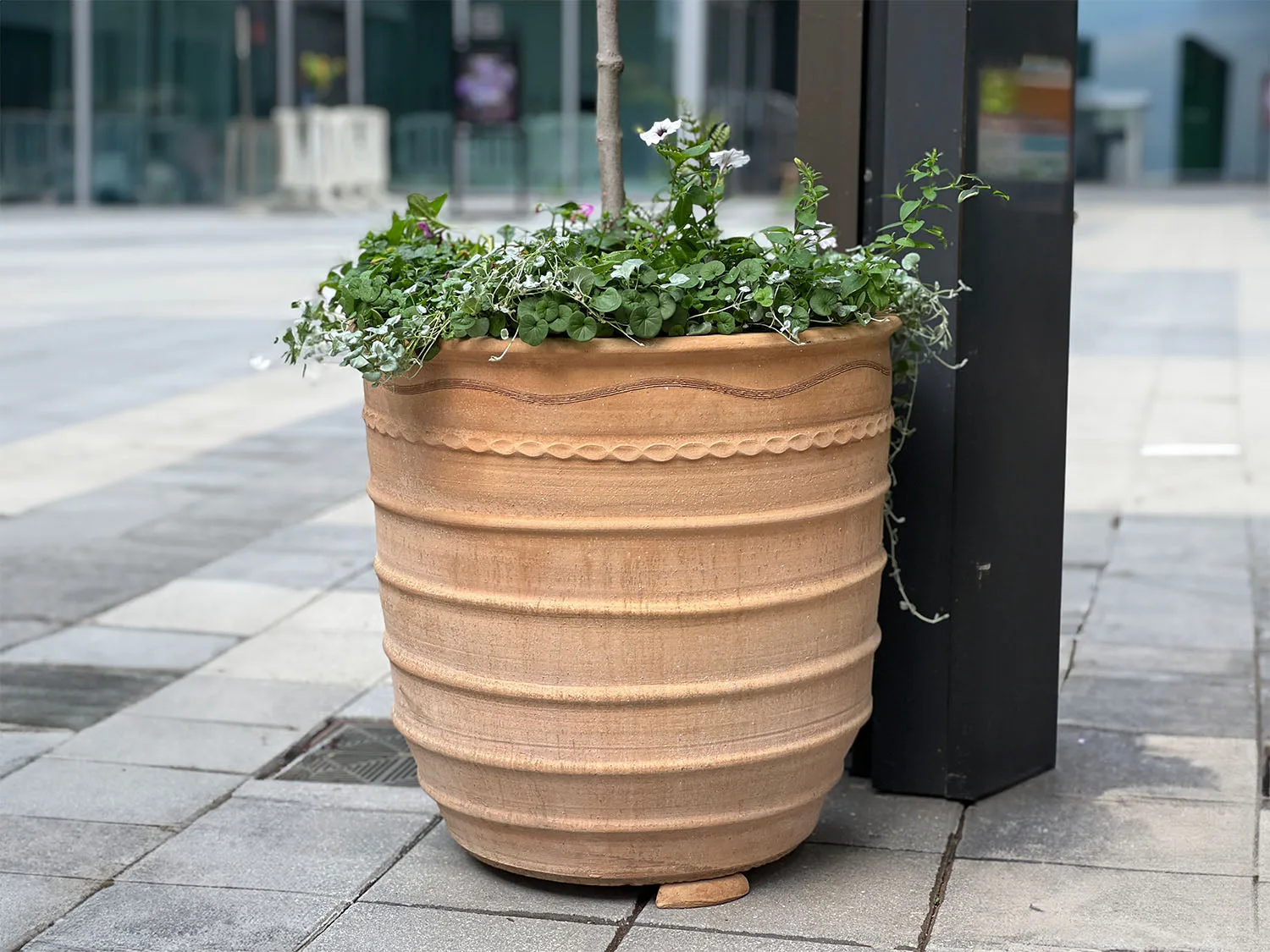
Verdict: false. Outdoor containers face freeze-thaw cycles, direct sun, and wind that indoor pots never see. Material and construction matter more than color. The Pitharaki Urn By Plantatorem is described as handcrafted from Cretan clay, and each urn is unique, which is part of the appeal but also means you should treat it as a traditional clay pot and protect it in hard freezes.
At the larger end, the Ancient Wine Vessel is a ceramic planter offered at 24.5" D x 33.0" H in Atlantis Sky, Aegean Sea, and Verdigris, and it is listed as suitable for both outdoor and indoor use. Size like that holds a lot of soil, so pair it with a plant that can actually use the moisture, or nest a smaller pot inside.
- Outdoor pots need drainage holes and a plan for winter.
- Large ceramic planters are heavy; place them before you fill them.
- Clay and ceramic can crack if water freezes inside the pot.
Myth: More Soil Means More Growth
Verdict: false. Plants grow from roots, light, and water, not from soil volume. Extra soil with no roots in it just holds moisture and delays drying. This is the quiet version of the wrong planter size mistake: the pot looks generous, the plant looks small, and the soil stays wet for weeks.
The Beverly Planter By Plantatorem is sold as a set of 3 with a wavy texture and a shiny glaze, in two colors and multiple sizes. A tiered set like that is useful precisely because you can match each plant to a pot that fits its root ball instead of forcing everything into one large container.
- Use the smallest pot that comfortably holds the roots.
- Fill unused depth with a lightweight filler, not extra soil.
- Repot when roots circle the inside of the pot, not on a fixed schedule.
Verdicts at a glance
- Rocks in the bottom: A gravel layer raises the saturated zone and keeps soil wetter near the roots. Verdict: myth. Use drainage holes and a saucer instead.
- Size up two inches: Extra soil with no roots stays wet and invites rot; one size up is safer. Verdict: partly true, often misapplied.
- Water on a schedule: Containers dry at different rates, so check the soil before watering. Verdict: myth. Water when the top inch or two is dry.
- Cache pots are planters: Cache pots are drop-in covers; the inner pot handles water and drainage. Verdict: myth. Never let water pool in the bottom.
- Any pot works outdoors: Freeze-thaw, sun, and wind demand drainage and winter protection. Verdict: myth. Match material and size to the site.
Planter details worth knowing
- Peace Lily Cache Pot By Plantatorem: Sold as a set of two handmade ceramic pots measuring 8.5" x 7.5", designed as drop-in cache pots so you slip your existing plant pot inside. You get a finished look without repotting, and the inner pot keeps drainage simple.
- Cube Cache Pot- 2.5" x 2.5" By Plantatorem: A compact cube-shaped ceramic cache pot measuring 2.5" x 2.5", offered as a case of 12 in mixed colors. Good for grouping small plants or carrying one consistent look across a room.
- Ancient Wine Vessel: A ceramic planter from PLANTATOREM sized 24.5" D x 33.0" H, offered in Atlantis Sky, Aegean Sea, and Verdigris, and suitable for outdoor and indoor use. A large statement piece needs a plant that can use the soil volume, or a nested smaller pot inside.
- Pitharaki Urn By Plantatorem: A handcrafted urn made from Cretan clay, with each piece unique, in a vintage-style terracotta look. Traditional clay dries faster and needs winter protection in freezing climates.
None of these fixes require new plants. They require checking drainage, matching pot size to the root ball, and watering by feel instead of by calendar. Get those three right and most planter care mistakes stop happening.