Quick answer
Most quilt pattern mistakes come from three places: cutting inaccuracies, seam allowance drift, and skipping the pattern's fabric requirements. Fix the cause, not just the symptom. If a mistake affects more than one block, correct it before you sew the top together; if it's isolated to a single block, remake that block and move on.
You've cut, sewn, and pressed — and your blocks still don't line up. Before you unpick everything, know that most quilt pattern mistakes fall into a handful of predictable categories. Each has a specific cause and a specific fix.
This guide walks through the symptoms you'll actually see at your machine, what likely caused them, and the point where you should stop fixing and choose another option. No vague advice — just the diagnosis-and-action steps that get your project back on track.
Cutting errors: when pieces are consistently too small or too large
If every piece from a strip is a hair narrow, your rotary cutter likely drifted off the ruler line. This is one of the most common quilt cutting errors. The fix is mechanical: re-check that your ruler edge is aligned with the fabric edge before every cut, and replace your blade if it's skipping. If the error is consistent across all pieces, adjust your cutting technique — don't try to compensate by sewing a wider seam.
When pieces are too large, the cause is usually measuring from the wrong edge or using a ruler with a worn corner. Trim one test piece and measure it against the pattern. If it matches, continue. If it's still off, your ruler may be inaccurate; switch to a different ruler before cutting more fabric.
- Always cut with the fabric folded selvedge to selvedge and the fold aligned with a ruler line.
- Measure twice, cut once — especially on directional prints.
Seam allowance drift: why your blocks shrink or grow
A quarter-inch seam that's actually 3/16" will make every block slightly small. Multiply that by the number of seams in a block and your finished unit won't match the pattern. The symptom: blocks that measure consistently off by 1/8" to 1/4" across the board. The fix is to test your seam allowance on a scrap, adjust your needle position, and re-sew a sample block before continuing.
If only some blocks are off, the cause is likely inconsistent pressing or feeding. Press seams to one side rather than open unless the pattern says otherwise, and let the feed dogs move the fabric — don't pull. If you're still off after two test blocks, your machine may need a different presser foot or a seam guide.
- Sew a test seam, measure the result, and adjust before chain-piecing.
- Nesting seams reduces bulk and helps corners meet.
Fabric shortages: when the pattern calls for more than you bought
Running out of fabric mid-project usually means the pattern's requirements assumed a different width or that you didn't account for directional prints. If you're short by less than a fat quarter, check your scrap bin for a matching piece from the same dye lot. If you're short by more, you have two choices: simplify the design by removing a round of blocks, or choose a coordinating fabric for the remaining units.
This is the point to stop and choose another option. Piecing in a visibly different fabric will look intentional only if you repeat it elsewhere. If you can't repeat it, consider making a smaller quilt — a crib or wall size — rather than forcing a mismatch.
- Buy 10–15% extra of any fabric you plan to cut across the grain.
- Keep a note of the dye lot on your pattern for future reference.
Pressing problems: seams that won't lie flat or blocks that won't square up
If seams are twisting or blocks won't lie flat, the cause is usually pressing with too much motion. Ironing — sliding the iron back and forth — stretches bias edges. Pressing — lifting and setting the iron — keeps shapes true. Switch to an up-and-down motion and press seams after sewing, not before.
If a block still won't square up, check whether your seam allowances were pressed in conflicting directions. Alternate pressing directions from block to block so seams nest when you join them. If the block is more than 1/4" off after squaring, remake it; the distortion will compound when you assemble the top.
- Press, don't iron, especially on bias edges.
- Let blocks cool flat before measuring.
Pattern-reading mistakes: skipping the fine print
Many common quilting mistakes start before you cut: misreading the pattern's fabric key, ignoring the note about directional prints, or assuming all seams are quarter-inch when some are scant quarter-inch. Read the entire pattern once before you buy fabric, and highlight any special instructions. If the pattern doesn't specify a seam allowance, assume quarter-inch — but test it.
If you've already cut and realize you misread, stop. Check whether the error affects one block or the whole layout. If it's one block, remake it. If it's the whole layout, you may be able to rotate or rearrange blocks to hide the error — but only if the design allows. Otherwise, treat it as a design change and adjust your plan.
- Read the pattern fully before cutting into any fabric.
- Mark your pattern with notes as you go so you don't repeat a mistake.
Diagnosis: symptom, cause, fix, and when to stop
- All pieces consistently 1/8" small: Your rotary cutter drifted off the ruler, or your ruler is worn. Re-cut one test piece and measure. If it's still small, replace the blade and check the ruler against a known square. If three test cuts are accurate, continue cutting. If not, stop and change tools.
- Blocks measure off but seams look even: Your seam allowance is likely wider or narrower than a quarter-inch. Sew a test seam, measure, and adjust needle position. Re-sew one sample block before chain-piecing. If the sample block matches the pattern, proceed. If it's still off, your machine may need a seam guide.
- One block won't square up after pressing: The block may have stretched on bias edges or been pressed with too much motion. Press again with an up-and-down motion. If it's still more than 1/4" off, remake the block. Remake any block that's more than 1/4" off — the distortion will compound when you assemble the top.
- You're short on fabric mid-project: Check your scrap bin for same-dye-lot pieces. If you're short by more than a fat quarter, consider simplifying the design or making a smaller quilt rather than piecing in a mismatched fabric. If you can't repeat the substitute fabric elsewhere, choose a smaller finished size instead.
Quilty tools that help you avoid and fix mistakes
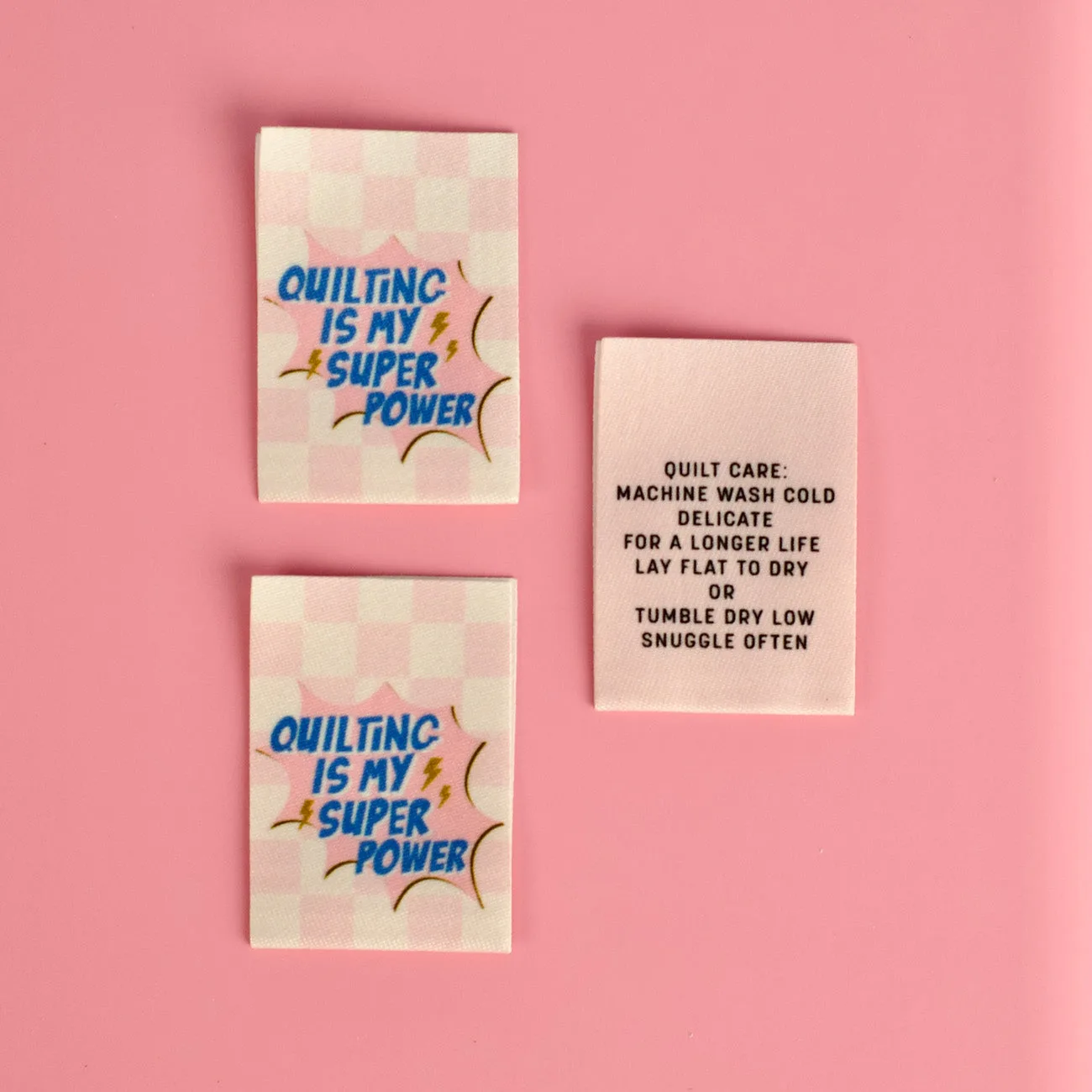
- Super Power - Quilty Labels: Premium designer sew-in labels, easy to sew, for handmade garments, quilts, bags, and accessories. If you're fixing a mistake by remaking a block or adding a patch, a sew-in label lets you mark the finished piece as intentional — and reminds you which project it belongs to.
- Forget Flowers - Zipper Pouch: Light cream canvas zipper pouch with berry blue design and zip, sized for sewing notions, pens, makeup, cords, gift cards. Keeping your seam ripper, extra blades, and marking tools in one grab-and-go pouch means you're less likely to skip the test seam or the ruler check that prevents most cutting errors.
Most quilt pattern mistakes are fixable if you catch them early. Test your seam allowance, cut carefully, and press with intention. When a mistake affects more than one block, correct it before assembly — and when it can't be corrected, adjust the design rather than forcing a fix that will show.