Quick answer
Choose one dominant focus fabric and one quiet background, then use the Compass pattern's 12 quarter-yard cuts for medium-scale prints that read clearly at a distance. If you want the diagonal movement to show, keep strong contrast between the focus rows and the background rather than between every individual print.
Why the on-point illusion changes your fabric plan
The Compass pattern is sewn in rows, but the diagonal angles create an on-point look. That means your fabric choices do two jobs at once: they separate rows enough to keep the construction readable, and they create the diagonal movement that makes the quilt look dynamic. A collection of beautiful fabrics that all share the same value will blur that movement, even if the prints are different.
Start by deciding which fabric should dominate. The pattern calls for 12 quarter-yard cuts of assorted focus fabrics plus a half-yard of yellow focus, so the assorted prints will be the busiest part of the quilt. If you make every one of those cuts high-contrast, the diagonal lines compete with the prints. If you make them too similar, the rows disappear.
Color choices that keep the compass bold without fighting it
Use the yellow half-yard as an accent rather than a second background. In a bold compass design, a warm accent works best when it appears in deliberate places, not scattered evenly through every row. If you replace the yellow with another color, choose one that is noticeably lighter or darker than your main focus fabrics so it still reads as an accent.
For the assorted focus cuts, limit yourself to two or three color families. A tighter palette makes the diagonal angles look intentional; a wide mix of unrelated colors can make the rows look random. If you love a large stash, pick a palette first and then pull prints that fit it.
Print scale and contrast trade-offs
Quarter-yard cuts reward small and medium prints. Very large motifs may be cut apart in ways that lose the design, so save those for a border or backing if you use them at all. Tone-on-tone and low-volume prints are useful for the background because they add texture without competing with the focus fabrics.
Contrast is not the same as color difference. Two fabrics can be different colors but nearly the same value, which makes them blend in a photograph and at a distance. Before cutting, sort your focus fabrics into light, medium, and dark piles and check that the background is clearly separate from all three.
What the paper pattern asks you to buy
The Compass paper pattern lists 12 quarter-yard cuts of assorted focus fabrics, a half-yard of yellow focus, and two 2/3-yard cuts, finishing at 59 inches by 59 inches. Those are the starting requirements; if you plan to change the background or add borders, buy extra rather than assuming the listed yardage covers it. The pattern also notes that the Quick Straight Ruler makes cutting bias edges easy, quick, and consistent, so a ruler you already trust matters as much as the fabric.
Fabric decision rules for the Compass quilt
- Choose your dominant focus group: Pick two or three color families for the 12 assorted quarter-yard cuts. If you cannot sort the prints into those families, remove the outliers before cutting. Lay the quarter-yard cuts side by side and squint; the palette should still look like one quilt.
- Set the background apart: Choose a background that is clearly lighter or darker than every focus fabric. If your focus fabrics are mostly medium value, a light low-volume background will keep the rows visible.
- Place the yellow accent deliberately: Use the half-yard of yellow focus in a few concentrated areas rather than spreading it evenly. If you substitute another accent color, keep it distinct from both the focus group and the background.
- Check print scale against the cut size: Favor small and medium prints for the quarter-yard cuts. If a large print is a must-have, use it where the motif can stay whole, such as a border or backing, and buy extra yardage.
- Buy for the listed size, then add margin: The pattern lists 12 quarter-yard focus cuts, a half-yard yellow focus, and two 2/3-yard cuts for a 59-inch square quilt. Add extra if you plan to change the background, add borders, or prewash. Confirm your total against the pattern before checkout, especially if you are substituting fabrics.
Product facts
-
Compass (Paper): The Compass paper pattern is constructed in rows but creates the illusion of an on-point setting, and it calls for 12 quarter-yard cuts of assorted focus fabric plus a half-yard of yellow focus. Buying the listed cuts in a coordinated palette lets you test the diagonal effect before you commit to a larger fabric pull.
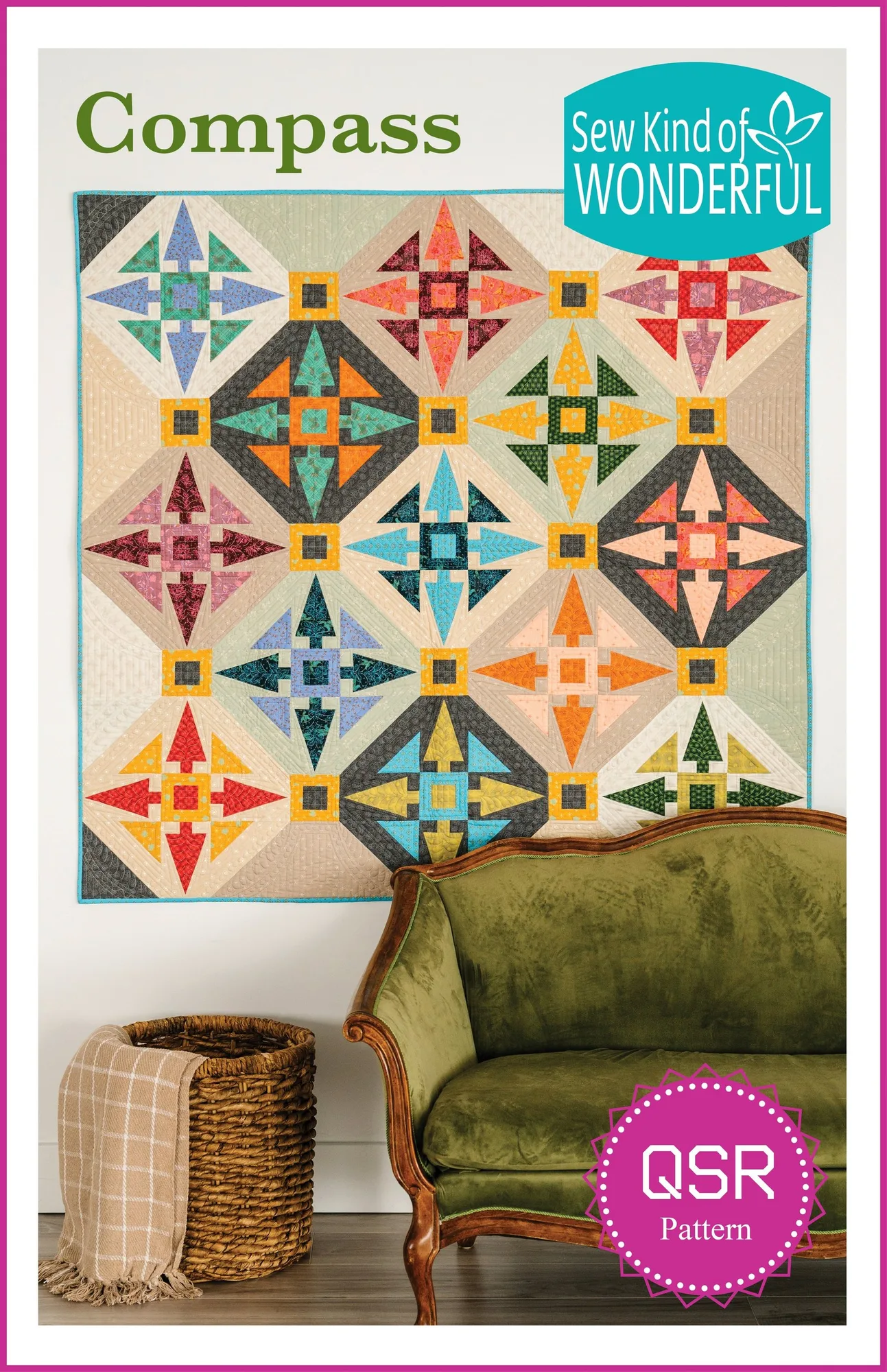
Compass (Paper)
Who this fabric plan suits
Best for
- Quilters who want a bold diagonal look but prefer row construction over on-point piecing
- Shoppers choosing a coordinated palette for the Compass paper pattern's listed quarter-yard cuts
Not for
- Quilters who want to use large-scale directional prints across every quarter-yard cut
- Shoppers looking for a finished quilt or a pre-cut fabric bundle, since this listing is the paper pattern