Quick answer
Reach for a composite wetting resin when composite pulls, sticks to your instrument, or fails to adapt to the preparation. Apply a thin film to the instrument or restoration surface before packing, and skip it when you need a bonding agent’s adhesion.
Wetting resin vs bonding agent: they are not interchangeable
A bonding agent is designed to bond composite to tooth structure. A wetting resin is designed to improve composite’s flow and adaptation and to reduce sticking to instruments. Using a bonding agent as a lubricant can compromise the bond or leave an uneven layer, while using a wetting resin as a bonding agent will not provide adhesion. Keep the two separate in your workflow.
When the problem is technique, not the material
If composite sticks only occasionally, check your instrument first. Excess composite on the tip, a dry preparation, or too much resin can all cause sticking. A wetting resin helps, but it will not fix a contaminated field or a preparation that is not properly isolated. Address those basics before adding another material.
Diagnose and fix sticky composite
- Symptom: composite sticks to the instrument: Dip the instrument in a small amount of wetting resin or apply a thin film to the instrument tip before picking up composite. Avoid overloading the instrument.
- Symptom: composite pulls away from the preparation: Apply a thin layer of wetting resin to the preparation walls with a microbrush, then place composite in small increments. Do not use bonding agent as a substitute.
- Likely cause: too much or too little resin: Excess resin can dilute the composite or leave a slippery surface; too little will not prevent sticking. Use the smallest amount that gives a thin, even film. If sticking persists after adjusting resin amount, check isolation and instrument cleanliness.
- Corrective action: technique checklist: Isolate the field, dry the preparation, apply resin sparingly to instrument or restoration, and pack composite firmly. Clean instruments between increments.
- When to stop or choose another option: If you need adhesion to tooth structure, use a bonding agent instead. If the preparation is contaminated or not isolated, stop and correct that first. If the restoration requires a specific bonding protocol, follow that protocol rather than using wetting resin. Wetting resin is a handling aid, not a replacement for bonding or isolation.
Product facts
-
Composite Wetting Resin: Composite Wetting Resin by Ultradent allows for excellent adaptation of composite for restorations and preparations. Use it when composite needs to flow into the preparation and adapt closely, rather than when you need a bonding agent.
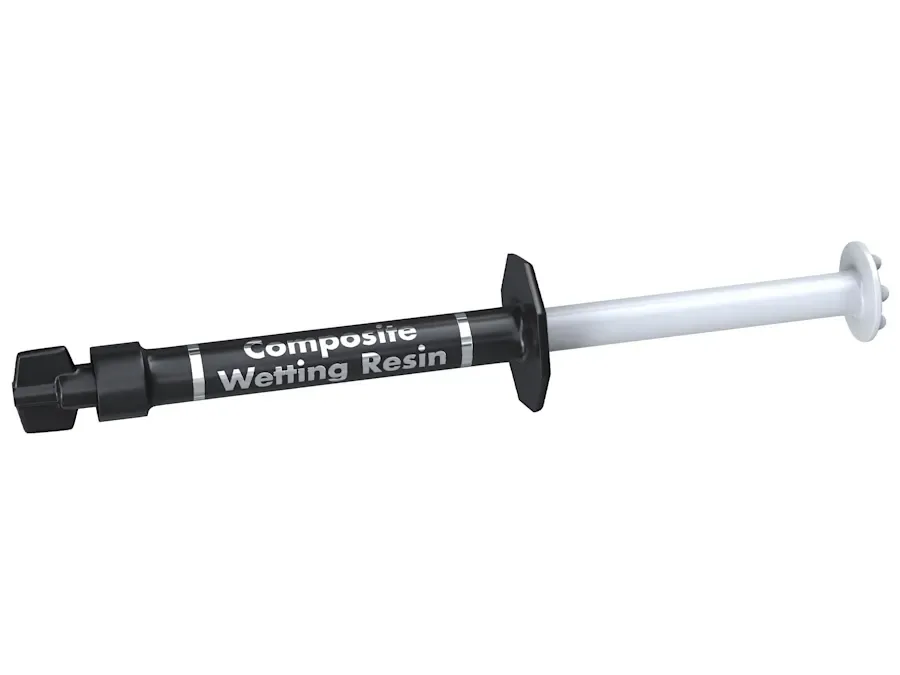
Composite Wetting Resin