Two Tools, Different Jobs
If you are choosing between a confined space ventilator and a standard axial fan, the decision comes down to the specific airflow needs, the environment, and safety requirements. Both move air, but they are designed for very different conditions. This comparison focuses on the features that matter most: airflow performance, build durability, portability, and certified safe use.
The key difference is that a confined space ventilator is built for high-velocity, directed airflow in tight, potentially hazardous areas, while a general axial fan is better suited for open, non-critical spaces. We will look at what each type offers and where each falls short.
8 In. Axial Confined Space Ventilator Fan at a Glance
-
8 In. Axial Confined Space Ventilator Fan: High-velocity ventilation delivers up to 900 CFM of powerful directional airflow to quickly exhaust dust and stale air from confined workspaces. CFM (cubic feet per minute) is the key measure of airflow. 900 CFM is substantial for a compact ventilator, making it effective for clearing dust, fumes (non-hazardous), and stale air from tight spaces.
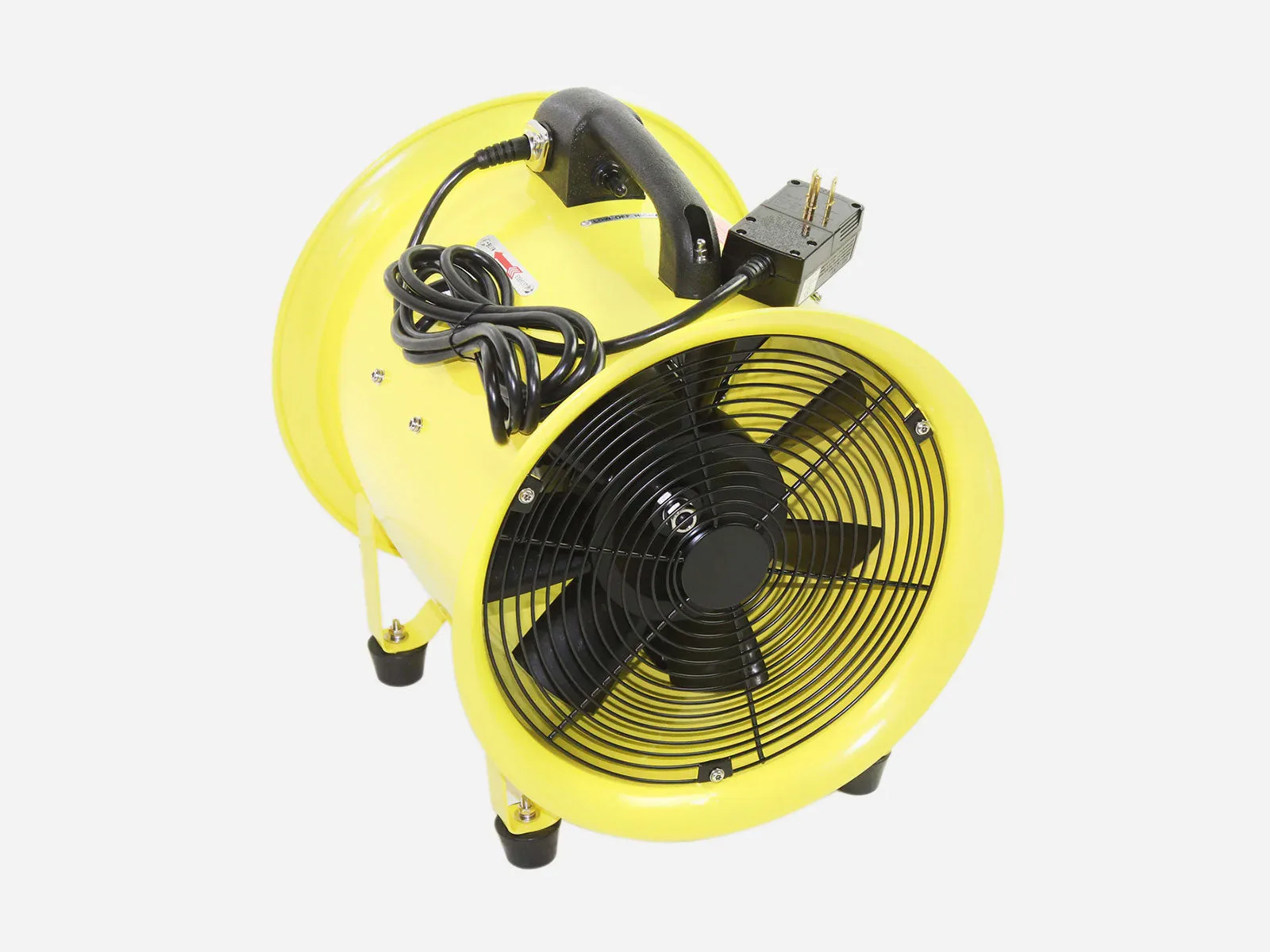
8 In. Axial Confined Space Ventilator Fan
-
8 In. Axial Confined Space Ventilator Fan: Features a built-in carry handle and rubber feet for easy transport; pairs perfectly with optional flexible ducting for targeted extraction. Portability and ducting compatibility are crucial in confined spaces where you need to position the ventilator at an entry point and direct airflow exactly where it is needed.
-
8 In. Axial Confined Space Ventilator Fan: UL Listed for indoor or outdoor/wet area use when used with a GFCI outlet. This safety certification allows the ventilator to be used in damp or outdoor environments, a common requirement for construction, maintenance, or utility work, as long as GFCI protection is provided.
-
8 In. Axial Confined Space Ventilator Fan: Not intended to exhaust hazardous chemicals or fumes. This is a critical limitation. Even though it is a confined space ventilator, it is not rated for chemical or fume extraction. For those applications, a specialized hazardous-duty ventilator would be necessary.
Confined Space Ventilator vs Axial Fan: Key Differences
The following comparison highlights the main differences between a confined space ventilator and a typical axial fan, based on the supplied information for the 8 In. Axial Confined Space Ventilator Fan.
- Airflow and Direction: A confined space ventilator delivers high-velocity, directional airflow (up to 900 CFM) and can be paired with flexible ducting for targeted extraction. A standard axial fan typically moves air in a broad, less directed pattern, which is fine for general circulation but not for exhausting a confined space.
- Build and Portability: The confined space ventilator features a heavy-duty steel housing, powder-coated grilles, a high-visibility yellow finish, a built-in carry handle, and rubber feet. This rugged construction is designed for job sites and frequent transport. Axial fans vary widely in build quality, but many are lighter and less durable.
- Safety Certifications: The 8 In. Axial Confined Space Ventilator Fan is UL Listed for indoor/outdoor/wet area use with a GFCI outlet. Axial fans may lack such certifications, making them unsuitable for damp or outdoor environments without additional protection.
- Application Limitations: The confined space ventilator is not intended for hazardous chemical or fume exhaust. A standard axial fan also cannot be used for that purpose unless specifically rated. Both have the same limitation, but the confined space ventilator is clearly labeled, reducing the risk of misuse.
- Speed Control: The confined space ventilator offers 2-speed selections via a toggle switch, giving you control over airflow intensity. Many axial fans also have multiple speeds, but the control mechanism and range vary by model.
Choosing Based on Your Situation
Use a confined space ventilator when you need to exhaust dust, stale air, or moisture from a tight workspace, especially in a construction, maintenance, or utility setting. Its rugged build, portability, and safety certifications make it the right tool for the job. The 8 In. Axial Confined Space Ventilator Fan is a solid example, offering 900 CFM, tool-free setup, and wet-area UL listing.
Choose a standard axial fan for general air circulation in open, dry, non-critical areas where directed exhaust is not needed. It will be lighter and often less expensive, but it lacks the safety certifications and directional airflow capabilities of a confined space ventilator.
What the Supplied Information Does Not Cover
The supplied information does not include specifications for a generic axial fan for direct comparison, so the differences described are based on the typical characteristics of each type and the specific facts about the 8 In. Axial Confined Space Ventilator Fan. Noise levels, exact dimensions, and power consumption are not provided for either product. For applications involving hazardous fumes, a different class of ventilator is required, and this information is not covered.