Quick answer
Most cosplay label problems come from three causes: a stiff or scratchy label placed against skin, a label sewn only along its edges so it lifts, or a label attached after the costume is finished and hard to reach. Fix the placement and attachment first; switch to a softer woven label only if the irritation persists.
Why cosplay costumes stress labels more than everyday sewing
Cosplay builds combine close-fitting layers, heavy armor pieces, and repeated wear across convention weekends. A label that feels fine on a quilt can feel like sandpaper when it sits under a shoulder strap or against a neck seam for eight hours. The same friction that wears down foam and paint also works on label edges.
That is why labeling handmade cosplay rewards a different approach from labeling a gift quilt: place the label where it will not rub, secure it more thoroughly than usual, and choose a material that tolerates sweat and repeated washing. The diagnosis below works through the common failures in that order.
When a woven label is the wrong fix
If the costume is a one-off photo shoot prop that will never be worn against skin, a printed or write-in tag is cheaper and faster. Woven labels earn their place when the piece will be worn repeatedly, washed, or handed to another cosplayer, because the text is woven into the fabric rather than printed on top.
Also skip a sewn-in label if the garment has no seam allowance to hide it, such as a fully lined corset with no accessible inner seam. In that case, a hanging tag looped to a zipper pull solves the labeling problem without opening the garment.
Symptom, cause, and fix
- Symptom: the label scratches or itches against skin: Likely cause: the label sits on a bare-skin area or its cut edges rub. Corrective action: move the label to an inner seam covered by a lining, or sew it flat with a narrow zigzag so no stiff corner stands up. If the irritation continues after repositioning, switch to a softer woven label rather than a printed one. Stop adjusting once the label sits under a covered seam and lies flat; further repositioning usually makes the seam weaker, not softer.
- Symptom: the label peels up or frays after a few wears: Likely cause: it was stitched only along two edges, leaving the ends free to catch on armor straps and gloves. Corrective action: sew all four sides with a short stitch length, or fold the label into a loop and stitch it into a seam so no raw edge is exposed. If the fabric around the label is already fraying, reinforce that seam before reattaching; a new label will not hold on unstable fabric.
- Symptom: you cannot find a place to attach the label: Likely cause: the costume is fully lined or the seam allowance is too narrow. Corrective action: hand-sew the label to the inside of a facing or behind a pocket bag, or loop it around a zipper pull as a hanging tag. Choose another option, such as a write-in tag on a care card, if no interior surface is reachable without opening the garment. Decide before you close up the lining; retrofitting a label through a finished corset is the point where the effort outweighs the benefit.
- Symptom: the label text is unreadable or worn away: Likely cause: a printed or write-in label exposed to sweat, friction, or repeated washing. Corrective action: replace it with a woven label, whose text is part of the weave rather than applied to the surface, and place it on an interior seam away from high-friction zones. If the costume is dry-clean only, confirm the label tolerates the cleaning method before sewing it in.
Product facts
-
Cosplay Multipack Woven Sewing Labels: Sold in packs of 8 woven labels in orange, green, black, and blue, each with a unique text and star design. Eight labels let you tag several pieces of one build or split a pack across a group cosplay, and the color range helps match different costume palettes.
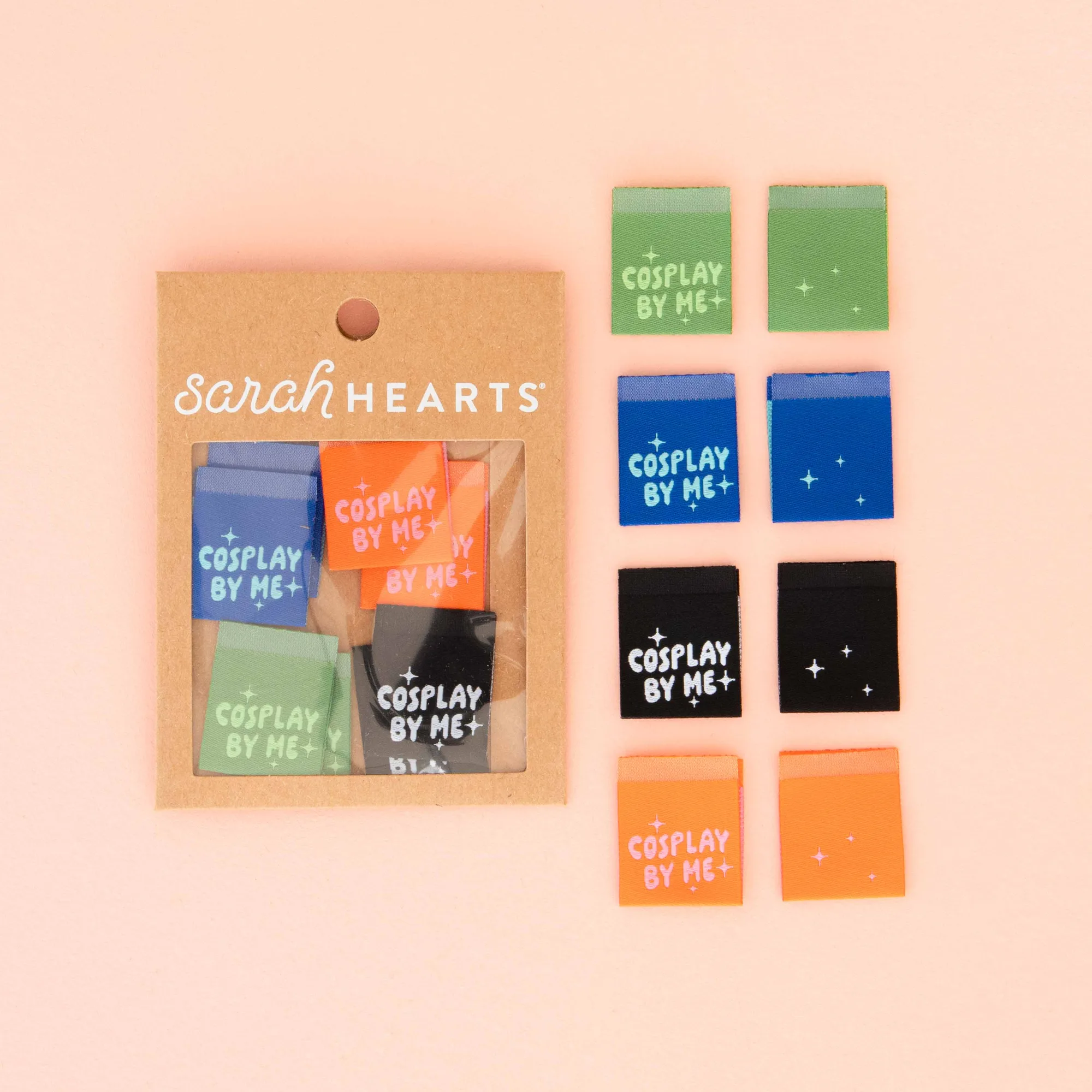
Cosplay Multipack Woven Sewing Labels
-
Cosplay Multipack Woven Sewing Labels: Made from 100% polyester and OEKO-TEX Standard 100 certified. The certification gives you a documented safety reference for a label that may sit against skin during long convention days.