Start with the pieces, not the numbers
The Count and Stack Toy is a wooden sorting and stacking puzzle with a woodland theme. Before you introduce counting, let your child explore the pieces freely. Pick up a piece, feel its shape, and try fitting it onto a post. This open-ended time builds comfort with the toy and gives you a sense of which pieces your child reaches for first.
The toy is recommended for ages 2 and up, so the earliest sessions should be about matching and stacking, not reciting numbers. Once your child can place a piece on a post with some success, you have a natural opening for counting.
What the Count and Stack Toy gives you to work with
-
Count and Stack Toy: Each shape has the same number of pieces as the number of holes you count: one acorn, two moons, three mushrooms, four leaves, and five ladybugs. This built-in pattern means the toy teaches counting through matching, not through abstract number drills.
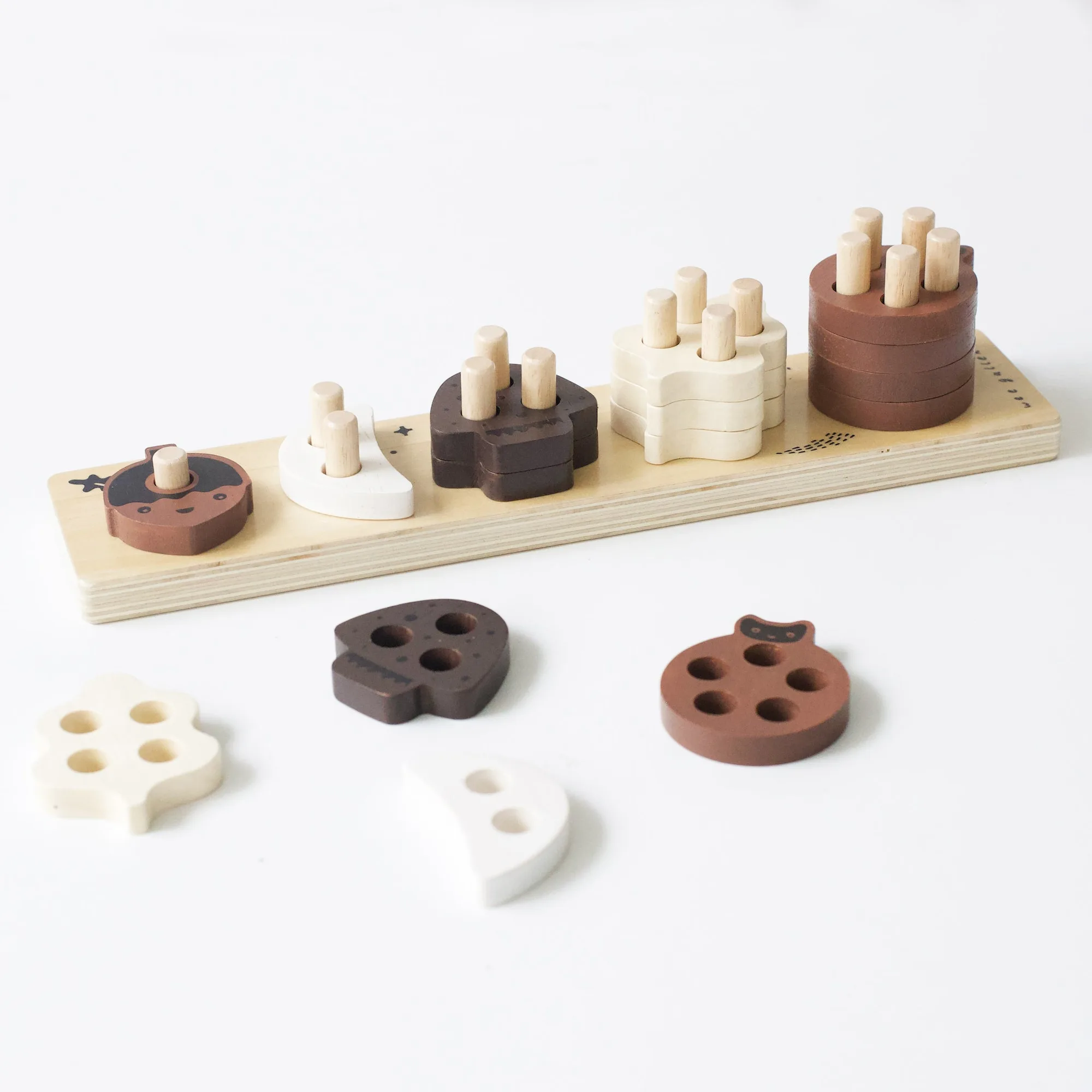
Count and Stack Toy
-
Count and Stack Toy: Kids can sort, stack, and count the number of holes in the pieces to find the corresponding posts. The physical act of finding the right post turns counting into a problem your child can solve with their hands.
-
Count and Stack Toy: The toy is made from rubberwood with a child-safe, nontoxic varnish finish. A smooth, durable wooden surface is practical for a toy that toddlers will handle repeatedly.
A simple counting routine to try
These steps work best when you follow your child's interest rather than rushing through all five shapes. A few minutes of focused play is plenty for a toddler.
- 1. Choose one shape family: Pick the acorn first, since it has just one piece. Place the acorn and its post in front of your child and count aloud: 'One acorn.' Let them fit it on.
- 2. Move to the moons: Bring out the two moon pieces. Count each piece as you hand it over: 'One moon, two moons.' Then count the holes together before finding the matching post.
- 3. Count the holes, not just the pieces: For the mushrooms, leaves, and ladybugs, point to each hole on a piece and count up. This connects the number of pieces to the number of holes, which is the core idea of the toy.
- 4. Let your child lead the matching: Once the pieces and posts are familiar, mix two shape families together and ask your child to sort them. Resist correcting every mismatch; let them test and adjust.
- 5. End on a success: Finish with a shape your child can complete independently. The goal is a positive association with counting, not finishing the whole puzzle every time.
Why stacking and counting belong together
Stacking toys for early math work because they make numbers physical. When a child picks up three mushroom pieces and counts three holes, they are not memorizing a sequence. They are matching a quantity to a set of objects and a set of holes. That is an early math skill called one-to-one correspondence, and it is the foundation for later counting and number sense.
The Count and Stack Toy also asks children to use spatial reasoning. Fitting a piece onto the correct post requires judging size and shape, then adjusting the angle of the wrist. These are motor skills and hand-eye coordination tasks that happen alongside the counting, which is why the toy can support several areas of development at once.
Wooden stacking toy activities for different days
Repeat the same routine if your child enjoys it, but variety can keep the toy in rotation. These activities use only the pieces and posts that come with the Count and Stack Toy.
- Sort by shape: Put all the pieces in a pile and ask your child to group them by type: acorns, moons, mushrooms, leaves, ladybugs. Name each group as it forms.
- Count and cover: Line up the pieces from one shape family. Count them together, then cover one with your hand and ask how many are hiding. Start with the two moons and work up to five ladybugs.
- Post hunt: Place the posts around the room and give your child one piece at a time. They find the post with the matching number of holes and stack the piece there.
- Gift-box play: The toy comes boxed and ready to give, so the box itself can become part of the play. Let your child pack and unpack the pieces, counting as they go.
What to check before you buy
The Count and Stack Toy is recommended for ages 2 and up, so it is not a first-birthday toy. If you are buying for a younger toddler, wait until they are steady on their feet and past the mouthing stage, or choose a toy with a lower age recommendation.
The supplied product information does not include specific care instructions, such as whether the wood should be wiped with a damp cloth or kept away from water. It also does not list the exact dimensions of the pieces or the tray. If those details matter for your storage space or your child's hand size, check the full product listing before ordering. What the record does confirm is the material (rubberwood with a child-safe finish), the age range, and the counting structure, which are the facts that matter most for this purchase.