Quick Answer
For a professional-grade custom pin that holds up to daily wear, choose hard enamel with a metal backing clutch and limit your design to bold, separated color areas.
Hard vs. Soft Enamel: What It Means for Your Design
Hard enamel pins have a smooth, glass-like surface because the enamel is baked and then polished flat. This gives a professional-grade appearance that collectors often prefer. Soft enamel, by contrast, leaves recessed grooves that catch light and add texture.
The trade-off is detail: hard enamel works best with bold shapes and distinct color areas, while soft enamel can handle finer lines and gradients. If your design relies on tiny text or intricate shading, hard enamel may not reproduce it cleanly.
Design Rules That Save You Money and Time
Keep your color count reasonable. Each color adds to the production cost and turnaround time, and too many colors can make the pin look busy. Separate colors with a metal line so the enamel doesn't bleed into a neighboring area.
Remember that the metal border is part of the design. Thicker lines create a bolder look and hide minor registration errors, while thin lines can make the pin feel delicate but risk misalignment.
Backing Options and Wearability
The backing you choose affects how the pin sits on fabric and how secure it feels. Rubber clasps are easy to remove and less likely to scratch surfaces, but they can wear out over time. Metal clasps hold more firmly and feel more premium, but they require a little more effort to fasten.
For pins you plan to wear on bags, jackets, or lanyards, a metal clutch is usually the safer choice. If you're designing a pin for a child or for temporary display, a rubber clasp may be more convenient.
Decision Rules for Your Custom Pin Order
- Choose hard enamel if...: You want a smooth, durable finish and your design uses bold, separated color blocks. Hard enamel is ideal for logos, icons, and simple character art. Confirm your artwork has at least a 0.5mm metal line between each color area.
- Choose soft enamel if...: Your design has fine details, gradients, or textured elements. Soft enamel's recessed grooves preserve those nuances better. Request a soft enamel proof if you're unsure how fine lines will translate.
- Pick a metal clutch if...: You plan to wear the pin on bags, jackets, or lanyards. Metal clasps hold more securely and last longer. Order a few extra rubber clasps as backups if you switch between uses.
- Limit your color count to 4–6...: Fewer colors reduce cost and production time while keeping the design crisp. More colors can cause bleed and raise the price. Simplify your palette before requesting a quote to see the price difference.
- Provide vector artwork...: Use AI, EPS, or SVG files with outlined text. Raster images like JPEGs can cause blurry edges and color mismatches. Ask your manufacturer for a template or checklist before you finalize your file.
Product Facts
-
Custom Hard Enamel Pin: Hard enamel pins are prized for their professional-grade appearance and are highly sought-after by pin collectors. This means your custom pin will look polished and hold value among enthusiasts, making it a strong choice for brand or RPG collectibles.
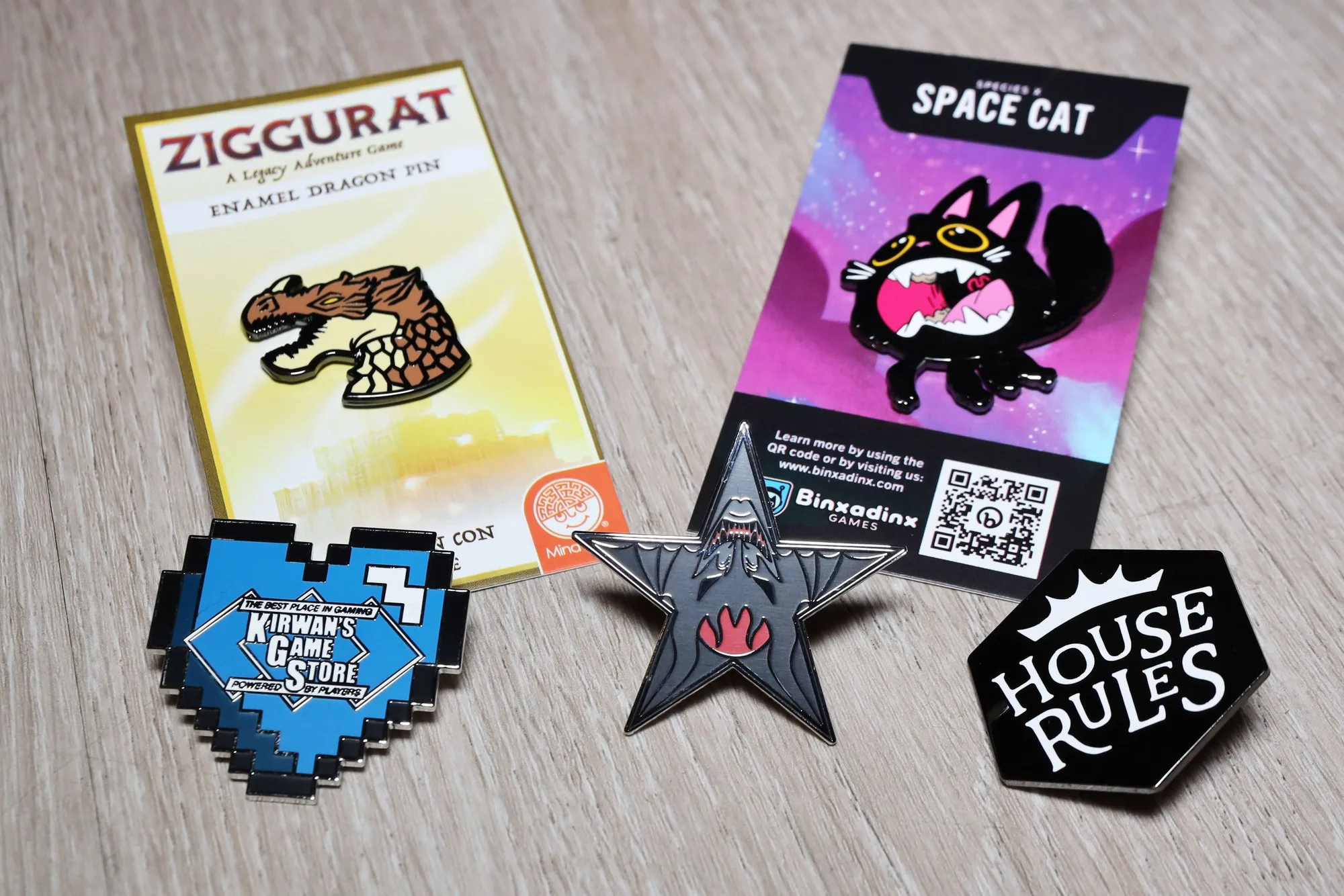
Custom Hard Enamel Pin
Who Should Choose Hard Enamel?
Best for
- RPG players and D&D groups wanting a durable, collectible pin
- Brands or creators ordering pins for professional giveaways or merchandise
Not for
- Designs with tiny text or intricate gradients that need soft enamel's texture
- Budget-first orders where a simpler soft enamel pin would meet the need