Start with a question, not a verdict
The Dark Mirror Shadow Work Cards are designed as a prompt deck for shadow work: a process of noticing and integrating the hidden parts of yourself. That purpose shapes how you use them. Unlike a predictive oracle reading, a shadow work session works best when you begin with a question about a reaction, a pattern, or a feeling you want to understand, then let the card prompt your reflection.
A useful first question is specific and personal: What am I avoiding in this situation? Where did that reaction come from? What part of this do I not want to look at? Keep the question open enough that the card can challenge you, but narrow enough that your journaling has a direction.
What the deck actually gives you
-
The Dark Mirror Shadow Work Cards 🪞 Not all truths live in the light. This deck dares you to look within.: The deck contains 45 full-colour cards with surreal artwork and challenging self-help prompts. It is a prompt-driven reflection tool, not a traditional fortune-telling deck, so your session should leave room for written response.
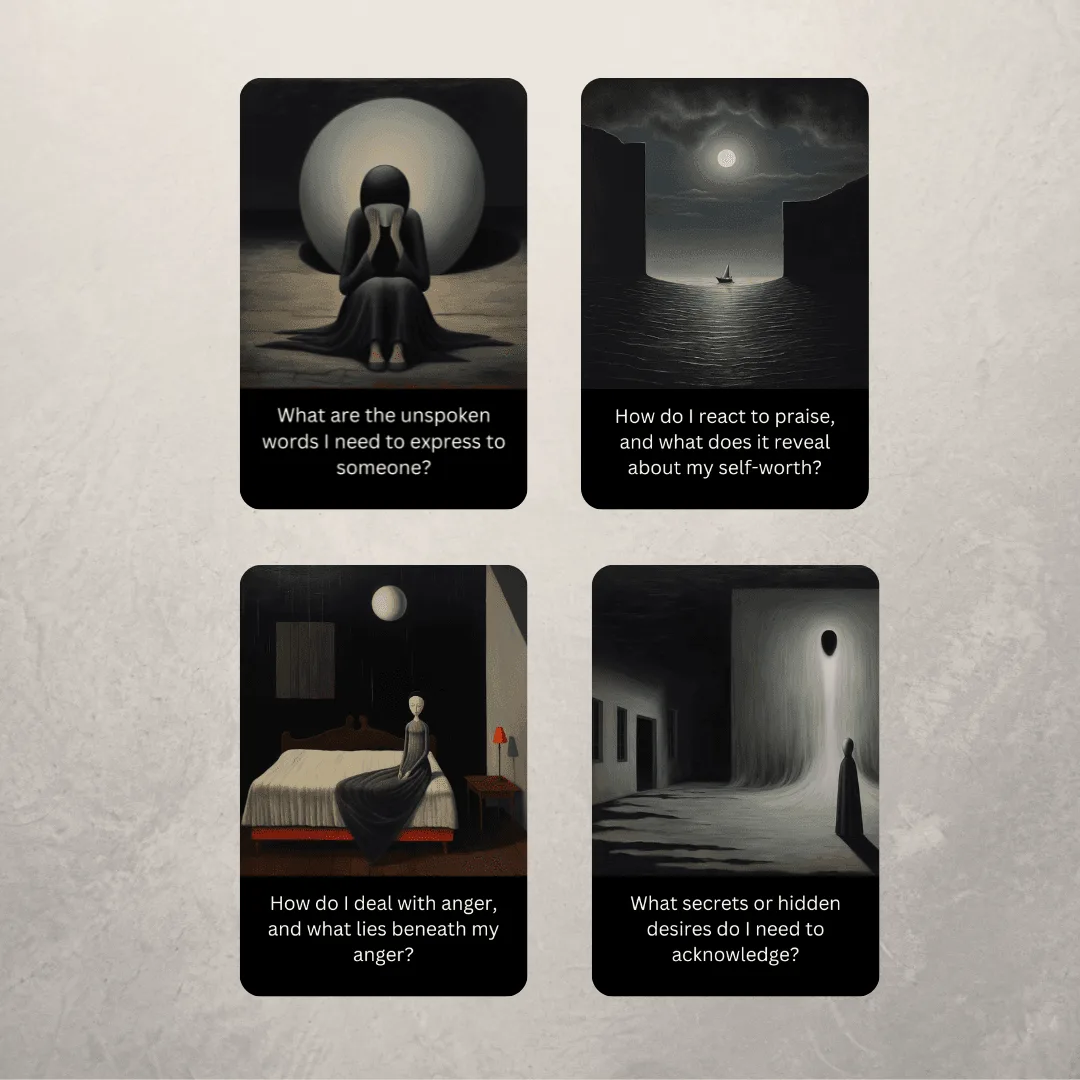
The Dark Mirror Shadow Work Cards 🪞 Not all truths live in the light. This deck dares you to look within.
-
The Dark Mirror Shadow Work Cards 🪞 Not all truths live in the light. This deck dares you to look within.: Cards are A7 size at 74mm x 105mm and printed on 410gsm card stock. The compact size suits tabletop spreads and journal-side draws, while the heavier stock is relevant if you plan to handle the deck often.
-
The Dark Mirror Shadow Work Cards 🪞 Not all truths live in the light. This deck dares you to look within.: The deck is described as 100% ecologically produced using solar-powered energy, eco-friendly papers and inks, with recyclable packaging. These are material and production details to weigh if sustainability is part of your purchase decision.
A first shadow work reading in four steps
This routine uses the deck as a journaling prompt. It does not require a spread layout or prior tarot experience, and it stays close to what the deck was designed to do.
- 1. Name the pattern: Write one sentence about the reaction or recurring feeling you want to examine. Keep it concrete: a moment, an argument, a habit you keep returning to.
- 2. Draw one card: Shuffle and draw a single card. Let the artwork and the printed prompt be the starting point rather than a final answer.
- 3. Write without editing: Set a short, fixed block of time and respond to the prompt in your journal. Note what feels uncomfortable or familiar; those are often the useful edges.
- 4. Close with one small action: End by naming one thing you will notice or do differently. Shadow work is integration, so the session should point back to daily life rather than stay on the table.
Using the cards as journaling prompts, not diagnoses
The deck's prompts are described as challenging self-help prompts. That makes them a good fit for shadow work journaling with cards: you draw, you write, and you look for the belief or memory underneath the reaction. The card is a mirror, not a clinician. It cannot tell you whether a pattern is trauma, burnout, or something else, and it should not be used as a substitute for professional support when a topic feels too heavy to handle alone.
A practical way to keep the session grounded is to separate observation from interpretation. Write what you noticed first, then write what you think it means. If the interpretation feels like a verdict about yourself, treat it as a hypothesis to test rather than a fact.
Shadow work card prompts that suit this deck
The following prompts are general journaling questions, not instructions printed on the cards. Use them when you want a starting point before you draw.
- The repeated reaction: What situation keeps triggering the same response in me, and what does that response protect?
- The hidden standard: What rule do I hold myself to that I would not impose on someone I love?
- The avoided conversation: What have I not said, and what am I afraid would happen if I said it?
- The inherited story: Which belief about myself did I learn from someone else rather than choose for myself?
What the supplied information does not settle
The supplied product details do not include a guidebook, a suggested spread, or step-by-step operating instructions. They also do not include care instructions for the cards. That means the routine above is a general journaling method rather than a manufacturer-prescribed procedure. If you want a structured spread, you can create one that fits your question, but the deck's own materials as described here do not supply one.
The listing also does not specify a recommended age range or professional training requirement. Given the deck's shadow work focus, it is reasonable to treat it as a reflective tool for adults and to seek outside support for material that feels beyond journaling.
Who this deck suits, and when to choose differently
The Dark Mirror Shadow Work Cards suit readers who want a compact, prompt-led deck for regular journaling and who are comfortable with surreal imagery and direct self-help questions. The 45-card count and A7 size make it easy to keep beside a journal. If you are looking for a predictive oracle, a gentle daily draw, or a deck with a full interpretive guidebook, the supplied information does not present this deck as that kind of tool, and a different deck may fit better.
At a catalog price of USD 27.30 against a comparison price of USD 42.00, the deck sits in a moderate range for a 45-card set. The value depends on whether you will actually use the prompts; a prompt deck earns its place through regular sessions rather than occasional draws.