Quick answer
Arrange your nesting tables by first nesting them fully to check the footprint, then pull out only the tables you need for the moment. Keep the set together as a group, and leave at least 18 inches of clearance around the largest table so people can pass without brushing the edges.
Why nesting tables work differently than a single side table
A nesting set gives you three surfaces that can shrink to one footprint or spread out for a party. That flexibility is the point, but it also means the arrangement has to change with the room's use. A setup that works for a quiet reading corner will feel cramped when guests arrive.
Dark oak shows dust and rings more readily than lighter finishes, so placement near a radiator, a sunny window, or a wet bar adds maintenance. Keep the set where you can wipe it easily and where drinks have a coaster within reach.
When to keep them nested versus spread out
Keep the tables nested when the room needs floor space or when the set is purely decorative. Spread them out only when each table has a clear job—one for a lamp, one for a drink, one for a book—otherwise the room starts to feel cluttered.
If you have young children or a dog with a wagging tail, nested is safer because there are fewer edges to catch. In a living room used for entertaining, pull out the middle table as a drinks surface but leave the smallest tucked away.
Step-by-step arrangement process
- Measure the nested footprint: Slide all three tables fully together and measure the width and depth of the largest table. Mark that footprint on the floor with painter's tape where you plan to place the set. Common mistake: guessing the size and ending up with a table that blocks a doorway or crowds a sofa arm. Check that the taped footprint leaves at least 18 inches of walkway on the busiest side.
- Choose a primary anchor point: Place the nested set beside a sofa arm, between two chairs, or against a wall where it can serve as a side table. The largest table should be at seat height or slightly lower for easy reach. Common mistake: centering the set in front of a window or fireplace, where it becomes an obstacle rather than a helper. The top of the largest table should sit within 2 inches of the sofa or chair arm for comfortable use.
- Decide how many tables to pull out: For daily use, pull out only the middle table and place it where you need an extra surface—next to a reading chair or between two seats. Leave the smallest nested. For entertaining, pull out all three and give each a clear role: drinks, snacks, and a shared plate. Common mistake: pulling out all three in a small room, which turns a flexible set into a cluster of obstacles. If you cannot walk a straight line through the room without turning sideways, nest at least one table back.
- Check traffic flow and clearance: Walk through the room along its main paths. You should be able to pass the tables without brushing them. Pull out any table that forces you to sidestep. Common mistake: forgetting that dining chairs or an open cabinet door need swing room near the tables. Leave at least 18 inches between the table edge and any door swing or drawer front.
- Protect the finish and the repaired table: Use coasters under drinks and felt pads under objects that might scratch the oak. Place the smallest table—the one with the repaired split—where it will not be used as a step or a footrest. Common mistake: putting the smallest table at the sofa end where feet often land. Keep the repaired table away from high-traffic foot zones and check the repair annually for stability.
Product facts
-
Set of Dark Oak Nesting Tables: Set of three solid oak nesting tables with rounded leg detailing, sized to slide neatly one beneath the other. The nesting design means you can store all three in the footprint of the largest, which is ideal for small-space side tables.
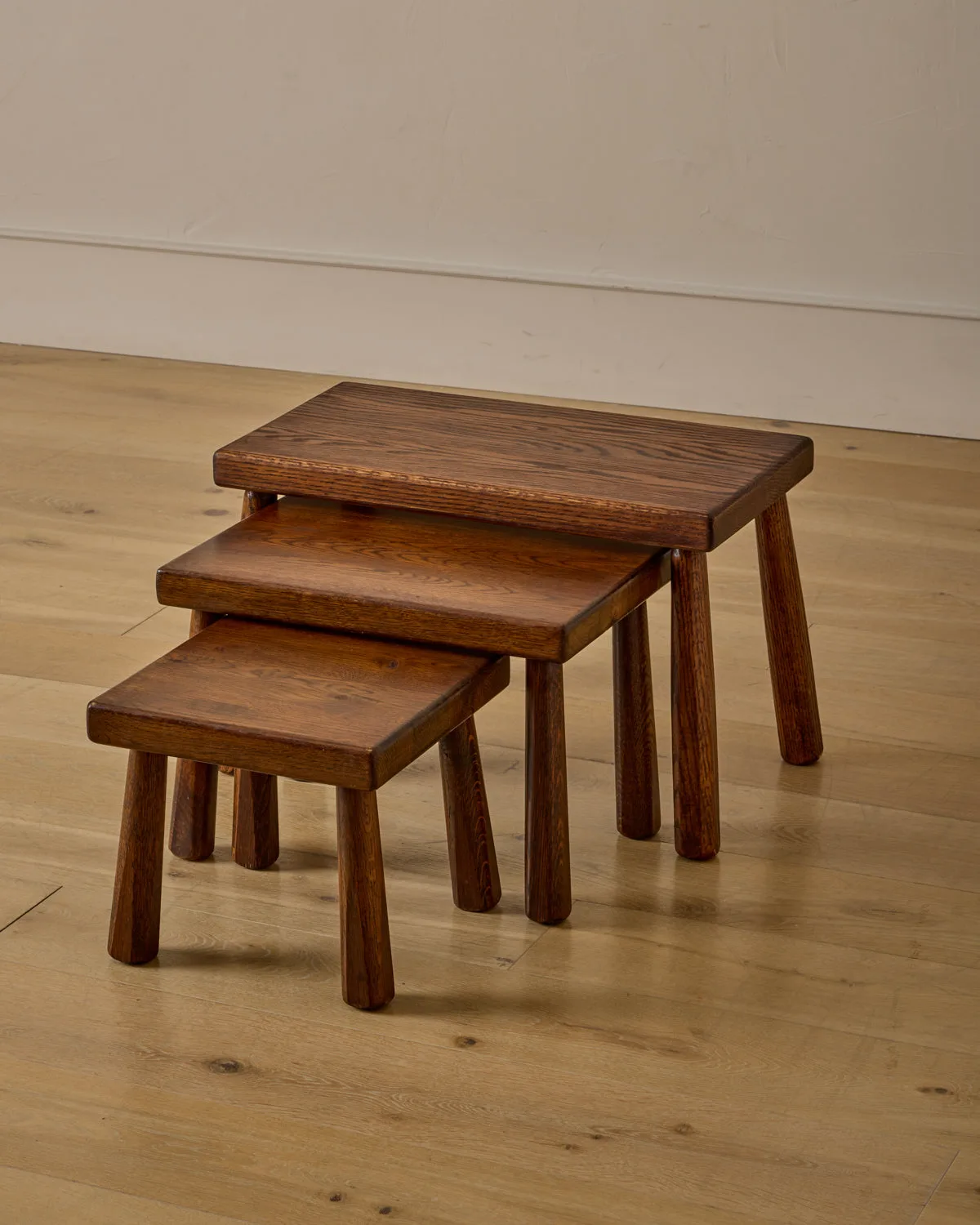
Set of Dark Oak Nesting Tables
-
Set of Dark Oak Nesting Tables: Good vintage condition; the smallest table has a repaired split, now fully reglued and stable; finish refreshed across the set. The repair is stable for normal use, but avoid placing the smallest table where it will be repeatedly bumped or used as a step.