Start with the input and output limits, not the load
The 300W 5A Step Down Buck Converter accepts 5-40V in and delivers an adjustable 1.2-35V out. Before you connect a load, decide two things: what voltage your source actually provides, and what voltage and current your load needs. The module cannot boost voltage, so the input must stay above the output you set.
This module is rated for up to 5A continuous, but the supplied information notes that 5A is not recommended for continuous use without additional cooling. Treat 5A as a ceiling that needs a thermal plan, not a casual everyday number.
Module facts that shape your setup
-
300W 5A Step Down Buck Converter 5-40V To 1.2-35V Power Supply Module: Input voltage range: 5-40V; adjustable output: 1.2-35V. Your source and load must fit inside these windows before wiring.
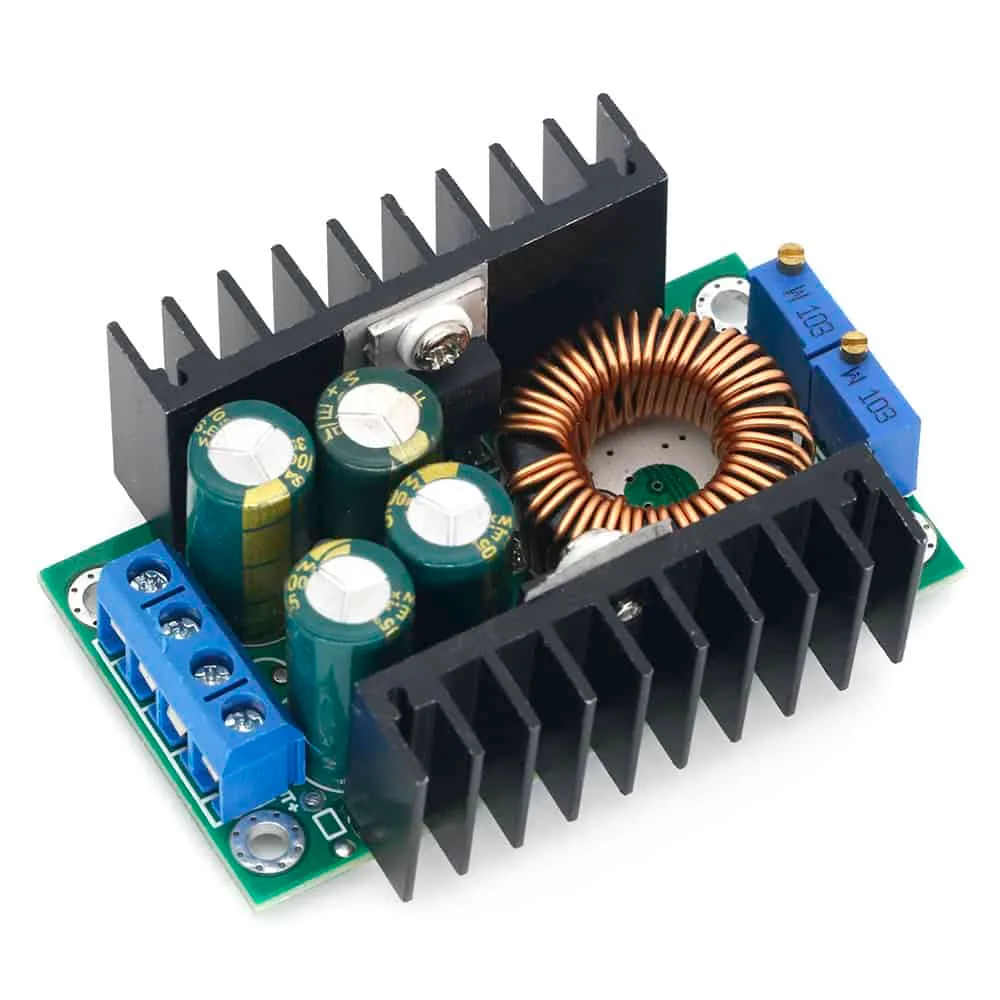
300W 5A Step Down Buck Converter 5-40V To 1.2-35V Power Supply Module
-
300W 5A Step Down Buck Converter 5-40V To 1.2-35V Power Supply Module: Output current up to 7A, with a cooling fan required if the power tube temperature exceeds 65°C. The module has a thermal limit you must monitor, not an unlimited current capability.
-
300W 5A Step Down Buck Converter 5-40V To 1.2-35V Power Supply Module: Maximum output power about 300W, again with a cooling fan if the power tube exceeds 65°C. High-power operation is conditional on temperature control, so plan airflow before running near the limit.
-
300W 5A Step Down Buck Converter 5-40V To 1.2-35V Power Supply Module: Constant current range adjustable between 0.2-5A. If you need current limiting for LEDs or sensitive loads, set it deliberately rather than assuming a default.
A safe order for wiring and first power-up
- 1. Set the output with no load connected: Connect only the input source, then adjust the output voltage to your target using the module’s adjustment. Keep the load disconnected until the voltage is confirmed.
- 2. Confirm polarity and input voltage: Check that input positive and negative match the module markings and that your source is within 5-40V. Reverse polarity or overvoltage can damage the board.
- 3. Set the current limit if your load needs one: The constant current range is 0.2-5A. Adjust it before connecting an LED or other current-sensitive load, then reconnect and observe.
- 4. Add the load and watch temperature: If the power tube temperature exceeds 65°C, add a cooling fan. Do not wait for a shutdown if you can measure or feel excessive heat.
Cooling is part of the setup, not an accessory
The supplied information gives two thermal triggers: a cooling fan is recommended for high output currents or power, and it is required if the power tube temperature exceeds 65°C. That makes the 300W and 7A figures conditional. For a 5A continuous load, the module’s own note says additional cooling is needed.
A practical approach is to mount the module where air can move across the board and power tube, then test at your intended load while checking temperature. If you cannot keep the power tube below 65°C, reduce the load or improve airflow. The module size is approximately 6.5 x 4.8 x 2.4 cm, so leave room around it rather than boxing it in.
Adjusting voltage and current without guessing
The output voltage is continuously adjustable from 1.2-35V. Set it with a multimeter at the output terminals before connecting anything sensitive. The constant current range is 0.2-5A, and the module uses a dedicated benchmark IC and high-precision current sensing resistor for stable constant current.
The supplied information does not include a step-by-step procedure for the adjustment potentiometers, so do not assume a particular turn direction or calibration method. Make one small adjustment at a time and measure the result. If you need a precise current limit, verify it with your own meter rather than relying on an unmarked dial position.
Where this module fits and where it does not
- LED driving: The module is described as well-suited for use as an LED driver, and the adjustable constant current range supports that use when set correctly.
- Sensitive electronics: Low output ripple is supported by a high-frequency capacitor, which helps with sensitive applications, but you should still confirm your load’s tolerance.
- Battery charging: The supplied information does not confirm charging profiles, termination, or battery compatibility. Do not treat this as a verified charger without that evidence.
- High-current continuous loads: The 5A continuous rating requires additional cooling per the module notes. Plan for a fan and temperature checks before relying on it.
What the supplied information leaves open
The module record does not include a wiring diagram, terminal torque values, or a procedure for setting the potentiometers. It also does not confirm efficiency, isolation, or protection features such as reverse-polarity or short-circuit shutdown. Those are decision limits, not proof that the module lacks them.
Use the ratings you do have: 5-40V input, 1.2-35V output, 0.2-5A constant current, and a 65°C power-tube threshold that calls for a fan. If your project depends on a feature not listed here, verify it against the manufacturer’s documentation before purchase or connection.