Start with the pattern's fabric structure, not a color scheme
The Deco Flora pattern is built around five different floral fabrics, each cut at 3/4 yard. That structure tells you more about fabric selection than any single palette trend: you are choosing a coordinated group of five prints, not one hero fabric with supporting solids. The pattern also calls for 2 3/4 yards of background fabric, 1 yard for sashing, 4 yards for backing, and 2/3 yard for binding. Those quantities are your shopping list; the creative decisions happen inside them.
Before you fall for a fabric collection, decide how much visual variety you want across those five floral prints. A tighter range of scale and color will read as a cohesive wash of pattern, while a wider range will make individual blocks stand out. Neither is wrong, but the choice affects how the quilt's overall design reads.
Deco Flora fabric requirements at a glance
-
Deco Flora: 5 different floral fabrics, 3/4 yard each This is the core of your fabric pull: five distinct florals, each with its own cut. Plan the group together so the prints relate without competing.
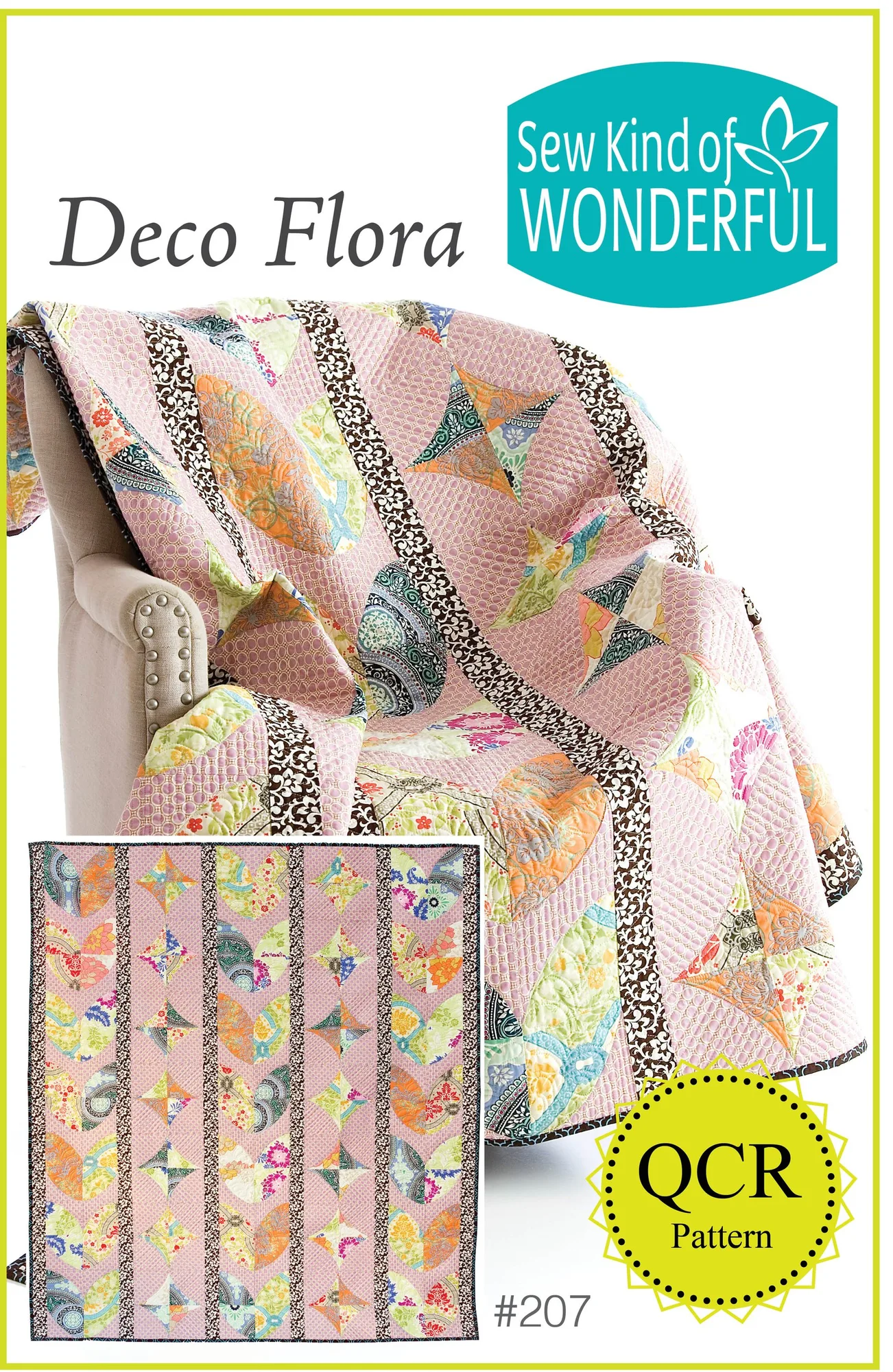
Deco Flora
-
Deco Flora: 2 3/4 yards background fabric The background is a large share of the yardage. Choose it after you see the five florals together, since it sets the contrast level for the whole quilt.
-
Deco Flora: 1 yard for sashing Sashing separates blocks visually. A calm sashing fabric can quiet a busy floral group; a stronger one can add structure.
-
Deco Flora: 4 yards for backing Backing is the largest single cut. Decide whether you want a coordinating print or a quieter fabric that lets the front do the talking.
-
Deco Flora: 2/3 yard for binding Binding frames the quilt. Use it to echo one of the five florals or to introduce a deliberate accent.
Build the five-floral group before you choose the background
The most practical order is to gather the five floral fabrics first. Lay them side by side and step back. Check whether they share a common color temperature or whether you want a deliberate mix. Pay attention to scale: five large-scale prints can blur together, while five tiny prints can read as texture from a distance. A mix of scales usually gives the eye more to explore.
Only after the five florals are settled should you choose the 2 3/4-yard background. Hold candidate backgrounds against the group and look for the contrast you want. A background that is too close in value to the florals can make the design mushy; one that is too stark can overwhelm the prints. The pattern does not specify a background color, so this is your call.
A fabric-selection checklist for Deco Flora
- Five florals, 3/4 yard each: Confirm each print is distinct enough to read as its own fabric once cut. If two are nearly identical, consider swapping one for a different scale or color.
- Background, 2 3/4 yards: Test contrast against all five florals, not just your favorite. The background touches many parts of the quilt.
- Sashing, 1 yard: Decide whether sashing should recede or define the grid. A fabric that matches the background will recede; a contrasting one will outline the blocks.
- Backing, 4 yards: Check that the backing fabric width and your preferred piecing method suit a 4-yard cut. The pattern supplies the yardage, not a backing piecing layout.
- Binding, 2/3 yard: Choose binding last, once the top is together or at least firmly planned. It is the final frame and easy to overlook.
Match fabric choices to the Quick Curve Ruler
Deco Flora lists the Quick Curve Ruler (QCR) among its materials. That is a useful signal for fabric selection: curved piecing can make directional prints and strong stripes harder to manage, because the curve changes how the fabric grain and pattern line up. If you are new to curved piecing, you may find small-scale or allover floral prints more forgiving than large directional motifs. If you are comfortable with the QCR, you have more freedom to experiment with bold prints.
The pattern does not include step-by-step cutting or piecing instructions in the supplied information, so treat the QCR reference as a tool requirement rather than a technique guide. Check your pattern copy for the full construction details before you cut.
Decide on backing and binding without overbuying
Backing is where fabric selection often goes off track. The pattern calls for 4 yards, which is a substantial cut. If you choose a wide backing fabric, confirm the usable width before you buy, since the pattern does not specify a backing seam layout. If you prefer a pieced backing, plan those seams as part of your fabric purchase rather than assuming the 4 yards will cover it in one piece.
Binding at 2/3 yard is a small commitment with visible impact. Pulling one of the five florals into the binding ties the edge to the quilt top. A solid or tone-on-tone binding can instead give the eye a rest. Either approach works; just decide before you cut the binding strips so you do not shortchange the yardage.
Pattern format and size details
- Deco Flora: 62 x 70 finished size Knowing the finished size helps you judge whether your fabric choices will read at the intended scale. A print that looks bold in a fat quarter may soften across a larger quilt.
- Deco Flora: Available as a PDF pattern The PDF format means you can review the fabric list and QCR reference before purchasing fabric, which helps you shop accurately.
What the supplied information does not settle
The supplied pattern details list fabric quantities and the Quick Curve Ruler, but they do not include cutting diagrams, piecing order, or a recommended backing layout. They also do not specify a background color, sashing style, or binding width. Those are design decisions you make with your own fabric in hand. Use the yardage list as your fixed constraint and let the five-floral group, background contrast, and sashing role guide the rest.