The real question is your imaging train, not the aperture
A 350 mm aperture at f/3 is a striking combination, and the DeltaRho 350 Optical Tube Assembly leans into it: a 1050 mm focal length, a 60 mm image circle, and a corrected Cassegrain optical design. But the decision that matters most before you buy is not how big the mirror is. It is whether your camera, filter wheel, and focuser can live inside the backfocus the scope provides, and whether your mount and budget can carry the rest of the package.
This is a catadioptric buying guide for people who already know they want wide-field astrophotography and are deciding whether this particular optical tube is the right host for their gear. If you are still choosing between optical designs in general, the comparison below will help you sort out where a large aperture catadioptric wins and where a reflector is the more sensible purchase.
DeltaRho 350 OTA specs that drive the decision
-
DeltaRho 350 Optical Tube Assembly: 350 mm aperture, 1050 mm focal length, f/3 focal ratio Fast, wide-field imaging at a focal length short enough to keep guiding and framing manageable for large sensors.
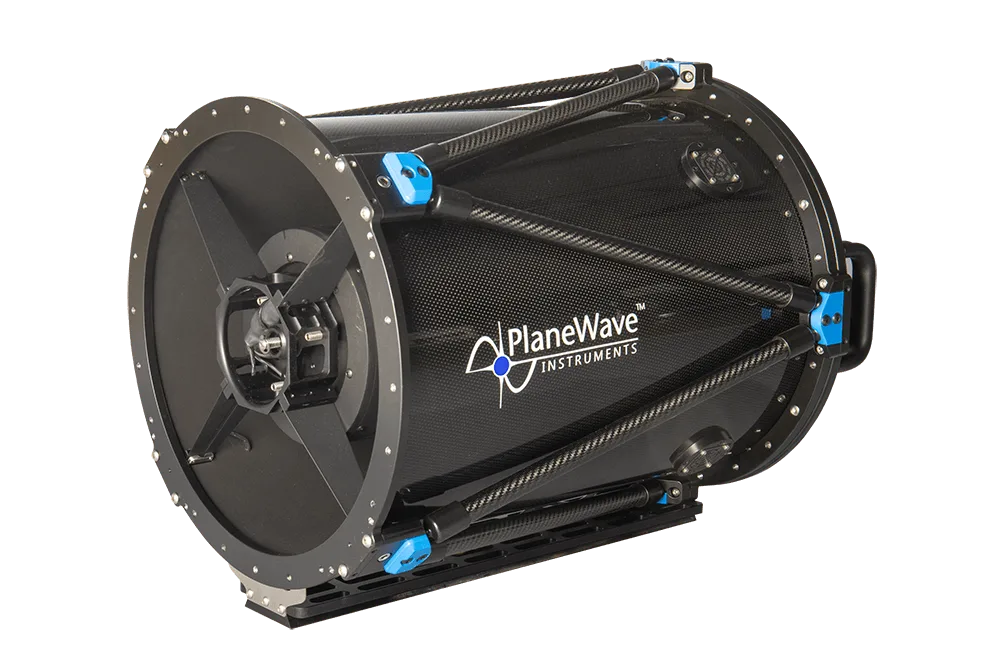
DeltaRho 350 Optical Tube Assembly
-
DeltaRho 350 Optical Tube Assembly: 60 mm image circle, more than 3 degrees Large-format sensors can be filled corner to corner, which is the point of buying this scope.
-
DeltaRho 350 Optical Tube Assembly: Backfocus of 5.6 inches (142.24 mm) from the mounting surface This is the number to measure your camera, filter wheel, and any accessories against before ordering.
-
DeltaRho 350 Optical Tube Assembly: Optical performance of 4.9 micron RMS on-axis, 6.2 micron RMS at 23 mm off-axis, and 7.6 micron RMS at 30 mm off-axis Spot size grows toward the edge of the field, so very small pixels at the far corners deserve a closer look.
-
DeltaRho 350 Optical Tube Assembly: OTA weight 46 lbs (21 kg); OTA length 23 inches (584 mm) Weight and length set your mount class and your balance and clearance planning.
Why the Cassegrain layout changes what you can hang off the back
The DeltaRho 350 is a Cassegrain optical design, which means the imaging train is secured at the back of the telescope and does not block the light path the way prime focus designs do. In practice, that is the difference between running a filter wheel and a large camera comfortably and fighting for space. If your planned setup includes a substantial camera and a filter wheel, this layout is a genuine advantage rather than a marketing line.
The corrected design is also meant to deliver a flat field free from off-axis astigmatism, coma, and field curvature, and the catalog states the scope produces no off-axis coma and no off-axis astigmatism. Pair that with the fixed primary mirror, and collimation is handled by adjusting the tip and tilt of the secondary mirror rather than chasing two mirrors. That is a simpler routine to learn, though it still assumes you are comfortable collimating a fast system.
Catadioptric vs reflector: where each one actually fits
Both designs can produce excellent deep-sky images. The trade-offs show up in your workflow, not in a spec sheet victory.
- Imaging train clearance: A Cassegrain like the DeltaRho 350 mounts the camera at the back and keeps the light path clear, so filter wheels and large cameras are easier to accommodate. A Newtonian reflector places the camera near the front of the tube, which changes balance and can limit heavy accessories.
- Collimation routine: The DeltaRho 350 has a fixed primary mirror, so collimation is done by adjusting the secondary mirror's tip and tilt. Many reflectors require aligning both the primary and secondary, which is more steps but also more adjustable.
- Field correction: The DeltaRho 350 is a corrected design with a 60 mm image circle and a flat field, so you are not adding a separate corrector to reach a wide, well-corrected field. A reflector often needs a coma corrector to clean up the edges.
- Cost and logistics: At USD 15,050.00 in the catalog, the DeltaRho 350 sits in a different bracket from most reflectors, and shipping is quoted and billed separately. A reflector is typically the lower-cost path, but you may spend more time and money on correctors and mounting hardware.
- Physical demands: At 46 lbs (21 kg) and 23 inches long, the DeltaRho 350 needs a mount rated well above entry-level imaging loads. Reflectors vary widely, but large-aperture versions are not light either.
Power, dew, and the accessories the catalog does not include
Two details are easy to miss. The built-in primary and secondary dew heaters with temperature sensors require the 5-Series Controller, which is sold separately. Budget for it, and plan how it will be powered at your site. Also note that the L-350 mount shown in the product photo is sold separately, so the OTA price does not include a mount.
The catalog does not supply a recommended mount capacity, a specific camera or filter wheel compatibility list, or step-by-step installation instructions. Treat those as questions to resolve with the seller before you commit, especially the backfocus budget and the power arrangement for the dew heaters.
Checks to run before you order
- Add up your backfocus: Total the optical path of your camera, filter wheel, and any adapters, then compare it to the 5.6 inch (142.24 mm) backfocus from the mounting surface. If you are close to the limit, confirm the remaining spacing with the seller.
- Match sensor size to the image circle: The 60 mm image circle supports large sensors, and the catalog cites a 170 x 170 arcminute field of view with 16803/4040-size sensors. Smaller sensors will work but leave much of that circle unused.
- Plan for weight and length: At 46 lbs (21 kg) and 23 inches long, the OTA alone is a serious load. Confirm your mount, tripod, and balance setup are rated for the complete imaging train, not just the tube.
- Price the whole system: The catalog price is USD 15,050.00 against a comparison price of USD 21,500.00, but shipping is quoted and billed separately. The crated shipping weight is 225 lbs in a 53 x 31 x 26 inch crate, so plan for freight handling and delivery access.
- Include the controller: The dew heaters need the 5-Series Controller, sold separately. Add it to your budget and to your power plan.
When this optical tube is the wrong purchase
If your main interest is visual observing, a fast f/3 astrograph is an awkward fit; the design is built around imaging. If you are not ready to handle a 46 lb tube, freight delivery, and a mount in the appropriate class, the total commitment will outweigh the optical benefits. And if you want a scope that arrives with a documented installation procedure, the supplied information does not include one, so plan on working through setup with the seller.
For the right imager, though, the combination of a 350 mm aperture, a corrected flat field, and a clear back-end imaging path is exactly what makes a large aperture catadioptric worth considering. Measure your backfocus, check your mount, and price the controller before you decide.