Quick answer
Choose a wooden dice tray if you want a stable, easy-to-clean surface that stays put. Choose a leather dice tray if you want a soft, quiet roll and a classic look. Choose a fabric dice tray if portability and low noise matter most. Match the tray's interior size to your largest dice set and your usual rolling space.
A dice tray is not just a nice-to-have. It keeps your rolls contained, protects your table, and makes cleanup faster after a session. But the material you choose changes how the tray feels, sounds, and travels. This dice tray buying guide walks through wooden, leather, and fabric options so you can pick the one that fits your table and your dice.
You will see three main materials on the market: wood, leather, and fabric. Each has real trade-offs in weight, noise, durability, and care. Below are concrete decision rules and fit guidance, plus a few product facts from our catalog to show how trays and dice work together.
Wooden dice tray: stable, loud, and easy to clean
A wooden dice tray gives you a firm, flat surface that does not shift when you roll. The hard bottom produces a crisp sound, which some players love and others find distracting. Wood also resists spills better than fabric, and a quick wipe with a dry cloth usually handles dust and crumbs. If you roll metal dice, a wooden tray with a felt or leather-lined bottom reduces damage to both dice and tray.
The main trade-off is weight and bulk. A solid wood tray is heavier and less packable than a fabric tray, so it suits a home table more than a backpack. Also, not all wooden trays have a soft lining. If yours does not, metal dice can dent the wood over time. Check the interior depth and lining before you buy.
- Best for: home games, metal dice, players who want a firm roll surface.
- Watch for: weight, lack of lining, and loud roll noise.
- Care: wipe with a dry or slightly damp cloth; avoid soaking.
Leather dice tray: quiet, classic, and travel-friendly
A leather dice tray offers a soft, muted roll and a timeless look. The surface absorbs some impact, so dice do not bounce out as easily as they might on bare wood. Many leather trays fold or snap flat, which makes them easier to pack than a rigid wooden tray. They are also less likely to scratch a table than a hard tray with exposed edges.
Leather needs a bit more care than wood or fabric. Spills should be wiped up quickly, and prolonged moisture can damage the finish. Some leather trays are made from bonded leather, which may peel over time, while full-grain leather lasts longer but costs more. If you often play in different locations, a leather tray is a strong middle ground.
- Best for: travel, quiet tables, players who want a classic aesthetic.
- Watch for: bonded leather quality, moisture sensitivity, and price.
- Care: wipe with a dry cloth; condition occasionally if the maker recommends it.
Fabric dice tray: light, soft, and packable
A fabric dice tray is usually the lightest and most packable option. The soft walls and bottom keep noise low and reduce bounce, which helps when you roll on a small table. Many fabric trays fold flat or collapse, so they fit in a bag pocket. They are also the most affordable material in most cases.
The trade-off is stability and cleaning. Fabric can slide on smooth tables, and spilled drinks soak in quickly. A fabric tray with a reinforced rim or a non-slip base solves the sliding issue. For cleaning, spot-clean with a damp cloth and mild soap, then let it air dry completely. If you often eat or drink at the table, fabric is the riskiest choice.
- Best for: conventions, small tables, players who pack light.
- Watch for: sliding, staining, and lack of structure.
- Care: spot-clean only; never machine wash unless the maker says it is safe.
Fit guidance: size the tray to your dice and your table
A tray that is too small causes dice to bounce out; one that is too large crowds the table. Measure your largest dice set first. A standard 7-piece polyhedral set includes one D4, D6, D8, D10, D%, D12, and D20. If you roll multiple dice at once, like 4d6 for ability scores, add roughly 1 inch of interior space per extra die.
For table fit, leave at least 2 inches of clearance around the tray so players can reach their sheets and snacks. If you share a table with four or more players, a tray with a 10- to 12-inch interior is a safe starting point. For solo play or a side table, a 6- to 8-inch tray is often enough. Check the exterior dimensions too, since rims and hinges add width.
- Measure your largest die before buying.
- Add space for multi-dice rolls like 4d6.
- Leave clearance for character sheets and drinks.
Storage and pairing: how trays work with dice cases
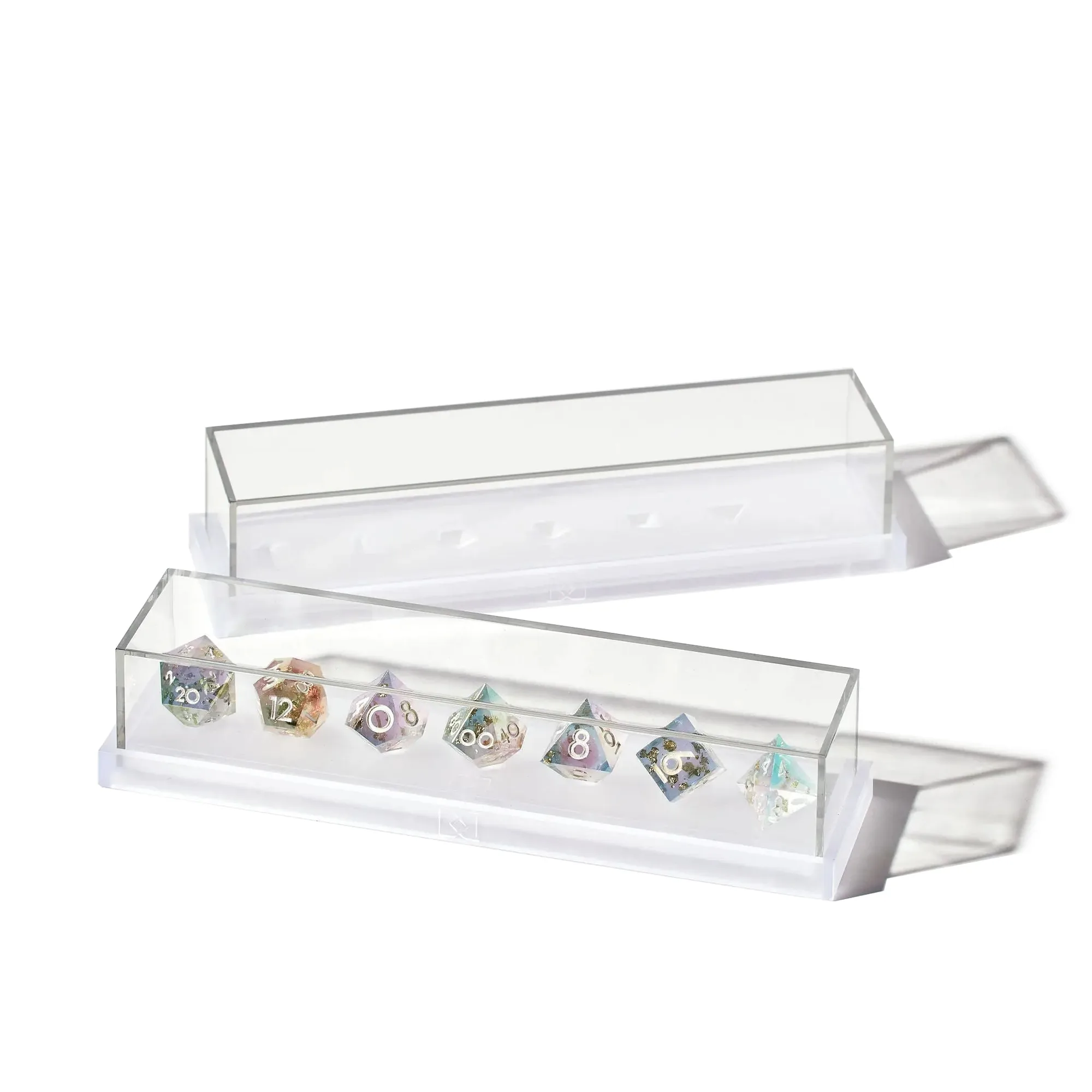
A dice tray protects your table, but it does not protect your dice when you are not playing. If you want to keep a set together, pair the tray with a storage case that fits the same dice. For example, a stackable display box can hold a 7-piece polyhedral set and sit on a shelf between sessions. That keeps your tray free for rolling and your dice safe from scratches.
Think about your whole kit: tray, dice, and storage. A heavy wooden tray stays home, while a folding leather or fabric tray travels. If you bring multiple sets, a modular storage box lets you swap dice without repacking the tray. The goal is a setup you can carry in one trip and set up in under a minute.
- Keep storage separate from your rolling surface.
- Match storage capacity to your largest set.
- Choose travel-friendly materials for conventions.
Decision rules for choosing a dice tray
- If you mostly play at home and use metal dice: Choose a wooden tray with a felt or leather lining. The firm base keeps the tray steady, and the lining protects both dice and table. Prioritize stability and a soft interior.
- If you travel to conventions or game stores: Choose a leather or fabric tray that folds flat. Check the folded size against your bag before buying. Portability beats rigidity for on-the-go play.
- If you roll many dice at once: Measure your largest multi-dice roll, such as 4d6, and add at least 1 inch of interior space per extra die beyond a single set. A larger interior prevents bounce-outs.
- If you eat and drink at the table: Avoid untreated fabric. Choose wood or sealed leather that wipes clean quickly. Cleaning ease matters more than softness.
Product facts from our catalog
- Modular Dice Display Box: Crafted with an innovative stackable design and tailor-made to fit any 7-piece polyhedral dice set. If you own a standard 7-piece set, this box keeps it organized and protected when it is not in the tray. The stackable design also saves shelf space.
- Aurora Borealis 7-Piece Iridescent Dice Set: Each gaming dice features a transparent, iridescent shell, with warm mylar. Iridescent dice show scratches and wear more easily, so a soft-lined tray or a separate storage box helps preserve their finish.
- Dispel x Eat the Reich "Neon Rot" 4-Piece Iconic D6 Dice Set: Each set contains 4 D6 dice with sharp-edged construction. Sharp-edged resin dice can chip if they hit hard surfaces. A lined wooden, leather, or fabric tray cushions the roll and reduces damage.
Who each material is for
Best for
- Home games with a dedicated table and metal dice
- Players who want a quiet roll and a classic look
- Convention-goers who need a packable, lightweight tray
Not for
- Players who need a tray that folds into a pocket (choose fabric or folding leather)
- Tables with very little space (choose a smaller 6- to 8-inch tray)
- Anyone who frequently spills drinks (choose wood or sealed leather over fabric)
Pick the material that matches your table, your dice, and how you travel. Wood for stability, leather for quiet portability, fabric for light packing. Then size the tray to your largest roll and pair it with storage that keeps your dice safe between sessions.