The short answer: yes, if the pac is made for it
Laundry detergent pacs can work in cold water, but the result depends on the formula. Some pacs are designed for hot and cold water; others may dissolve slowly or leave residue in a cold wash. Check the label before you switch your routine.
Puracy Laundry Detergent Pacs are explicitly compatible with hot and cold water, so you can use them in a cold wash without changing your usual cycle. That compatibility is the key checkpoint—if a pac doesn’t state cold-water compatibility, test one pac in a small load before committing.
Why cold water can be harder on pacs
Pacs rely on a water-soluble film that breaks down during the wash. Cold water slows that breakdown, especially in short or gentle cycles with low agitation. If the film doesn’t fully dissolve, you may see sticky residue on clothes or find undissolved pieces in the dispenser.
Concentration matters too. A 100% concentrated formula with no added water—like Puracy’s—delivers cleaning power in a smaller dose, but it still needs enough water and movement to disperse. Cold water is not a problem for a compatible pac; it just leaves less margin for error if you overload the drum or skip the right placement.
How to use laundry detergent pacs in a cold wash
Follow these steps to give the pac the best chance to dissolve completely, even in cold water.
- Start with an empty drum: Place the pac directly into the washing machine drum before adding clothes. This lets the pac contact water immediately instead of getting trapped in a dispenser or folded inside fabric.
- Add clothes on top: Load your laundry over the pac. Avoid packing the drum—overloading restricts water flow and agitation, which are the main forces that dissolve the film.
- Select a cold cycle with enough agitation: Use a normal or heavy-duty cold cycle rather than a delicate or quick cycle. Puracy pacs are compatible with all washing machine types, but shorter cycles give the film less time to break down.
- Check for residue after the wash: If you notice film fragments or sticky spots, reduce load size and run the same cycle again. Persistent residue usually points to overloading or a very short cycle, not the water temperature alone.
When cold-water pacs might not dissolve well
Even a cold-water-compatible pac can struggle in certain conditions: a tightly packed drum, a cold quick-wash cycle, or a machine that uses very little water. If you routinely see undissolved pacs, try a longer cold cycle or a slightly smaller load before assuming the pac is faulty.
If residue continues, check the pac packaging for any specific cold-water instructions. The supplied information for Puracy Laundry Detergent Pacs confirms hot and cold water compatibility but does not list a minimum water temperature or cycle length, so use your machine’s normal cold setting and adjust load size first.
Puracy Laundry Detergent Pacs: cold-water facts
-
Laundry Detergent Pacs: Compatible with hot and cold water This is the direct confirmation that the pac is designed to dissolve and clean in a cold wash, so you can use it without pre-dissolving.
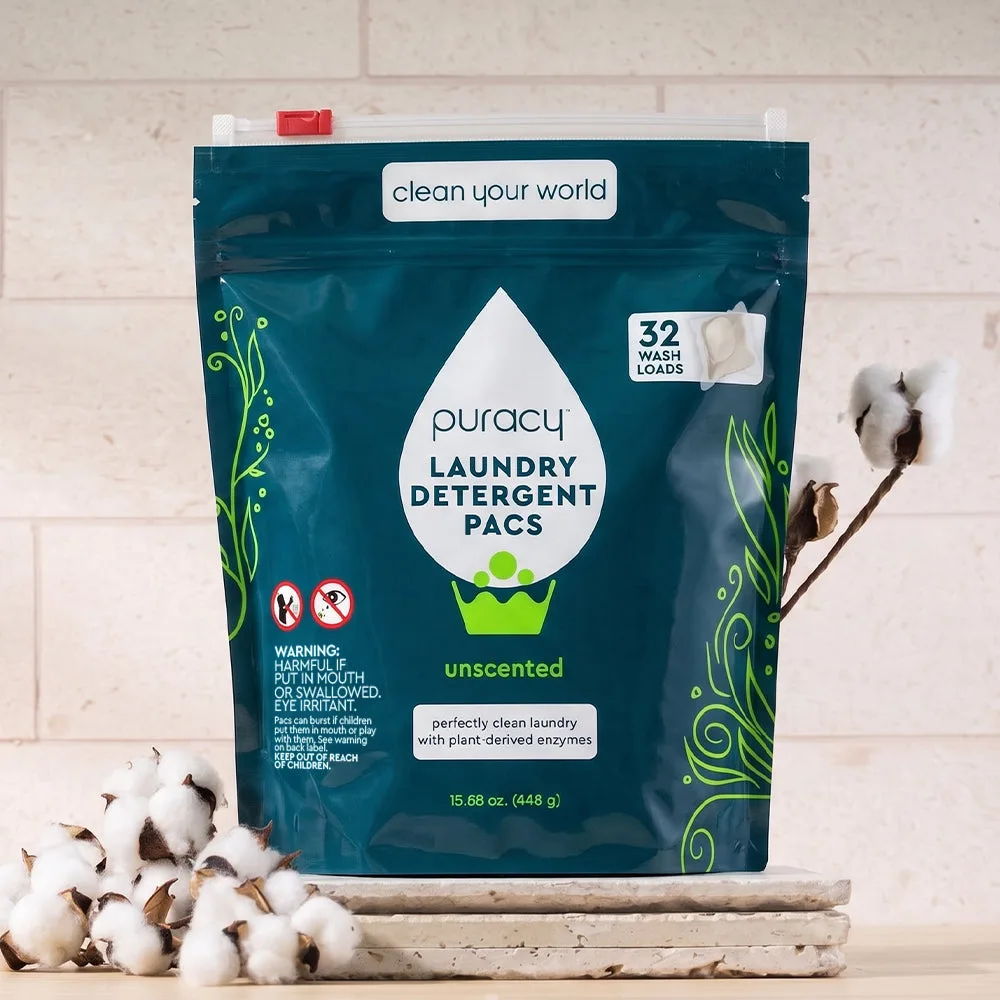
Laundry Detergent Pacs
-
Laundry Detergent Pacs: 100% concentrated formula, no added water A concentrated pac delivers cleaning power in a small dose, which helps in cold water where you want efficient dispersion without extra fillers.
-
Laundry Detergent Pacs: With 2 active enzymes (protease and amylase) Enzymes support stain removal, and their presence means the pac is formulated to work during the wash cycle—cold water does not automatically deactivate them.
-
Laundry Detergent Pacs: 32-pack, Free & Clear A 32-load pack gives you a fixed number of cold washes to test your routine; Free & Clear means no added scent, which suits sensitive households.
Cold water, concentrated pacs, and eco-friendly laundry
Washing in cold water is a common way to reduce energy use, and a concentrated pac supports that goal by avoiding added water in the formula. Puracy Laundry Detergent Pacs are free from harmful ingredients and come in a 32-pack, making them a practical choice for eco friendly laundry pacs routines.
That said, cold water is not a cleaning shortcut—it is a setting that works when the pac is compatible and the load is not overloaded. If you regularly wash heavily soiled items, a longer cold cycle or a pre-treat step may be needed; the supplied information does not include specific stain pre-treatment instructions for this pac.
Pacs vs. liquid in cold water: what changes
Both formats can work in cold water, but pacs remove the measuring step and place a fixed dose directly in the drum. Here is how the trade-offs differ for cold washes.
- Dissolving speed: Liquid detergent mixes instantly; a pac needs the film to break down. Choose a cold-water-compatible pac and avoid short cycles to close that gap.
- Dose accuracy: A pac gives one pre-measured dose, which is helpful in cold water where you cannot easily adjust by sight. Liquid lets you fine-tune, but requires measuring.
- Residue risk: Pacs carry a small residue risk if overloaded or used on a very short cold cycle. Liquid has less film residue but can leave detergent spots if overdosed.