Quick Answer
If your headlights dim when the bass hits or your amplifier struggles to deliver clean power, a capacitor like the BOSS CPBK3.5 can help stabilize voltage. But if your electrical system is already solid, a capacitor may not be necessary.
When a Capacitor Helps
A capacitor acts as a temporary power reserve, releasing stored energy when your amplifier demands a sudden surge. This is most noticeable with subwoofers playing heavy bass passages. If your lights flicker or dim in time with the music, your car's alternator and battery may not keep up with the amp's peak draw.
Adding a capacitor with low ESR, like the CPBK3.5's <0.004Ω, helps reduce voltage drop at the amp, letting it perform more consistently. It also protects your alternator from repeated high-current spikes.
When You Might Not Need One
If your system draws less than 1,000 watts RMS total, or if you have a high-output alternator and a second battery, a capacitor may be redundant. A capacitor stores less energy than a battery and discharges quickly; it is not a substitute for a weak alternator or insufficient wiring.
Also, if your amplifier already has a large internal capacitor bank, adding an external one may offer diminishing returns. In those cases, upgrading the Big Three wiring or the alternator itself is usually more effective.
Frequently Asked Questions
How do I know if my system needs a capacitor?
Watch for headlight dimming, amplifier shutdowns, or distorted sound during bass peaks. If you see voltage drop below 12V on a meter while the system is playing, a capacitor can help.
Can a capacitor fix all electrical problems?
No. It only smooths short-term voltage dips. A weak alternator, undersized wiring, or a dying battery need separate upgrades. The capacitor is a band-aid, not a cure. Always check your alternator rating and wiring gauge first.
How do I install the CPBK3.5?
Mount it as close to the amplifier as possible. Connect the positive terminal to the amp's power wire through a fuse, and the negative terminal to a solid chassis ground. Charge the capacitor slowly with a resistor before first use to avoid a spark. Use a resistor (e.g., a 12V light bulb) in series during initial charging to prevent a sudden current surge.
Product Spotlight
-
CPBK3.5: The CPBK3.5 has 3,500,000 µF (3.5 Farad) capacitance and ultra-low ESR (<0.004Ω). This high capacitance and low resistance mean it can deliver power quickly and with minimal loss, helping stabilize voltage during demanding bass hits.
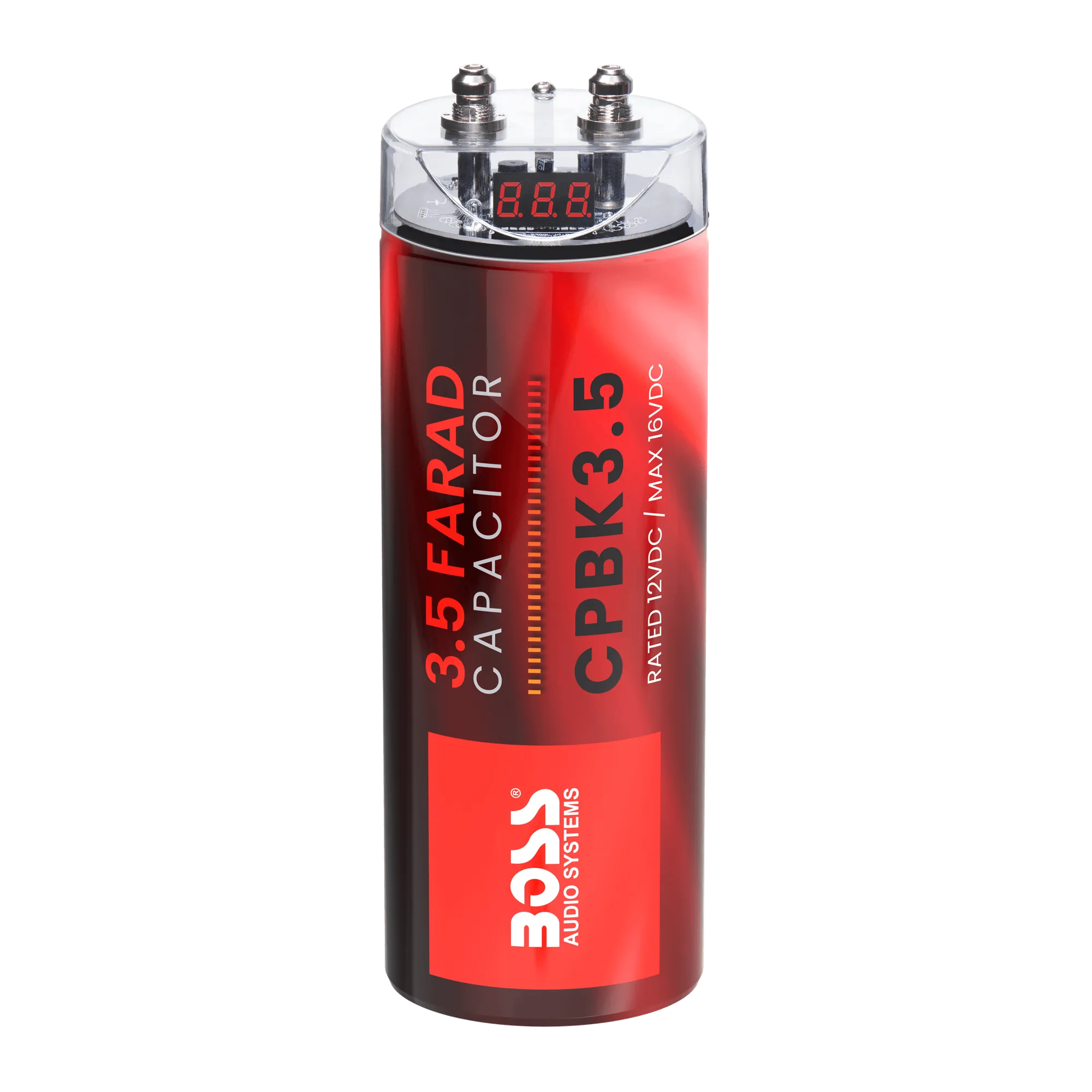
CPBK3.5
-
CPBK3.5: It includes an audible warning for reverse polarity, voltage overload, and low battery voltage, plus a 3-digit LED voltage meter. These safety features help you install it correctly and monitor system voltage at a glance, reducing the risk of damage from incorrect wiring or over-discharge.