Quick answer
You need a 4 BAR MAP sensor once your Honda's boost exceeds what the factory sensor can read, typically on a turbo or supercharger build targeting more than about 11 psi. A 4 BAR sensor reads up to roughly 43 psi, so it gives the ECU usable data instead of a capped signal.
Why the stock sensor runs out of range
Most factory Honda MAP sensors are 1 BAR or 2 BAR units. Once manifold pressure climbs past their ceiling, the ECU sees a flat-lined signal and can no longer fuel or time the engine correctly. A 4 BAR sensor raises that ceiling, but it only helps if your tuner scales the ECU to match the new sensor's voltage curve.
When a 4 BAR is overkill
If you run a stock or lightly modified naturally aspirated engine, a 4 BAR sensor adds no useful resolution and can make idle and part-throttle tuning fussier. A 2 BAR or 3 BAR unit is a better match for low-boost setups. Match the sensor range to your realistic peak boost, not to the biggest number available.
Honda 4 BAR MAP sensor questions answered
How do I know if my Honda needs a 4 BAR MAP sensor?
Check your target peak boost against your current sensor's range. If you plan to exceed roughly 11 psi on a factory 2 BAR sensor, or your datalogs show manifold pressure flat-lining under load, step up to a 4 BAR unit and have the ECU rescaled. Log boost before buying; a flat-lined MAP trace is the clearest sign you have hit the sensor ceiling.
Will the PLM sensor fit my B-series?
The PLM 4 BAR MAP sensor is listed for Honda B, D, H and F-Series applications with direct plug-and-play fitment. Confirm your engine code and connector style against the listing before ordering, since some swapped intake manifolds use a different sensor footprint.
Is a K-series MAP sensor upgrade different?
K-series engines often use a different sensor mounting and connector than older B/D/H/F engines, so do not assume a B-series sensor drops onto a K-series intake. Verify the part number for your specific K-series intake manifold and throttle body combination. K-series owners should confirm connector and mounting style separately rather than relying on B-series fitment.
Can I run a 4 BAR MAP sensor on a D-series?
Yes, the PLM unit is listed for D-series applications. The sensor can read the pressure, but the ECU still needs a tune that includes the 4 BAR sensor's scaling so fuel and ignition tables interpret the signal correctly.
Do I need a tune after installing a 4 BAR MAP sensor?
Yes. A 4 BAR sensor outputs a different voltage curve than the factory unit, so the ECU must be rescaled before the engine runs under boost. Driving on the stock calibration with a 4 BAR sensor can cause incorrect fueling and timing. Book the tune before the install, not after.
How hard is the MAP sensor install on a Honda?
On most Honda applications the sensor is a plug-and-play swap: disconnect the battery, unplug the harness, remove the retaining fastener, swap the sensor, and reconnect. Use a new O-ring if the old one is hardened, and avoid overtightening the mounting screw.
Product facts
-
PLM Power Driven 4 BAR MAP Sensor B / D / H / F-Series: PLM Private Label Mfg. 4 BAR MAP sensors for Honda B, D, H and F-Series engines support up to 43 psi of boost with direct plug-and-play fitment. That range covers most turbo and supercharger builds, and the plug-and-play connector means you can install it without rewiring the harness.
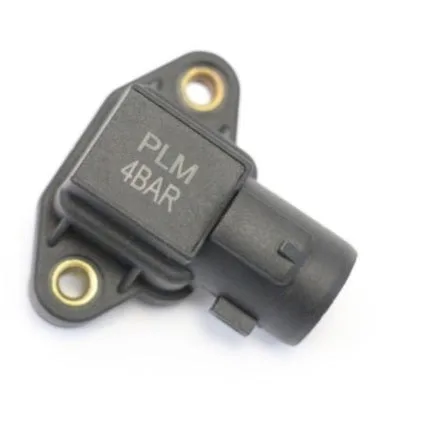
PLM Power Driven 4 BAR MAP Sensor B / D / H / F-Series