Quick Answer
Double ended trigger hooks let you quickly connect and adjust straps on your Bound set harness. Attach them by threading the strap through the hook's eye, then clip the trigger onto a D-ring or O-ring.
Why Use Double Ended Trigger Hooks?
Unlike fixed buckles, these hooks allow you to change strap length or swap connections without unbuckling the entire harness. The double-ended design gives you two attachment points in one piece, reducing hardware clutter.
The main trade-off is that trigger hooks can release if the trigger is pressed accidentally, so they work best in positions where the clip won't be bumped or sat on.
What You'll Need
You need a Bound set harness (or similar strap-based harness) and the Double Ended Trigger Hooks. The hooks are nickel plated steel, 101mm wide, and come in sets of 1, 2, or 4. For a typical harness, a set of 2 or 4 gives you enough for both sides.
How to Attach Double Ended Trigger Hooks to Your Bound Set
- 1. Identify the Attachment Points: On your Bound set harness, locate the D-rings or O-rings where you want to add the hook. These are usually on the front or back panels of the chest harness or belt. Common mistake: attaching to a ring that is too small. The hook's 101mm width needs a ring at least that wide to clip securely.
- 2. Open the Trigger Clip: Press the trigger on one end of the hook to open the clip. The spring-loaded mechanism will snap back when released. Checkpoint: ensure the trigger moves freely. If it sticks, the hook may not latch properly.
- 3. Clip to the Harness Ring: Insert the open clip over the D-ring or O-ring and release the trigger. You should hear a click when it locks. Give the hook a gentle tug to confirm it's secure. Common mistake: clipping only the tip of the ring. The entire clip opening must surround the ring for a safe hold.
- 4. Thread the Strap Through the Other End: Take the strap from your Bound set and thread it through the eye of the hook's other end. You can adjust the strap length by pulling more or less through the eye before tightening the strap's own buckle. Checkpoint: do not overtighten the strap against the hook eye. Leave a small gap so the hook can pivot freely without binding.
- 5. Test the Connection: Once both ends are attached, move the harness gently to see if the hook stays closed and the strap stays in place. Repeat steps 2-4 for the other side of the harness. Common mistake: assuming the hook is locked without testing. Always do a quick pull test before wearing the harness.
- 6. Adjust for Comfort: If the hook feels too bulky or presses into your skin, reposition the strap so the hook sits on the outside of the harness panel rather than against your body. The nickel plated steel may feel cold initially, but it warms to body temperature quickly.
Product Details
-
Double Ended Trigger Hooks: Heavy duty die-cast construction, 101mm wide, nickel plated steel. The metal build and width ensure the hook can handle tension from latex straps without bending or breaking.
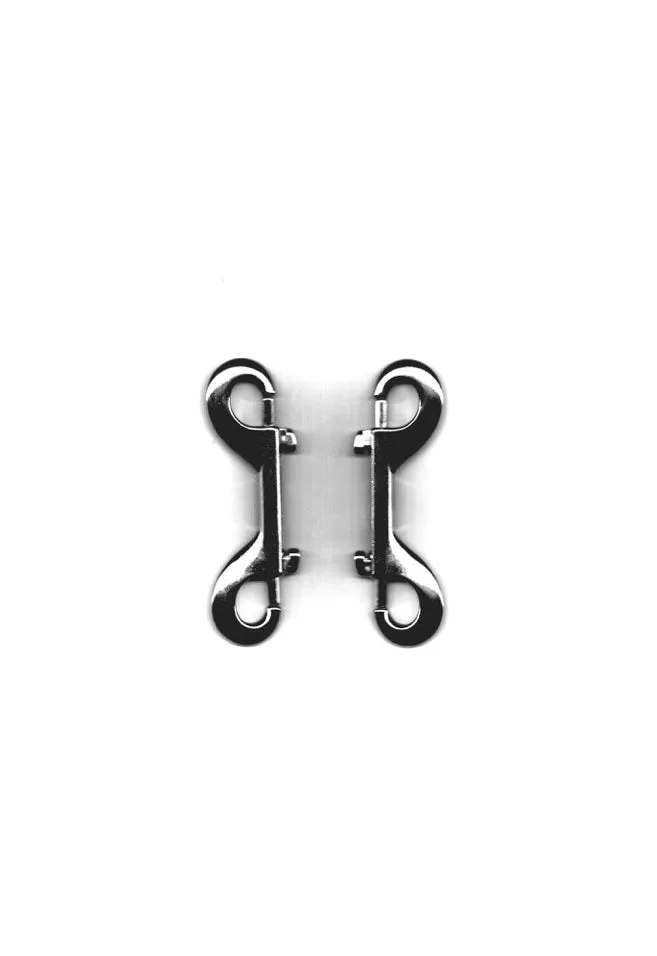
Double Ended Trigger Hooks