Quick answer
Choose a drop-in griddle if you are building or renovating a fixed outdoor kitchen and want the cooking surface flush with your countertop. Choose a freestanding griddle if you rent, move your setup often, or want to start cooking without a construction project. The drop-in route costs more up front and needs a supporting structure, while the freestanding route trades countertop space for portability and a simpler install.
How each option installs
A drop-in griddle is set into a cutout in a countertop or island, so the cooking surface sits at counter height and the body hangs below. That means the enclosure has to be built to hold the weight and, when the enclosure is combustible, insulated from the heat. Blackstone's 28" Drop-in Griddle Insulating Jacket is designed for the 3 Burner Drop-In Griddle and is required when installing into a combustible enclosure such as an outdoor kitchen or BBQ island; it is built from 304 stainless steel with a water drainage system and a cable utility routing port, and it needs substructure support.
A freestanding griddle arrives as a complete unit on a cart or cabinet with its own legs or casters. You roll it into place, connect fuel, and cook. There is no cutout, no framing, and no insulation decision, which is why it is the faster path to a first cook.
- Drop-in: requires a measured cutout, a supporting substructure, and insulation for combustible enclosures.
- Freestanding: requires only a level spot, clearance from walls, and a fuel connection.
- Drop-in mistakes are expensive to fix; freestanding mistakes are usually just a reposition.
Countertop space and layout
The main draw of a drop-in griddle is that it does not eat your patio footprint the way a cart does. The cooking surface becomes part of the counter, so prep space sits beside it rather than competing with a separate appliance. If your patio is small or your island is already planned, this is the difference between a workable layout and a cramped one.
Freestanding griddles claim floor space plus clearance around them. On a tight balcony or a narrow patio, that footprint can be the deciding factor. On a large deck, it usually is not a problem, and the cart's side shelves can add prep area that a bare drop-in cutout does not provide.
Cost, structure, and committed space
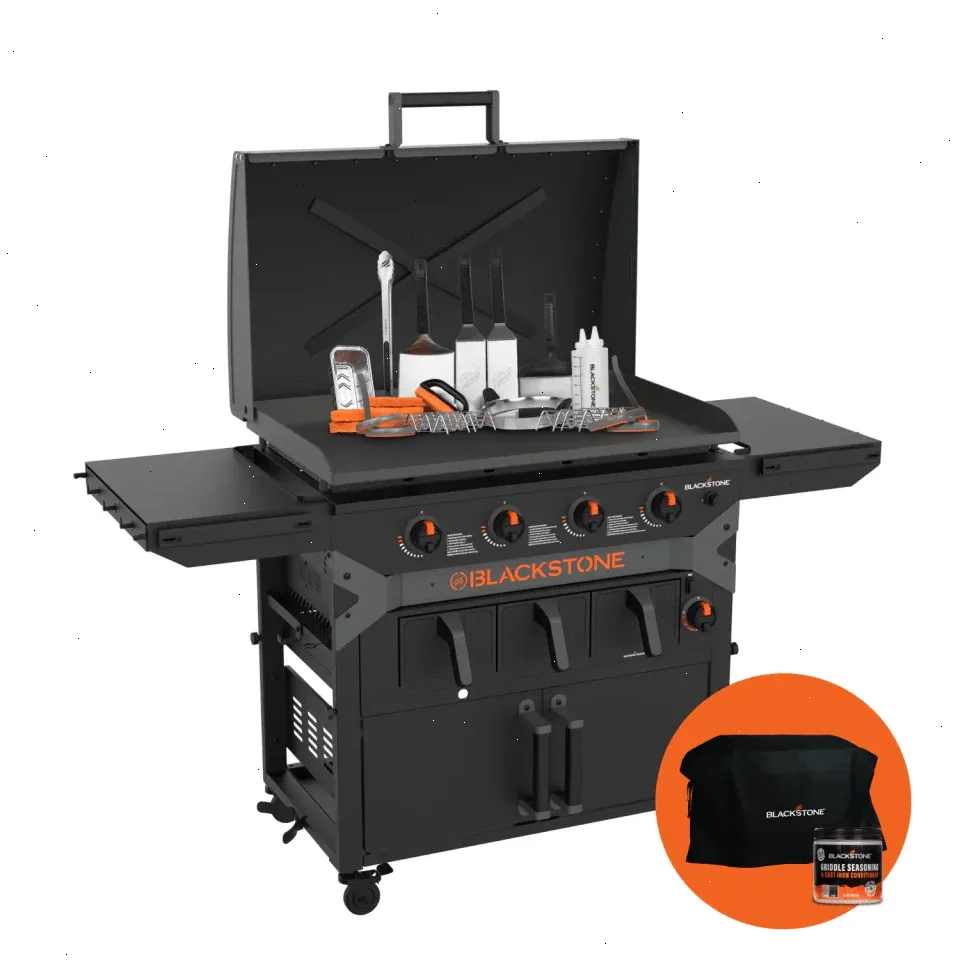
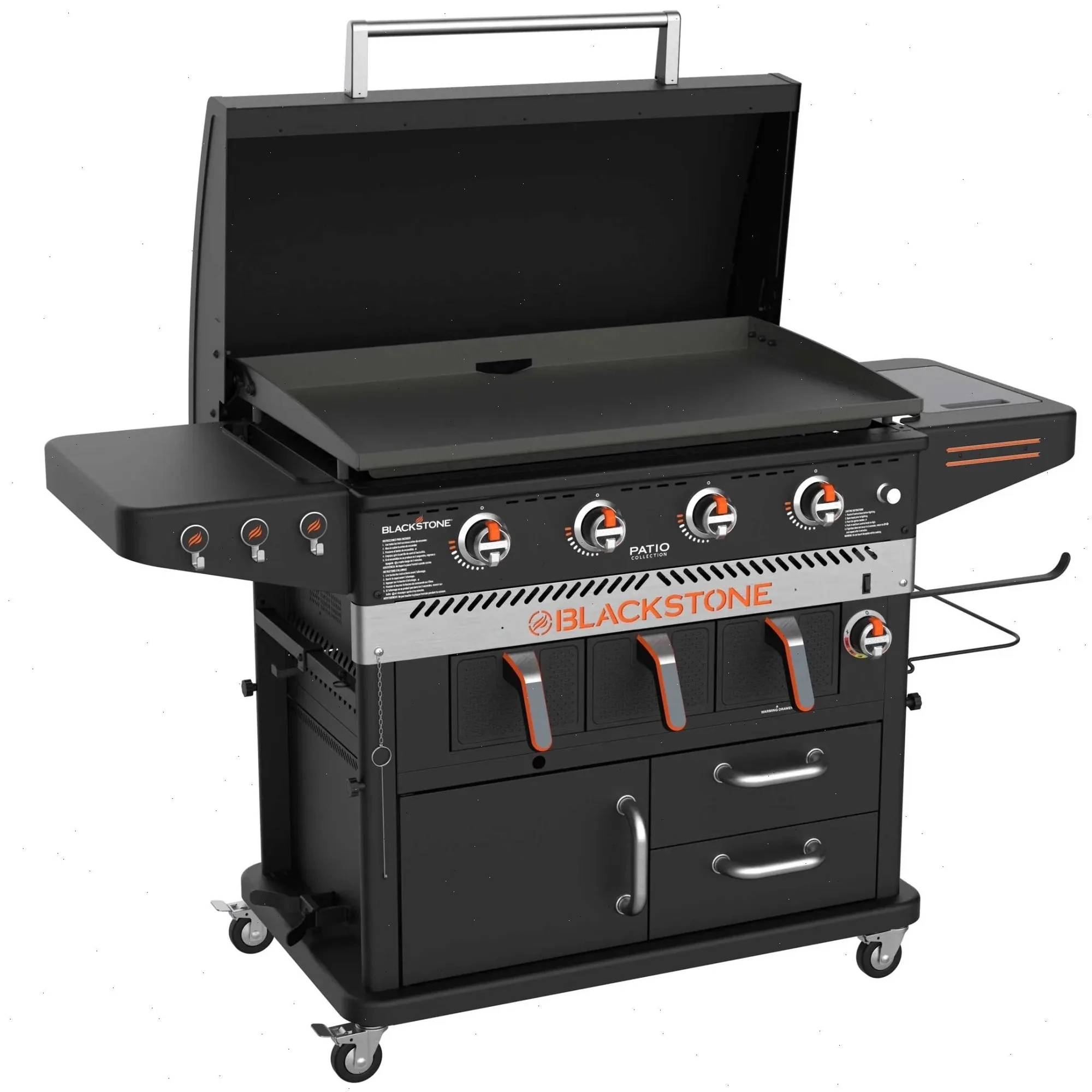
Budget the drop-in as a project, not a purchase. The griddle itself is one line item; the countertop cutout, substructure, insulation jacket, and any electrical or gas routing are others. Blackstone's 50" Outdoor Kitchen Module with 36" Drop-in Griddle shows how a modular build comes together: it includes propane storage and shelving behind a cabinet door, three drawers with soft-close slides, utility punch-outs to route electricity and gas from module to module, four caster wheels for movement, and four leveling feet for stability. It is made of galvanneal, weatherproof and rust resistant, outdoor certified, and made in the USA, with a recessed toe kick.
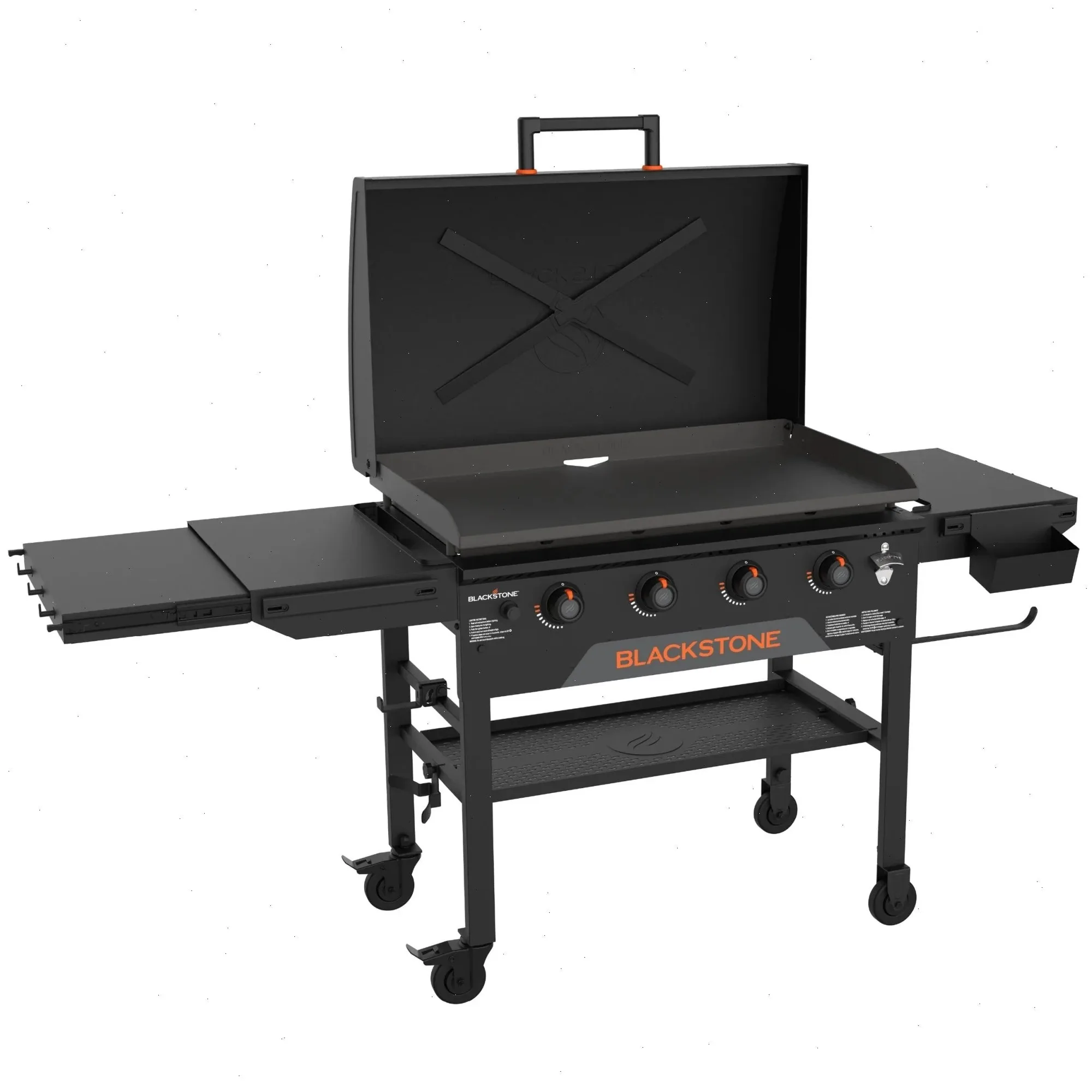
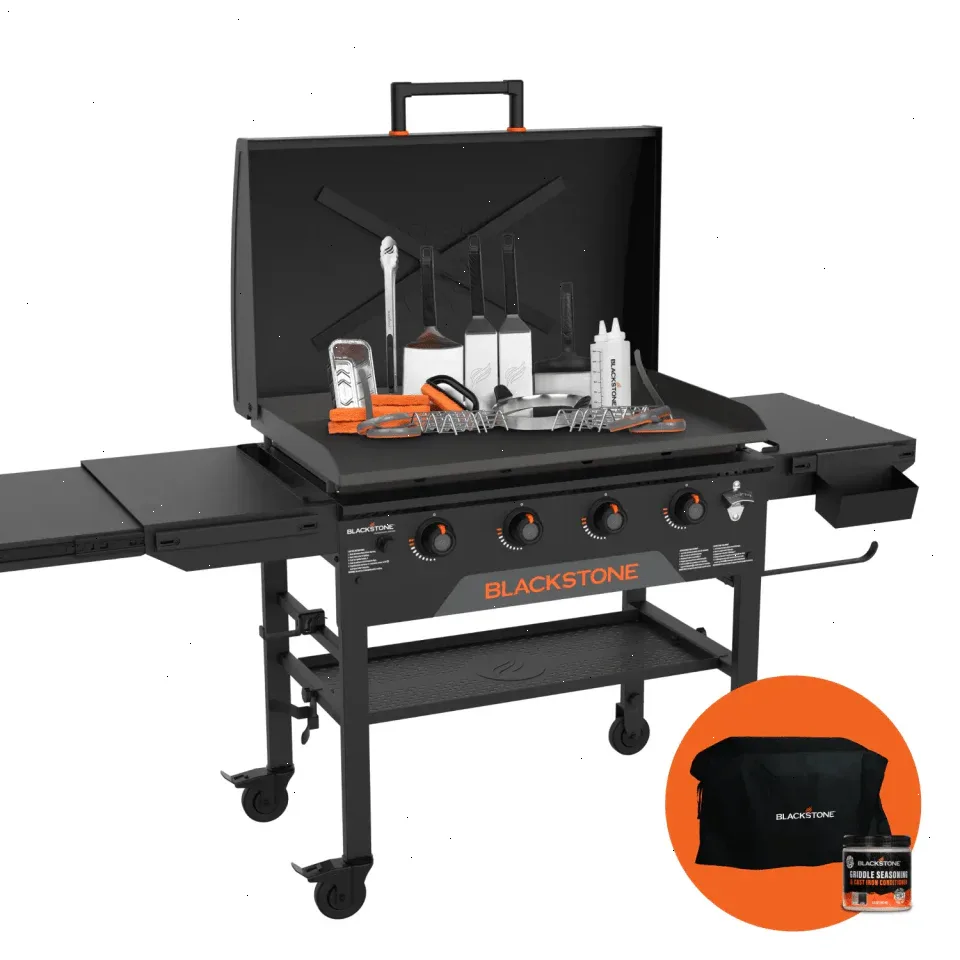
A freestanding griddle bundles the cooking surface and the stand into one price, which is why it usually wins on total cost. Blackstone's 44" Griddle with Hard Cover is a freestanding example: it uses the Omnivore griddle plate for heat distribution and fuel efficiency, has five independently controlled heat zones, side shelves for prep space, and locking caster wheels. The hard cover is included rather than a separate purchase.
The trade-off is commitment. Once a drop-in is set into a counter, moving it means redoing the counter. A freestanding unit can be rolled to a new spot, stored for winter, or sold with the house without touching the patio structure.
Which one holds up better outdoors
Both formats are built for outdoor use, but they face different stresses. A drop-in lives inside a structure, so its exposure is mostly heat, grease, and moisture from the enclosure. That is exactly why drainage and utility routing matter in an insulating jacket, and why the substructure has to be right the first time.
A freestanding griddle takes full weather on all sides, including the cart, wheels, and shelves. Locking casters keep it from drifting during use, but the unit still needs a cover and a sensible storage plan for the off-season. If you already deal with winter storage, that routine does not change with a freestanding griddle; it just becomes non-negotiable.
Small details that change the decision
Plan your serving and prep flow before you commit. A drop-in frees counter space for plating, which is where a set like the Serving Trays (4-Pack) earns its place: four food-safe plastic trays that stack for storage and go in the dishwasher. With a freestanding cart, those trays often end up on a side shelf or a separate table.
Check fuel and power access early. A drop-in needs gas and, in many builds, electricity routed to the module, and punch-outs exist for exactly that reason. A freestanding griddle needs a propane tank or a gas line nearby and nothing more. If you cannot get a line to the island without major work, that alone can settle the comparison.
Trade-offs at a glance
- Countertop space: A drop-in griddle sits flush in the counter and adds no cart footprint; a freestanding griddle occupies floor space plus clearance and often adds side shelves instead. Small patio or planned island: drop-in. Open deck with room to spare: freestanding.
- Installation effort: Drop-in needs a cutout, substructure, and an insulating jacket for combustible enclosures; freestanding needs a level spot and a fuel connection. If you are not ready for a build, freestanding gets you cooking this weekend.
- Up-front cost: Drop-in spreads cost across the griddle, jacket, counter work, and utility routing; freestanding bundles the cooking surface and stand into one purchase. Compare total project cost, not just the griddle price.
- Flexibility later: A drop-in is committed to its counter once installed; a freestanding unit on locking casters can be moved, stored, or relocated. Renting, moving soon, or unsure about your layout: freestanding.
Products in this comparison
- Blackstone 50" Outdoor Kitchen Module with 36" Drop-in Griddle: 50" Outdoor Kitchen Module with 36" Drop-in Griddle: propane storage and shelving behind a cabinet door, three drawers with soft-close slides, utility punch-outs to route electricity and gas module to module, four caster wheels, four leveling feet, galvanneal construction that is weatherproof and rust resistant, outdoor certified, made in the USA. Shows what a drop-in build actually includes beyond the griddle, and why the module, not just the cooktop, drives the project cost and layout.
- 28" Drop-in Griddle Insulating Jacket: 28" Drop-in Griddle Insulating Jacket: designed for the Blackstone 3 Burner Drop-In Griddle, required for installation into a combustible enclosure such as an outdoor kitchen or BBQ island, 304 stainless steel, water drainage system, cable utility routing port, requires substructure support. This is the hidden line item in most drop-in plans; skipping it is a safety problem, not a shortcut.
- 44" Griddle with Hard Cover: 44" Griddle with Hard Cover: Omnivore griddle plate for heat distribution and fuel efficiency, five independently controlled heat zones, side shelves for prep without sacrificing storage, locking caster wheels, hard cover included. Represents the freestanding path: one purchase, no cutout, and heat-zone control that suits cooking several foods at once.
- Serving Trays (4-Pack): Serving Trays (4-Pack): food-safe plastic, four trays, dishwasher safe, stack for storage. Useful in either setup, but especially for drop-in builds where counter space is the reason you chose that format.
Which should you choose?
Choose a drop-in griddle if you...
- are building or renovating a fixed outdoor kitchen and can plan the cutout, substructure, and insulation now
- want the cooking surface flush with the counter and no extra cart footprint on the patio
- can route gas, and electricity if needed, to the island before the counter goes on
Choose a freestanding griddle instead if you...
- rent, move often, or may rearrange the patio within a year or two
- want to cook without a construction project or a countertop cutout
- need to store the griddle away for part of the year