Calming Treats Are Not Tranquilisers
The biggest myth around calming treats for dogs is that they work like a sedative—that one biscuit will turn a frantic dog into a sleepy one. That is not what the evidence for The Pets Larder Apothecary Calming & Digest Treats describes. The product is a grain-free treat built around freshly prepared duck (40%) and chicken (24%), with camomile and lavender included at 50 mg/kg each. The record frames these as 'calming ingredients' and 'soothing herbs', not as a treatment for anxiety.
That distinction matters when you are deciding whether to buy. A treat can be a useful part of a calm routine without being a behavioural fix. If your dog has serious anxiety—destructive chewing, panic during storms, separation distress—a treat is not a substitute for advice from your vet or a qualified behaviourist. What the record does support is a gentle, balanced treat for pets that benefit from added relaxation and digestive support.
What the Duck and Chicken Recipe Actually Contains
The formula is built on fresh duck and chicken, with sweet potato (13%), potato, peas and a small amount of chicken gravy (1%). The calming herbs are listed at 50 mg/kg camomile and 50 mg/kg lavender—a modest inclusion rate, not a concentrated supplement dose. The record also lists nucleotides (1%), cellulose, fructooligosaccharides (FOS), beta glucans and mannanoligosaccharides (MOS), which are described as digestive and immune support ingredients. A probiotic strain, Enterococcus faecium, is included at 1,000,000,000 cfu.
The analytical constituents give a clearer picture of the nutritional profile: crude protein 25%, crude fat 16%, crude fibre 4.5%, crude ash 8%, moisture 8%, and metabolisable energy of 371 kcal/100g. That is a moderately rich treat, so it is worth accounting for in your dog's daily intake rather than treating it as calorie-free.
The Product Record at a Glance
-
Calming Duck & Chicken Cat & Dog Treats: The Pets Larder Apothecary Calming & Digest Treats combine freshly prepared duck (40%) and chicken (24%) with soothing herbs and essential nutrients. The named proteins are the first ingredients, which is relevant if you are choosing a treat for a dog with sensitivities to other meats.
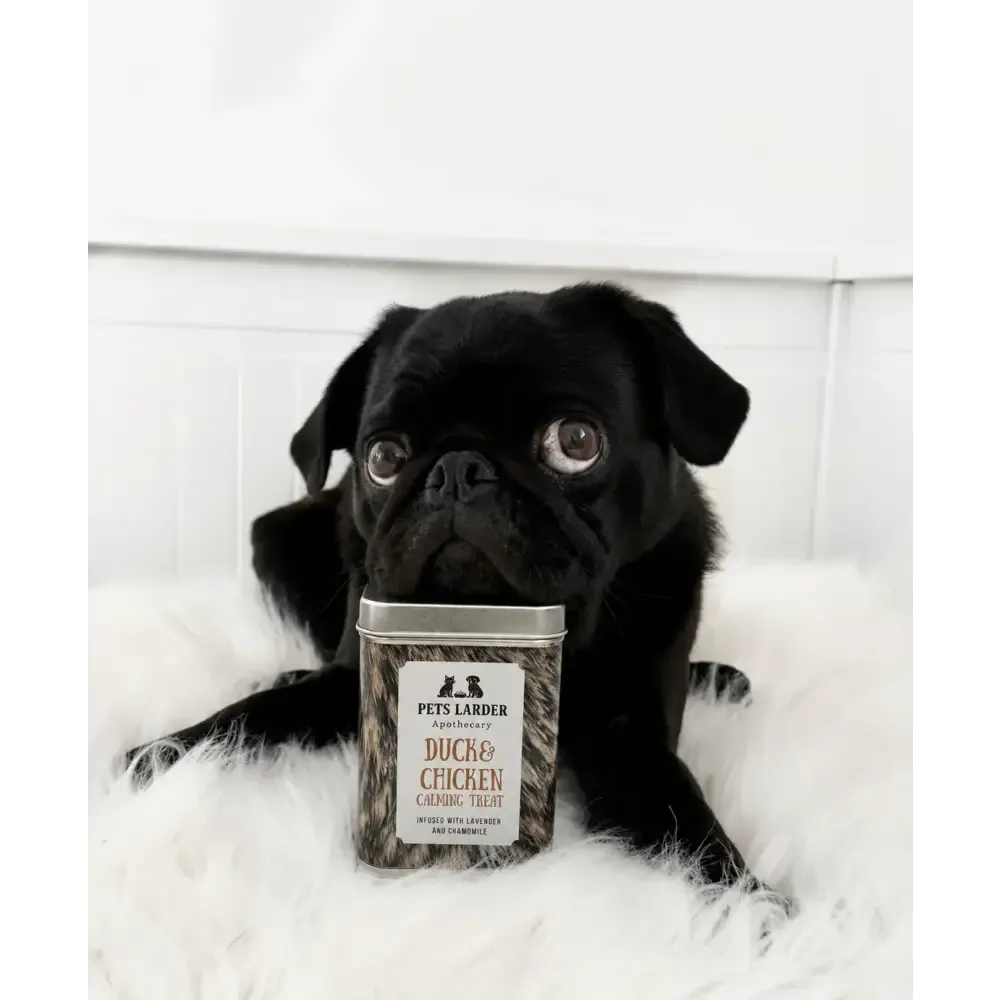
Calming Duck & Chicken Cat & Dog Treats
-
Calming Duck & Chicken Cat & Dog Treats: The recipe is crafted without added grains, making it suitable for pets sensitive to grain-based diets. If your dog reacts to wheat or other grains, a grain-free treat removes one common trigger—though it does not guarantee a reaction-free experience.
-
Calming Duck & Chicken Cat & Dog Treats: Camomile is included at 50 mg/kg and lavender at 50 mg/kg; the record describes camomile as also thought to help calm an upset stomach. These are the 'calming' ingredients, but the record does not claim a clinical effect or a dose-response relationship.
-
Calming Duck & Chicken Cat & Dog Treats: The treats are suitable for cats as well as dogs. If you have both species, one tin can serve both—but cats have different nutritional needs, so treats should stay a small part of the diet.
Do Calming Dog Treats Work? What the Evidence Says
The supplied record does not include any trial data, behavioural studies or veterinary claims. It describes the treats as offering 'a holistic approach to pet care, combining delicious taste with functional support for calmness, digestion, and well-being.' That is marketing language, not proof. The honest answer to 'do calming dog treats work?' is that the evidence for herbal calming ingredients in treats is generally modest, and this record does not add to it.
What the record does confirm is the presence of ingredients traditionally associated with relaxation—camomile and lavender—and a digestive support package including FOS, MOS, beta glucans and a probiotic. Whether your individual dog shows a noticeable difference is something you will have to observe. Some owners report a calmer settle after a treat; others notice nothing beyond a happy dog. Neither outcome is a failure of the product, because the product is not positioned as a treatment.
When to Give Calming Treats—and When Not To
The record does not supply a feeding amount, frequency or timing instruction, so we cannot give you a manufacturer-recommended schedule. What we can say is that a treat works best as part of a routine, not as an emergency intervention. A common approach is to offer one before a known mild stressor—a car journey, a visitor, a nail trim—so the dog associates the event with something positive. The act of chewing and the owner's calm attention may do as much as the herbs.
Do not use these treats as a substitute for veterinary care. If your dog's anxiety is severe, sudden, or accompanied by other symptoms, speak to your vet first. The record makes no claims about treating clinical anxiety, and a treat cannot address an underlying medical or behavioural issue.
Cats, Portion Sizes and Practical Considerations
The record confirms the treats are suitable for cats as well as dogs, which is useful in a multi-pet home. However, cats are obligate carnivores with different nutritional requirements, and the record does not provide a cat-specific feeding guide. Treats should remain a small proportion of any pet's daily calories. With 371 kcal/100g, these are not a low-calorie snack, so if your dog is prone to weight gain, factor them into the daily allowance rather than adding them on top.
The treats come in two package types: a 175g metal tin and a 500g refill bag. The tin is a good way to try the product or keep a small amount fresh; the refill bag suits households that already know the treats work for their pet. Neither format is described as resealable in the supplied record, so storage advice beyond the packaging is not confirmed.
What the Record Does Not Confirm
- Calming Duck & Chicken Cat & Dog Treats: The supplied information does not include a feeding amount, daily frequency, or a maximum number of treats per day. You will need to use your judgement or ask your vet, especially if your dog has health conditions or is on a weight-management plan.
- Calming Duck & Chicken Cat & Dog Treats: No clinical or behavioural trial results are provided for the calming effect of the camomile and lavender in this recipe. Treat the calming claim as a traditional-use ingredient claim, not a guaranteed outcome.