Quick answer
The Engino Discovering STEM Fluid Dynamics kit is a build-and-experiment set that walks kids through how liquids and gases behave, using a small number of guided models rather than a big pile of random parts. It suits roughly ages 9 and up, works best as a parent-and-child or classroom activity, and pairs well with other Discovering STEM sets if your child wants to keep going.
Fluid dynamics sounds like a university topic, but the version kids meet in an Engino Discovering STEM set is much more hands-on: build something, pour or push, watch what happens, then read why. That loop is what makes the series work, and it is also why parents ask very specific questions before buying.
This article answers the questions that come up most often about the Fluid Dynamics kit: what is actually in the box, which models you build, whether the age rating is realistic, and how it fits alongside the rest of the Discovering STEM line.
What is actually in the Engino Discovering STEM Fluid Dynamics box?
You get Engino's snap-fit construction parts, the specialized pieces needed for the fluid experiments, and an instruction book that combines building steps with short theory and experiment prompts. Engino's Discovering STEM sets are built around that combination, so the booklet is part of the product, not an afterthought.
The exact part count and the full parts list are printed on the box and in the manual. If a specific number of components matters to you, check the listing's specification table rather than assuming it matches a different set in the series.
- Lay out all bags before the first build so you can spot a missing piece early.
- Keep the manual with the parts; the theory pages are what turn a model into a lesson.
Which models can you build with the Engino Fluid Dynamics set?
The kit is organized around six guided models, and each one demonstrates a different fluid behavior rather than repeating the same idea six times. Expect builds that show how pressure changes with depth, how flow behaves through a narrow opening, and how air and water push against surfaces in different ways.
The point of the six-model structure is progression. Early builds are quick wins that get a child comfortable with the snap-fit system; later builds add more steps and depend on the earlier ones, so the difficulty curve is intentional.
- Build in the order printed in the manual, even if a later model looks more fun.
- Photograph each finished model so you can rebuild it later without re-reading every step.
Is the Engino Fluid Dynamics set right for a 9-year-old?
Ages 9 and up is a reasonable fit, with the caveat that the reading level matters as much as the building. The theory sections are written for a child who can follow a few sentences of explanation, and the experiments only make sense if they do.
Younger siblings can often help with assembly, but expect to run the experiments yourself and narrate what is happening. If your child is closer to 6 or 7, a simpler Engino Creative Builder or Qboidz set will produce less frustration.
- If your child reads independently, they can run most of this set alone.
- If not, plan to co-pilot the first two builds and then step back.
How do the fluid dynamics experiments actually work?
Engino's approach is to build a physical rig, then change one variable and observe the result. That is why the kit includes experiment prompts alongside the build steps instead of just a model gallery. The child is meant to predict, test, and compare.
This is also where the set earns its place next to a screen. The models are simple enough to rebuild with a change, which is exactly what an experiment requires. A static model you build once teaches far less.
- Do experiments over a tray or towel; water-based builds get messy fast.
- Ask your child to guess the outcome before each test, then compare.
Where does Fluid Dynamics fit in the Discovering STEM series?
Discovering STEM is Engino's themed science line, with each set focused on one area of physics or engineering. Fluid Dynamics sits alongside topics like mechanics and solar power, and the sets share the same snap-fit system, so parts from one can support builds from another.
If your child already owns a mechanics set, Fluid Dynamics is a natural next step because the building skills transfer. If they own nothing yet, starting with a mechanics set first is usually the easier on-ramp.
- Shared snap-fit parts mean sets combine rather than compete.
- Check the manual's model list before buying a second set to avoid overlap.
What should you check before buying?
Confirm the age range, the number of models, and whether the experiments need household items like water or a container. Some Engino sets use everyday materials in addition to the included parts, and knowing that in advance prevents a stalled first session.
Also decide whether you want a single-topic set or a broader one. A focused kit like Fluid Dynamics goes deeper on one idea; a master mechanics set covers more ground with more models. Neither is better, they just serve different kids.
- Read the model count, not just the part count, when comparing sets.
- Check whether the experiments need water, air, or extra household items.
Fluid Dynamics buying checklist
Model count
The set is structured around six guided models, each demonstrating a different fluid behavior. Six focused models beat dozens of near-identical ones for teaching a single topic.
Age fit
Ages 9 and up is realistic if your child can read the theory pages; younger kids will need an adult to run the experiments. Buy for reading level as much as building ability.
Experiment setup
Fluid experiments typically involve water or air, so check the manual for household items you need to supply. Set up a tray and towel before the first session.
Engino sets that pair well with Fluid Dynamics
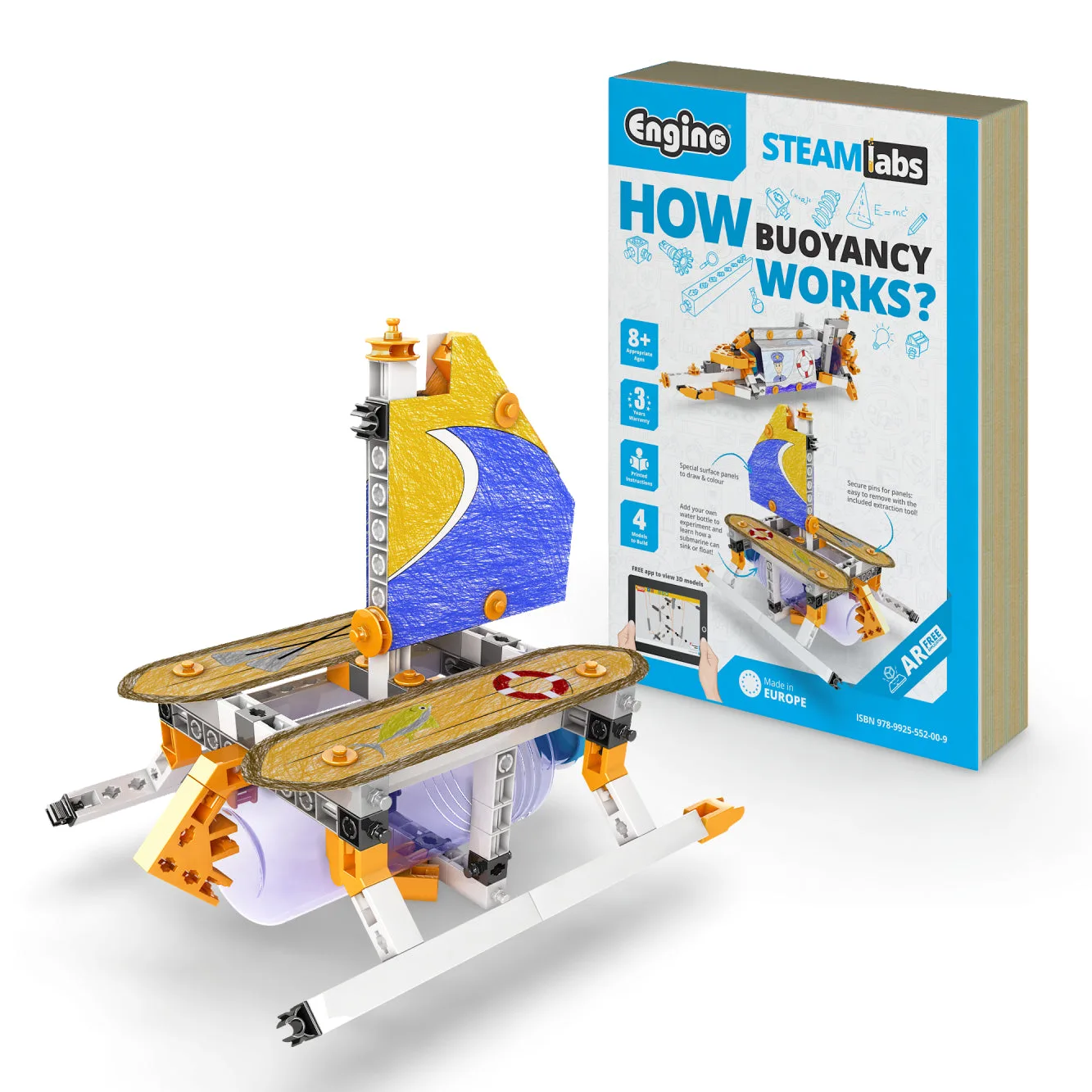
- Engino STEAM Labs: How Buoyancy Works, STEM Building Toys for Kids Ages 8+ (4 Models to Build): This kit explores floating and sinking through hands-on builds and uses a plastic bottle and pebbles for water-based experiments. It is the closest companion topic to fluid dynamics, and it shows that some Engino sets deliberately rely on household items, so plan for water play.
- Engino Discovering STEM Mechanics: Wheels, Axles & Inclined Planes Set for Kids Ages 9+ (14 Models to Build): This set covers wheel and axle types, lever classes, torque, friction, and inclined-plane geometry, with experiments comparing wheel sizes, axle thickness, and ramp angles. It uses the same age range and snap-fit system, making it a logical next purchase once your child has finished the fluid dynamics builds.
- Engino STEM Mechanics Master Set – Explore Simple Machines, Structures & Newton’s Laws, STEM Building Kit for Kids Ages 9-12+ (100 Models to Build): The master set combines simple machines, physics, and structural engineering with 100 models to build using Engino's 3D snap-fit system. If your child wants breadth after a focused topic set, this is the broadest option and shares the same building system.
The Engino Discovering STEM Fluid Dynamics kit is a focused, experiment-driven set that rewards a child who likes to ask why. If you want a single-topic science build that turns into a real activity, it fits; if you want maximum model variety, a broader mechanics set will serve you better.