Quick answer
Choose fabrics with clear value contrast, cut your foundation paper piecing triangles slightly oversized, and sew with a short stitch length. These three habits prevent the most common problems in the Equilateral Gone Awry quilt block.
Why hexagon blocks reward careful fabric planning
The Equilateral Gone Awry pattern produces 6-inch, 8-inch, or 12-inch hexagons from two simple foundation paper pieced triangles. Because each block is built from just two triangle units, any fabric choice you make is magnified across the finished hexagon. Busy prints can obscure the geometric layout, while low-contrast fabrics make the block read as a single shape rather than a pattern.
You do not need to buy a special pre-cut bundle to make this work. The pattern is designed to work with the Striped Hexi's collection or stand alone, so you can pull from your stash as long as you test contrast before cutting.
How many fabrics to use per block
A single hexagon block uses two FPP triangles, so you can keep it simple with two fabrics or introduce more variety by changing the fabric in each triangle. The 18 block layouts in the pattern give you room to experiment, and the four bonus blocks that combine both collections bring the total to 40 different layouts. If you are new to FPP, start with two high-contrast fabrics so you can clearly see whether your triangle units are aligning correctly.
Step-by-step fabric and cutting process for Equilateral Gone Awry blocks
- Pick your finished block size first: Decide whether you are making 6-inch, 8-inch, or 12-inch hexagons before you choose fabrics. The pattern includes all three sizes, and each size uses a different amount of fabric per triangle unit. Write your chosen size on a sticky note and keep it by your cutting mat.
- Audit your fabric for value contrast: Lay your candidate fabrics side by side and squint at them. If two fabrics blend into one gray mass, they will not show the triangle geometry clearly. Choose at least one light, one medium, and one dark if you plan to mix multiple fabrics. Take a black-and-white photo of your fabric pull to check contrast instantly.
- Pre-wash and press your fabric: Pre-wash if you plan to wash the finished quilt, then press with a dry iron before cutting. Skipping the press leaves creases that distort triangle shapes and throw off your seam allowances. Press, do not iron back and forth, to avoid stretching bias edges.
- Cut foundation paper piecing triangles oversized: Cut your fabric pieces larger than the printed foundation triangle outlines. The pattern uses FPP, so the extra fabric gets trimmed after stitching. Cutting exactly to size is a common mistake that leads to short corners and exposed foundation paper. Add at least a quarter inch of margin on every side of each FPP triangle.
- Label your fabric pieces before sewing: Because each block uses two triangles, it is easy to mix up which fabric goes where. Use small sticky notes or a fabric-safe marker to label the pieces for each block. This is especially helpful when you are making multiple blocks from the 18 layouts. Keep pieces for each block in a separate bag or tray.
- Sew with a short stitch length: Set your machine to about 1.5 to 2.0 mm so the perforations in the foundation paper are close together. A longer stitch makes it harder to tear away the paper cleanly and can loosen seams. Test on a scrap foundation first. Reduce stitch length before you start, not after the first seam.
- Trim each triangle unit after stitching: Press the seam flat, then trim the fabric to the printed line on the foundation paper. Use a small ruler and a sharp rotary cutter. Trimming after each addition keeps the triangle edges straight and prevents bulk from building up. Trim with the paper side up so you can see the printed line clearly.
Pattern facts that affect your fabric and cutting choices
-
Equilateral Gone Awry Quilt Block Pattern: Finished blocks are 6-inch, 8-inch, or 12-inch hexagons made from two foundation paper pieced triangles. The size you choose changes how much fabric each triangle uses, so decide your finished block size before you cut.
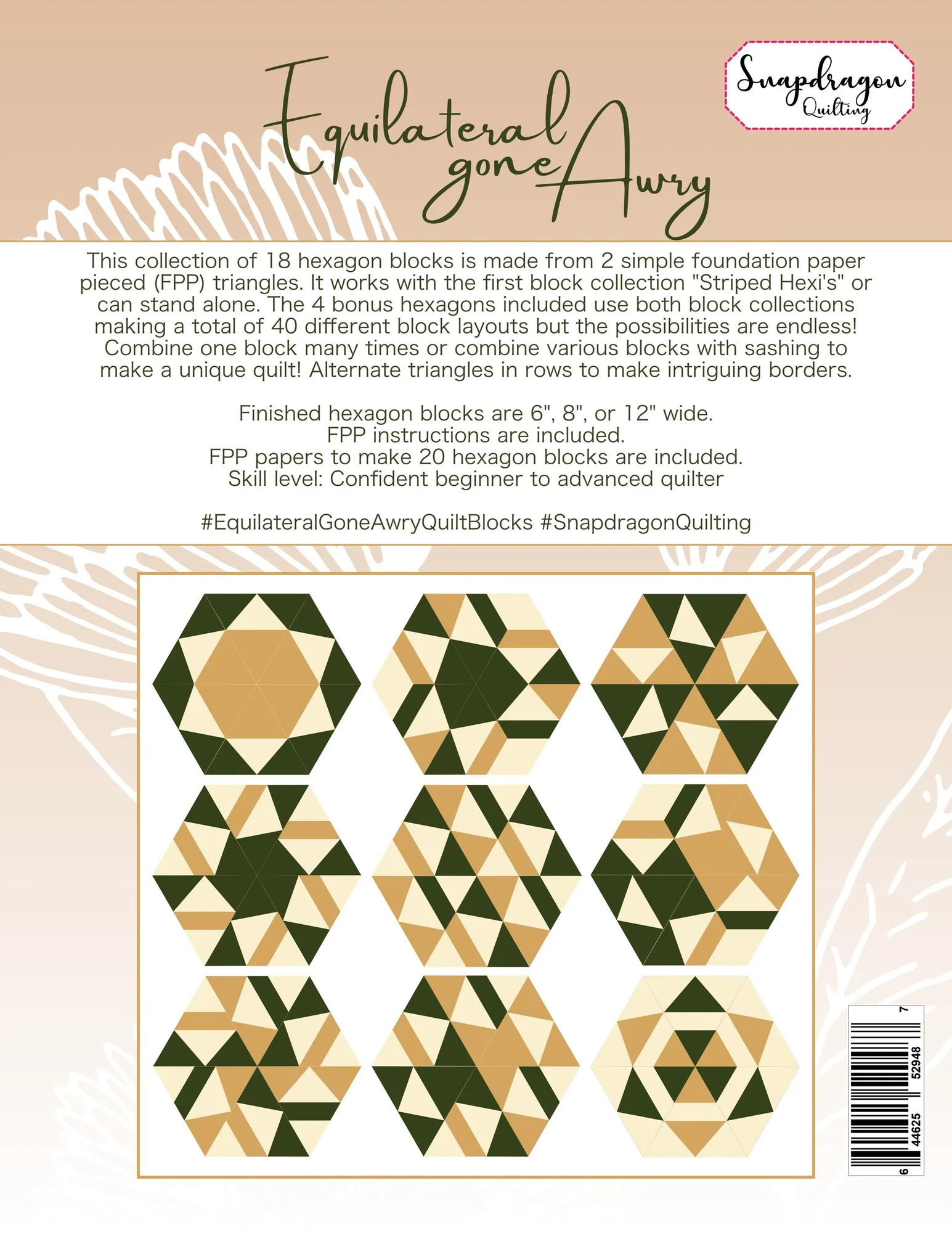
Equilateral Gone Awry Quilt Block Pattern