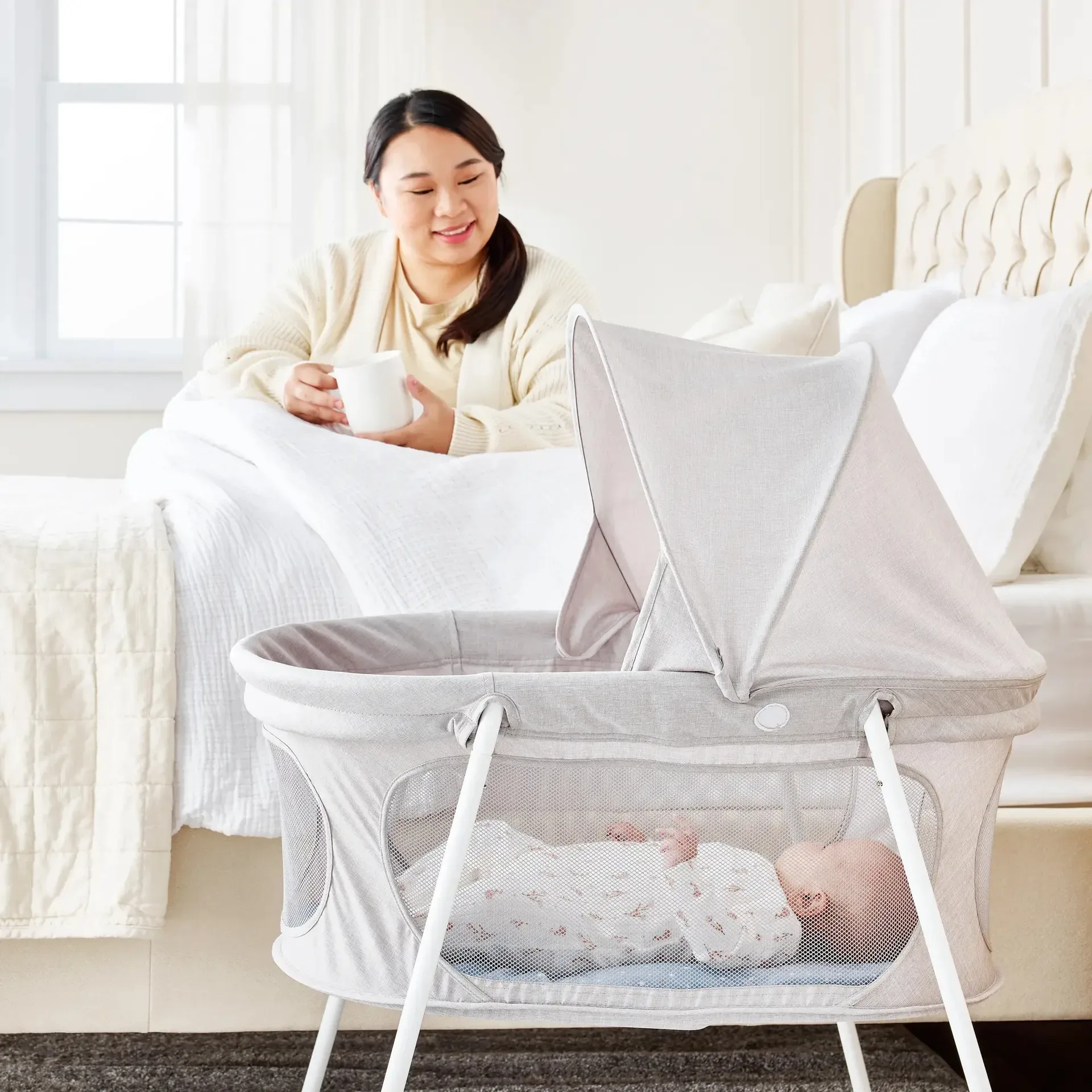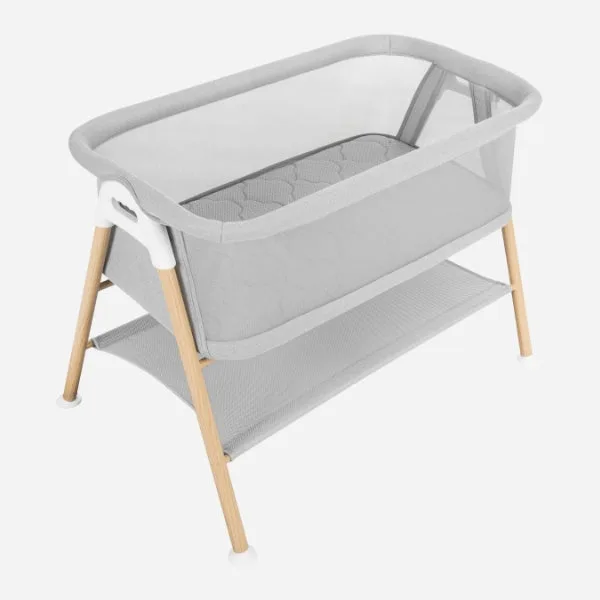
Start with a free-standing sleep space
A stand-alone bassinet gives your baby their own dedicated sleep surface while keeping them close. Unlike bedside sleepers that attach to your bed, the Newton Essential Bassinet is free-standing, so you can place it anywhere in the room without worrying about bed height or attachment compatibility.
The Essential Bassinet is designed for newborns up to approximately 6 months, or until your baby can push up on hands and knees, roll over front to back, or reaches 20 lbs—whichever comes first. Keep those limits in mind as you set up and use the bassinet.
Assemble the bassinet in minutes
The Essential Bassinet uses a click-together assembly with no tools or hardware required. Follow these steps to put it together:
- Unpack and lay out the parts: The bassinet ships flat and includes a carry bag. Remove the frame pieces, mattress, and fabric cover from the packaging.
- Click the frame together: The lightweight metal frame assembles by clicking together a few buttons. No tools or hardware are needed.
- Attach the fabric surround: The machine-washable fabric cover with breathable mesh sides zips onto the frame. Make sure it is fully secured before placing the mattress.
- Place the mattress: The Wovenaire® mattress is included and fits the 35” x 19” sleep surface. It is 1.5” thick—the thickest mattress depth allowed for bassinets.
- Check stability: Once assembled, gently press on the frame to ensure all connections are secure. The bassinet should feel stable and ready for use.
Why the mattress matters for newborn safety
-
Essential Bassinet: The only standalone bassinet with a Wovenaire® breathe-thru mattress for optimal airflow, reducing suffocation risk and keeping baby comfortable. Breathable materials help reduce suffocation risk, a key concern for newborn sleep safety.
-
Essential Bassinet: Made without foam, glue, latex, or springs, its patented Wovenaire® core is 90% air and 10% food-grade polymer, delivering firm, breathable support. A firm, breathable mattress is important for safe sleep, and this construction avoids common allergens and chemicals.
-
Essential Bassinet: Independent testing conducted by an accredited lab determined that among the top three bestselling bassinets, only Newton does not pose a significant suffocation risk. Third-party testing provides evidence that the bassinet meets high safety standards.
Choose the right spot in your bedroom
Place the bassinet on a flat, stable surface, away from windows, blinds, cords, and other hazards. Keep it clear of walls or furniture that could interfere with airflow. The mesh sides provide 360° visibility and airflow, so you can see your baby from any angle in the room.
Avoid placing the bassinet near heat sources or in direct sunlight. The bassinet is lightweight (15 lbs) and easy to move, so you can reposition it as needed during the day or night.
Clean before first use and maintain regularly
Wash the fabric cover and mattress cover before first use. The fabric cover and mattress cover are machine washable in cold water on a delicate cycle. Do not bleach, iron, or dry-clean. Tumble dry on low. The Wovenaire® core can be removed and rinsed by hand in a bathtub or shower, then shaken and air-dried or fan-dried. The metal frame can be wiped with mild soap and water.
For complete care instructions, refer to the product manual. Keeping the bassinet clean helps maintain a healthy sleep environment for your baby.
Certifications and materials that support a safer sleep space
- Essential Bassinet: Non-toxic & GREENGUARD Gold Certified GREENGUARD Gold certification means the product has been tested for low chemical emissions, contributing to healthier indoor air quality.
- Essential Bassinet: Machine-washable fabric and breathable mesh sides Easy cleaning and breathable sides help maintain a hygienic and comfortable sleep environment.
When to transition out of the bassinet
The Essential Bassinet is designed for use up to approximately 6 months, but always follow the specific limits: when your baby can push up on hands and knees, roll over front to back, or reaches 20 lbs, whichever comes first. At that point, transition to a crib or another appropriate sleep space.
The large 35” x 19” sleep surface may allow longer use than some bedside sleepers, but the developmental and weight limits are the key factors.