Quick answer
Choose a 7-foot ETCO2 nasal cannula for most bedside monitoring in confined spaces, and opt for a 14-foot cannula when you need extra reach for patient mobility or equipment placement. Your decision should balance patient comfort, safety, and monitoring accuracy.
Why tubing length matters for ETCO2 monitoring
Tubing length directly affects patient mobility, equipment placement, and the risk of accidental disconnection. A shorter line keeps the sampling port closer to the monitor, which can reduce the chance of tugging or tangling. A longer line offers more flexibility for patients who need to move around or for monitors positioned farther from the bed.
Trade-offs to consider
Longer tubing can introduce more dead space, which may slightly delay the CO2 sample reaching the monitor. However, for most standard adult monitoring, this delay is negligible. The bigger trade-off is between convenience and safety: a 14-foot line gives freedom of movement but increases trip hazards, while a 7-foot line is more compact but limits reach.
Decision rules for tubing length
- Choose 7-foot if: The patient is bed-bound or in a confined space, and the monitor is positioned close to the head of the bed. Shorter tubing reduces clutter and the risk of tripping. Check that the sampling line can reach the monitor without stretching.
- Choose 14-foot if: The patient is ambulatory or the monitor is placed farther away. The extra length allows for movement without disconnecting the cannula. Ensure the longer tubing is secured to avoid tangling or pulling.
- Always verify connector compatibility: Check whether your monitoring system uses a male or female Luer-style connector. The 7-foot cannula has a male Luer-Lok, while the 14-foot has a female Luer-style connector.
Product facts
-
ETCO2 Nasal Cannula Salter-Style® Adult Curved Prongs 7 Foot Tubing Low Flow Rate: Salter Labs ETCO2 sampling cannula with oxygen delivery, both lines 7 foot, male Luer-Lok connector, 25 per case. This 7-foot option is ideal for bedside use where the monitor is close, and the male Luer-Lok connector ensures a secure fit to standard sampling lines.

ETCO2 Nasal Cannula Salter-Style® Adult Curved Prongs 7 Foot Tubing Low Flow Rate
-
ETCO2 Nasal Cannula Salter-Style® Adult Curved Prongs 14 Foot Tubing Low Flow Rate: Sun Med adult curved-prong cannula with 14-foot tubing, low flow rate, non-flared tip, female Luer-style connector, 25 per case. The 14-foot tubing offers extended reach for patients who need to move around or when the monitor is placed farther away, while the female Luer-style connector provides compatibility with a range of sampling systems.
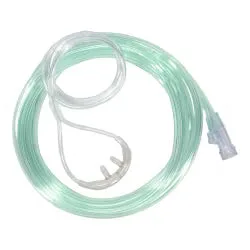
ETCO2 Nasal Cannula Salter-Style® Adult Curved Prongs 14 Foot Tubing Low Flow Rate
Who should choose which length
Best for
- Bedside monitoring in ICU or recovery rooms where space is limited
- Patients who remain mostly in bed and need a secure, low-profile setup
Not for
- Ambulatory patients who need to walk or move around their room
- Situations where the monitor must be placed more than 7 feet away from the patient