Start with a scale that resolves small dose changes
Espresso doses are small, so the scale needs to show meaningful changes without rounding them away. The Wacaco Exagram Pro is specified with 0.1g accuracy and a drop-by-drop count over 0.3g, which means it can register the small additions that happen as you grind or transfer coffee. For a dose-weighing routine, that resolution is the foundation: you can see a 0.2g adjustment instead of guessing whether the basket is slightly over or under.
Before you rely on any number, set the scale on a stable, level surface. The Exagram Pro is pocket-size, but its weighing range goes up to 2kg, so it can handle a portafilter or a brewing vessel as well as loose grounds. Use the on/off switch to start, and keep the protective carrying box nearby if you are working away from home.
A practical dose-weighing workflow
The sequence below uses only functions confirmed in the supplied Exagram Pro record: weighing, tare, timer, auto-detection, and unit conversion. Adjust the target dose to your own basket and recipe; the scale does not prescribe a dose.
- 1. Place the empty vessel and tare: Put your dosing cup or basket on the platform and press tare so the display returns to zero. Taring removes the container weight from the reading, so the number you see is the coffee itself.
- 2. Add grounds and watch the 0.1g changes: Add coffee gradually. The Exagram Pro's 0.1g accuracy lets you stop close to your target rather than overshooting by a visually estimated amount. If you use the drop-by-drop count, note that it is specified for additions over 0.3g.
- 3. Confirm the dose before brewing: Read the final weight with the vessel still centered on the platform. A stable reading is more useful than a number captured while the cup is moving. If the display drifts, re-center the vessel and let the reading settle.
- 4. Use the timer for the extraction: The Exagram Pro includes a timer function. Start it when your extraction begins so you can compare dose, yield, and time as one record. The supplied record does not specify an auto-start trigger for the timer, so start it manually unless you have confirmed otherwise.
- 5. Weigh the yield if your setup allows: If your cup and machine fit on the 2kg platform, tare the cup before extraction and watch the yield accumulate. The scale's auto-detection and high-sensitivity sensor are intended to register drops, but the supplied record does not give a minimum detectable drip weight beyond the 0.1g accuracy specification.
Exagram Pro features that support dose control
-
EXAGRAM PRO: 0.1g accuracy with a drop-by-drop count over 0.3g Dose adjustments in espresso are often small; this resolution lets you see them instead of estimating.
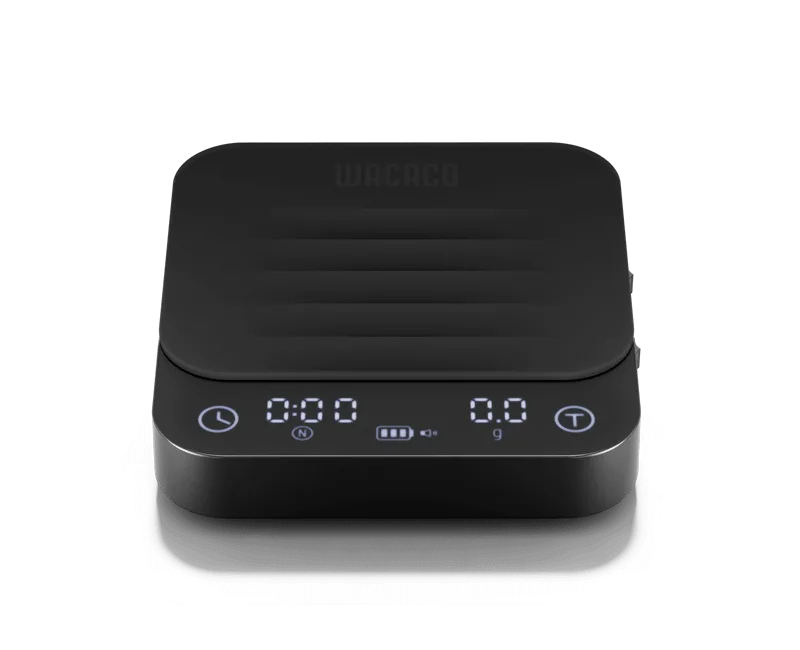
EXAGRAM PRO
-
EXAGRAM PRO: Weighing range up to 2kg You can weigh a dose, a portafilter, or a brewing vessel on the same pocket-size scale.
-
EXAGRAM PRO: Tare, timer, and unit conversion (g/oz/ml) Tare isolates the coffee weight, the timer adds extraction context, and unit conversion helps when a recipe uses a different unit.
-
EXAGRAM PRO: USB rechargeable lithium-ion battery with up to 15 hours of use and 2-hour recharge A rechargeable scale avoids disposable batteries and is practical for travel espresso sessions.
Using the Pour-Over Ratio Program for espresso-adjacent brewing
The Exagram Pro includes an exclusive Pour-Over Ratio Program, which the supplied record describes as guiding pour-over brewing. If you also brew pour-over or experiment with other methods, this mode can help you keep a ratio consistent. For espresso dosing specifically, the core workflow remains tare, weigh, and timer; the ratio program is an additional mode rather than a requirement for weighing a dose.
When channeling makes the scale reading misleading
A precise dose does not guarantee an even extraction. If your shot runs fast or tastes uneven, channeling may be the cause rather than the scale. The Exagram Pro record notes that for messy espresso extractions and channeling, you can elevate the scale with the included box to get closer to the portafilter. That positioning can make it easier to watch the basket and catch drips, but it does not itself prevent channeling. Use the scale to confirm dose and yield, then address distribution and puck preparation separately.
Portable coffee scale habits that keep readings reliable
- Keep the platform clean and dry: Coffee grounds and moisture can interfere with a stable reading. Wipe the platform before a session, especially after a messy extraction.
- Use the protective carrying box: The Exagram Pro ships with a protective carrying box. Storing the scale in it between uses helps protect the weighing mechanism during travel.
- Mute the sound when it matters: The scale has a mute sound switch. In a quiet cafe or shared kitchen, muting button beeps keeps your workflow unobtrusive without changing the weighing function.
- Watch the standby function: The Exagram Pro has a standby function. If the display goes dark mid-session, wake it and re-tare before trusting the next reading.
What the supplied record does not settle
The supplied information does not include a recommended espresso dose, a maximum portafilter size that fits on the platform, or a stated auto-start behavior for the timer. It also does not give a minimum detectable weight for a single drip beyond the 0.1g accuracy and the over-0.3g drop-by-drop count. Treat those as open questions to test with your own equipment rather than assuming a specification. The Exagram Pro's role is to give you a repeatable number; your recipe and basket determine what that number should be.