Quick answer
These eyepieces serve opposite jobs: choose the Explore Scientific 34mm 68° for low-power, wide-field views through a 2-inch focuser, and the TeleVue 11mm Plossl for higher-magnification, on-axis planetary and lunar detail in a 1.25-inch focuser. If you can own only one, match it to your telescope’s focuser size and your most common targets.
Focal length and magnification: low power vs high power
The 34mm focal length of the Explore Scientific produces lower magnification than the 11mm TeleVue in any given telescope, making it better for large star fields, extended nebulae, and finding objects. The 11mm Plossl yields higher magnification, which helps reveal fine lunar and planetary detail when the atmosphere cooperates.
Because magnification depends on your telescope’s focal length, calculate the actual power for your scope before deciding. A short-focus refractor may find the 11mm too powerful on many nights, while a long-focus SCT may find the 34mm less useful for deep-sky objects.
Barrel size and focuser compatibility
The Explore Scientific is a 2-inch eyepiece, so it requires a 2-inch focuser or a 2-inch diagonal. The TeleVue is a 1.25-inch eyepiece and fits the smaller focuser standard found on many beginner and mid-size scopes.
If your telescope only accepts 1.25-inch accessories, the 34mm is not an option without upgrading your focuser or diagonal. Conversely, if you have a 2-inch focuser, you can use the 11mm with a 1.25-inch adapter.
Field of view and observing style
The Explore Scientific’s 68-degree apparent field of view gives a wider true field than the TeleVue Plossl’s narrower apparent field at the same true field stop, though true field depends on telescope focal length. That makes the 34mm more immersive for sweeping the Milky Way or framing the Pleiades.
The TeleVue Plossl’s strength is on-axis sharpness and contrast for small, bright targets. Its narrower field is not a drawback for planets, which occupy a tiny fraction of the view.
Eye relief and comfort
The Explore Scientific advertises generous eye relief, which can be more comfortable for glasses wearers or long observing sessions. The TeleVue Plossl’s eye relief is not specified in the supplied catalog, so if you need a specific eye-relief figure, check the manufacturer’s specifications before buying.
Trade-offs at a glance
- Choose the Explore Scientific 34mm 68° if…: You have a 2-inch focuser and want the widest, most immersive low-power views for nebulae, star clusters, and scanning the sky. Accept that it will not deliver high magnification for planets. Check that your focuser or diagonal accepts 2-inch barrels before ordering.
- Choose the TeleVue 11mm Plossl if…: You have a 1.25-inch focuser and want a dedicated high-power eyepiece for lunar and planetary detail. Accept the narrower apparent field and the need for steady atmospheric conditions. Confirm your telescope’s focal length gives a usable magnification with an 11mm eyepiece.
- If you want one eyepiece to do both jobs: No single eyepiece covers both wide-field and high-power planetary work well. Consider a mid-power eyepiece or a Barlow lens to extend the range of whichever eyepiece you choose. Plan your eyepiece set around your most frequent targets rather than trying to cover everything with one purchase.
Product facts
-
TeleVue 11mm Plossl Eyepiece - 1.25" - EAP-110: TeleVue 11mm Plossl is fully multi-coated using high-index glass and delivers diffraction-limited on-axis performance. That combination supports sharp, high-contrast views of planets and the Moon, where on-axis detail is what you are judging.
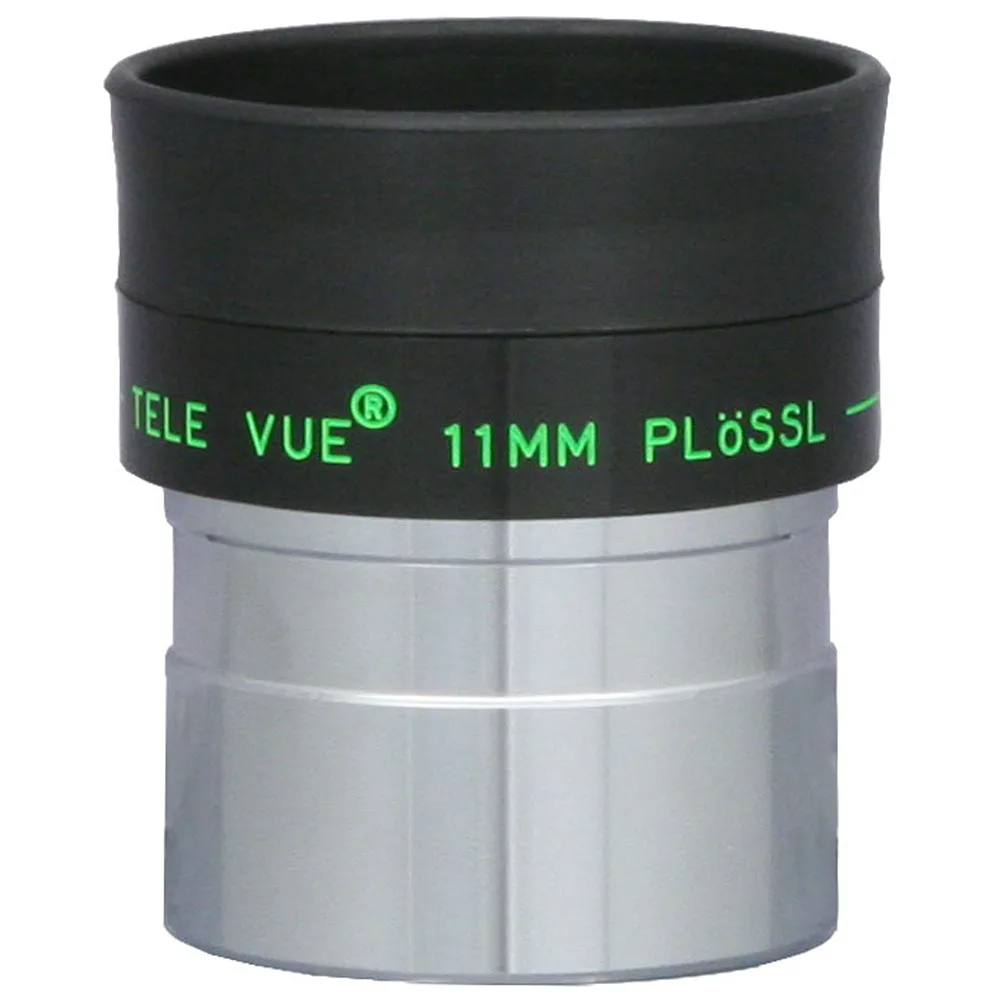
TeleVue 11mm Plossl Eyepiece - 1.25" - EAP-110
-
Explore Scientific 34 mm - 68° Argon-Purged Waterproof 2" Eyepiece - EPWP6834-01: Explore Scientific 34mm 68° is a 2-inch eyepiece with a 68-degree apparent field of view and a close-to-parfocal design. The wide apparent field helps frame large deep-sky objects, while the near-parfocal design means less refocusing when switching among similar eyepieces.
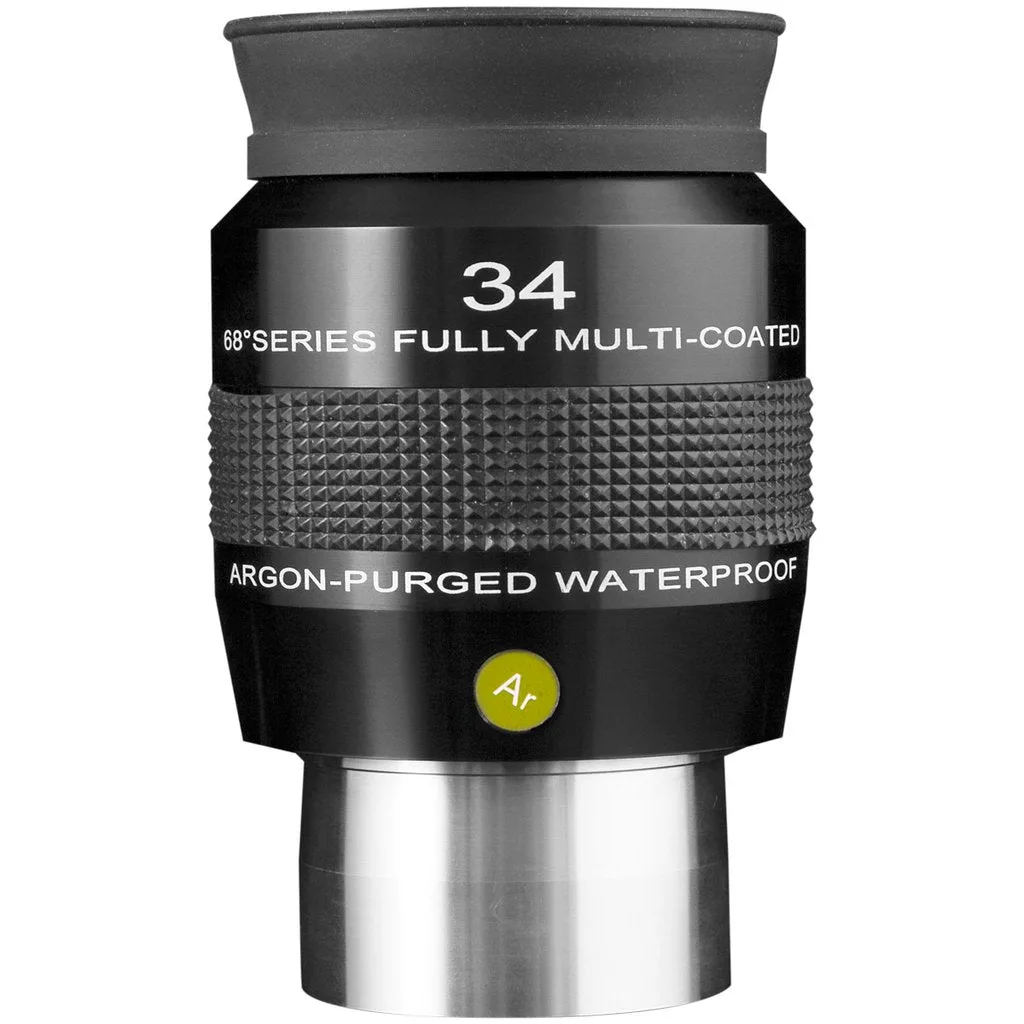
Explore Scientific 34 mm - 68° Argon-Purged Waterproof 2" Eyepiece - EPWP6834-01
Which eyepiece fits you?
Best for
- Observers with a 2-inch focuser who want low-power, wide-field views of deep-sky objects
- Those who prefer generous eye relief and an immersive apparent field
Not for
- Telescopes with only a 1.25-inch focuser
- Observers whose main interest is high-magnification planetary detail