Quick answer
The FirstLight 127mm Mak-Cassegrain with Twilight Nano mount is a solid grab-and-go option for beginners who want a compact scope that handles both solar system and brighter deep-sky targets without a heavy learning curve.
Why the Mak-Cassegrain design matters for beginners
A Maksutov-Cassegrain telescope uses a corrective meniscus lens and a spherical mirror to fold the light path into a short, portable tube. That means you get a 127mm aperture (good light gathering) in a package that is easy to store, carry, and set up—ideal if you do not have a permanent observatory or a lot of storage space.
The trade-off is that this design has a central obstruction (the secondary mirror) and a slower focal ratio than a pure refractor, so it is not the best choice for ultra-wide star fields or critical planetary detail under very high magnification. For a first serious scope, though, it strikes a practical balance between portability and capability.
What the Twilight Nano mount adds (and limits)
The included Twilight Nano is a manual alt-azimuth mount. It is lightweight, intuitive to use—just point and follow—and does not require polar alignment or power. That removes two barriers that trip up many beginners who start with an equatorial mount.
The limitation is that manual tracking at high magnification can be frustrating once you start chasing planets or small deep-sky objects. If you plan to do a lot of high-power lunar or planetary observing, you may eventually want a motorized mount. For casual stargazing and low-to-moderate magnification, the Twilight Nano works well.
Decision rules for the FirstLight 127mm Mak-Cassegrain
- Portability priority: If you need a telescope that fits in a small car trunk or apartment closet and sets up in under five minutes, the compact Mak-Cassegrain tube and lightweight Twilight Nano mount make this a top choice.
- Target variety: This scope works well for lunar craters, Saturn’s rings, Jupiter’s cloud bands, and brighter deep-sky objects like the Orion Nebula and globular clusters. It is not ideal for faint, extended nebulae or very wide Milky Way sweeps. Set realistic expectations: brighter DSOs are fine; faint fuzzies will be disappointing.
- Manual vs. motorized tracking: If you are patient and enjoy learning the sky by nudging the tube manually, the Twilight Nano is a fine start. If you know you want to share the view at star parties or track planets at 200x+, budget for a motorized mount later. The mount is the primary upgrade path; the optical tube itself can serve you for years.
Product facts
-
FirstLight 127mm Mak-Cassegrain Telescope with Twilight Nano Mount - FL-MC1271900TN: The FirstLight 127mm Mak-Cassegrain comes with a red dot viewfinder and one eyepiece, plus the Twilight Nano mount, as a complete observing package. You can start observing the night sky right out of the box without buying additional accessories, which lowers the initial investment and complexity for a beginner.
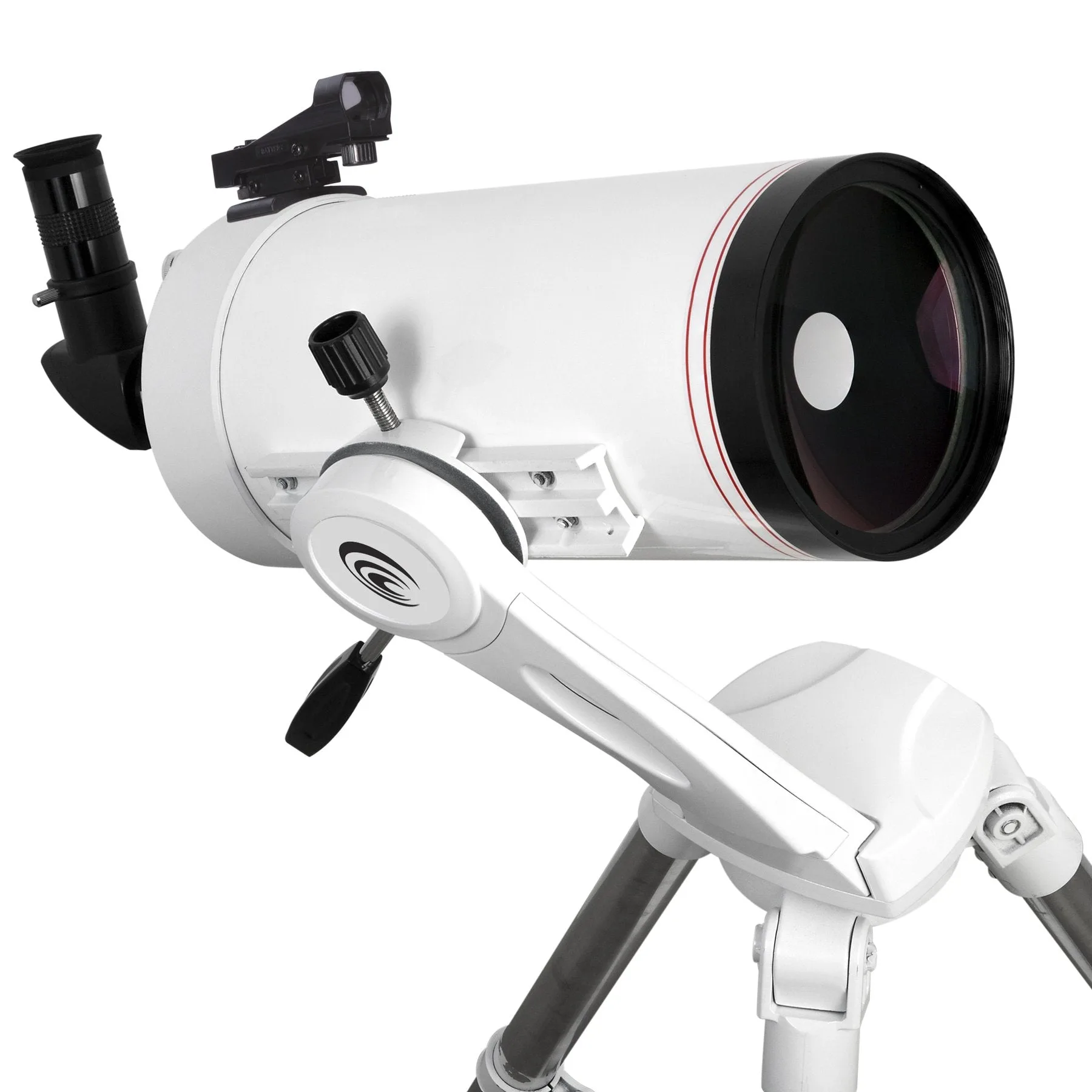
FirstLight 127mm Mak-Cassegrain Telescope with Twilight Nano Mount - FL-MC1271900TN
Who should buy this telescope
Best for
- Beginners who want one complete package that is portable and easy to use without a steep learning curve
- Observers who plan to spend most of their time on the Moon, planets, and brighter deep-sky objects
Not for
- Astromers who want to photograph faint galaxies or nebulae (the manual mount and slow focal ratio limit long-exposure imaging)
- Budget buyers who need a very wide-field scope for sweeping the Milky Way (a short-tube refractor would be better)