Quick answer
Use flat nose pliers as your holding and straightening tool: grip the work across the full length of the smooth jaws, close only until the metal stops moving, and keep bending for round nose pliers. Long 1.5-inch jaws suit beading wire and watch components because the grip spreads over more surface and leaves soft metal unmarked.
Why jaw length changes how you hold the work
A long flat jaw is not simply a bigger version of a short one. The extra contact length lets you hold a wider component or a longer run of wire in a single grip instead of taking several short bites along it. That matters when you are straightening beading wire or steadying a small watch part, because each extra grip is another chance to mark the surface or shift the alignment.
The trade-off is reach versus control. Long jaws are excellent for spreading pressure over soft metal, but they are not the tool for tight loops or fine bending, where a round nose or chain nose profile gives you more precision at the tip.
Where flat jaws stop being the right tool
Flat nose pliers hold and align; they do not form curves. If your task is making a loop, shaping a jump ring, or bending wire around a mandrel, reach for a round nose or looping plier and keep the flat jaws for steadying the work. Similarly, if you need to reach into a recessed watch case, a shorter or bent profile may serve you better than a long straight jaw.
Stainless steel construction helps resist corrosion and keeps the jaw faces stable over time, but it does not make the tool suitable for every metal. Very soft or highly polished surfaces still benefit from a gentle grip and, where possible, a barrier such as tape or a soft jaw cover.
Step-by-step: holding and straightening with flat nose pliers
- Match the jaw to the job: Pick up the flat nose pliers only when the task is holding, aligning, or straightening. If you are forming a loop or curve, set them down and use a round nose or looping plier instead. Checkpoint: if the work needs a curve, this is the wrong tool.
- Position the work across the full jaw: Lay the wire or component so it sits along as much of the 1.5-inch jaw length as possible, not just at the tip. A full-length grip spreads pressure and reduces the chance of a local mark. Common mistake: gripping only at the jaw tips concentrates force and dents soft wire.
- Close until the work stops moving: Squeeze gradually and stop as soon as the wire or component no longer shifts between the jaws. Extra force adds no holding benefit and increases the risk of flattening or marking. Checkpoint: the work should be secure, not crushed.
- Straighten in one continuous pull: With the work held firmly, draw the pliers along the wire in a single smooth motion rather than several short tugs. The long jaw supports the wire as it straightens. Common mistake: repeated short grips create a series of small flats along the wire.
- Release and inspect before the next grip: Open the jaws, check the surface for marks or distortion, and reposition if needed. For watch work, confirm the component is still seated correctly before continuing. Checkpoint: inspect after every grip on polished or plated parts.
- Store with the jaws closed and dry: Wipe the jaws after handling wire or watch parts, close them gently, and keep the pliers dry. Stainless steel resists corrosion but benefits from the same care as any precision hand tool. Common mistake: leaving residue or moisture on the jaw faces between sessions.
Product facts
-
Flat Nose Pliers — Long 1.5 Inch Jaws, Stainless Steel, 140mm, Beading & Watch Work: Flat nose pliers with 1.5-inch (38mm) smooth, flat jaws and stainless steel construction, 140mm overall. The long jaw spreads grip across wider components and wire runs, so soft metal is less likely to be marked during holding or straightening.
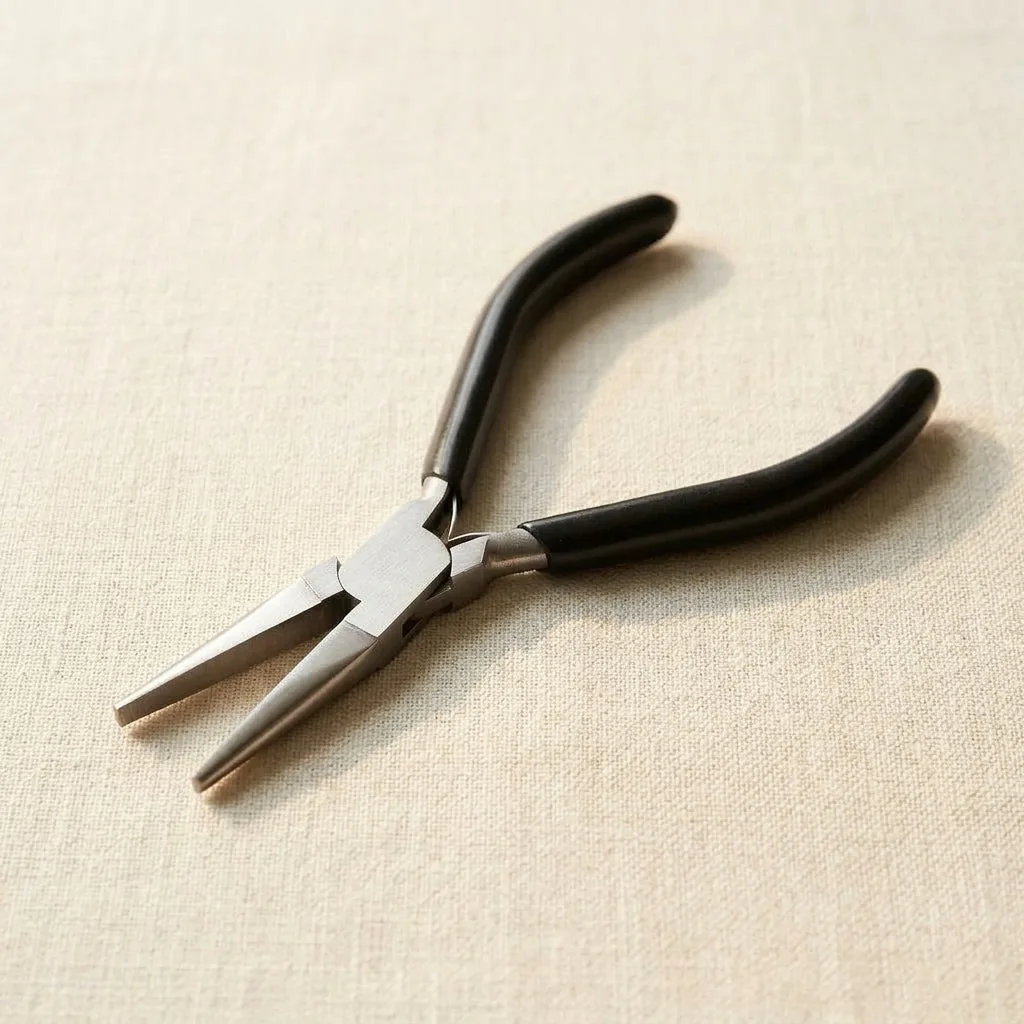
Flat Nose Pliers — Long 1.5 Inch Jaws, Stainless Steel, 140mm, Beading & Watch Work