Quick Answer
Choose the Zendure Flexible Plug and Play Solar Kit if your balcony has weight limits, curved surfaces, or limited space. Stick with standard rigid panels if you have a sturdy, flat, south-facing balcony and want maximum efficiency per square foot.
Why Flexibility Matters for Balcony Solar
Standard rigid solar panels are heavy and require a flat, stable mounting surface. They work great on traditional rooftops or sturdy balcony railings, but many renters or apartment dwellers have balconies with weight restrictions, glass railings, or irregular shapes. The Zendure Flexible Plug and Play Solar Kit is designed for these exact scenarios: its lightweight, bendable panels can conform to curved or uneven surfaces, and they weigh significantly less than rigid alternatives.
The trade-off is that flexible panels typically have a slightly lower conversion efficiency than the best rigid monocrystalline panels. The Zendure kit achieves a 23% conversion rate, which is excellent for flexible technology, but top-tier rigid panels can reach 24-25%. For most balcony setups, the difference in daily energy harvest is small — often just a few percent — and the flexibility advantage often outweighs the efficiency gap.
Installation and Mounting Differences
Rigid panels usually require drilling, brackets, and a solid railing or frame. That can be a deal-breaker for renters who cannot make permanent modifications. The Flexible Plug and Play Solar Kit uses adhesive or simple tie-down methods, making it truly plug-and-play. You can install it in minutes without tools and remove it just as easily when you move.
However, because flexible panels lie flat or conform to a surface, they may not achieve the ideal tilt angle for your latitude. Rigid panels can be angled toward the sun with adjustable brackets, potentially capturing more sunlight during winter months. If your balcony faces south and you can tilt rigid panels, you might get 10-15% more annual output — but if your balcony faces east or west, the angle advantage is minimal.
Durability and Longevity Considerations
Flexible panels are more prone to micro-cracks from repeated bending or heavy foot traffic. They also tend to run slightly hotter than rigid panels because they have less airflow underneath, which can reduce lifespan slightly. Standard rigid panels with aluminum frames and tempered glass are extremely durable and often come with 25-year warranties.
The Zendure Flexible Kit is built with high-quality materials and is designed for stationary balcony use, not portable camping. If you plan to leave it in place for years without moving it, the durability difference is manageable. But if you need to frequently reposition the panel, a rigid panel with a handle or a folding portable panel might be more practical.
Flexible vs Standard: Key Trade-Offs at a Glance
- Efficiency: Flexible: 23% conversion rate. Standard rigid: up to 24-25%. The difference is small for most balcony setups. If every watt counts and you have ideal sun exposure, rigid wins. Otherwise, flexible is fine.
- Installation & Portability: Flexible: adhesive or tie-down, no drilling, easy to remove. Standard: brackets, drilling, permanent mount. Renters or those who move frequently should choose flexible.
- Durability & Lifespan: Flexible: more sensitive to bending and heat; shorter typical lifespan. Standard: glass and aluminum, very durable, long warranty. If you plan to keep the system for 15+ years, rigid is the safer bet.
- Surface Compatibility: Flexible: works on curved, uneven, or weight-restricted surfaces. Standard: requires flat, sturdy mounting. For unusual balcony shapes or glass railings, flexible is the only practical choice.
- Cost: Flexible kits like Zendure's are often priced higher per watt than basic rigid panels, but include the microinverter and cabling. Compare total system cost, not just panel price. All-in-one kits can save on additional components.
Product Facts
-
Flexible Plug and Play Solar Kit: 23% high solar conversion rate with advanced flexible solar panels, generating an average of 3 kWh/day. This means you can still get meaningful daily energy — up to 1000+ kWh per year — even on a balcony that can't support heavy rigid panels.
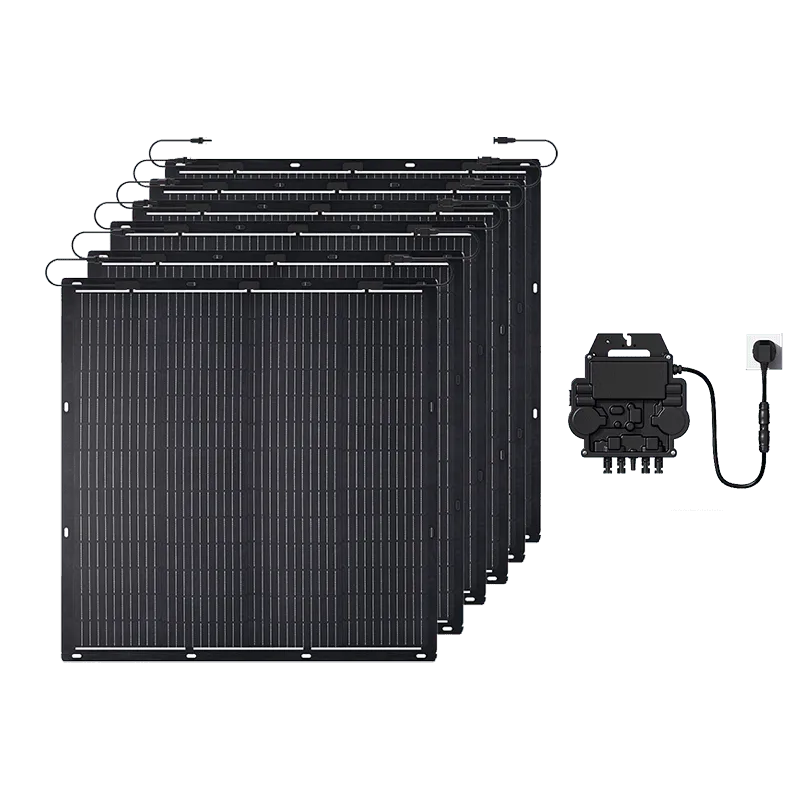
Flexible Plug and Play Solar Kit
Which Should You Choose?
Best For
- Renters who cannot drill into balcony railings
- Balconies with curved surfaces, glass railings, or weight limits
- Users who want a simple, tool-free installation they can reverse later
Not Ideal For
- Those with a sturdy, flat, south-facing balcony who want maximum long-term efficiency
- Users who plan to keep the same solar setup for 20+ years without moving