Why flying geese units go wrong before you sew
Flying geese look simple: one large triangle and two small ones. But small errors in cutting or seam allowance multiply across a quilt. The most common flying geese piecing problems start with fabric preparation, not the sewing machine. If your cut pieces are slightly off, or your seam allowance wanders, the unit will finish too small, too large, or with a wavy edge.
A quilt block piecing workbook can help by giving you a repeatable process. The Let's Stitch Quilt Blocks & Flying Geese A Piecing Workbook is a companion to Natalia Bonner's online classes and includes 18 full-color step-by-step block piecing instructions, plus instructions for making the flying geese and putting it all together. It also lists fabric and cutting requirements, so you can check your cuts before you stitch.
What the workbook provides for flying geese
-
Let's Stitch Quilt Blocks & Flying Geese A Piecing Workbook: Includes instructions to make the flying geese and putting it all together. Gives you a structured reference for the flying geese unit and how it fits into the finished block.
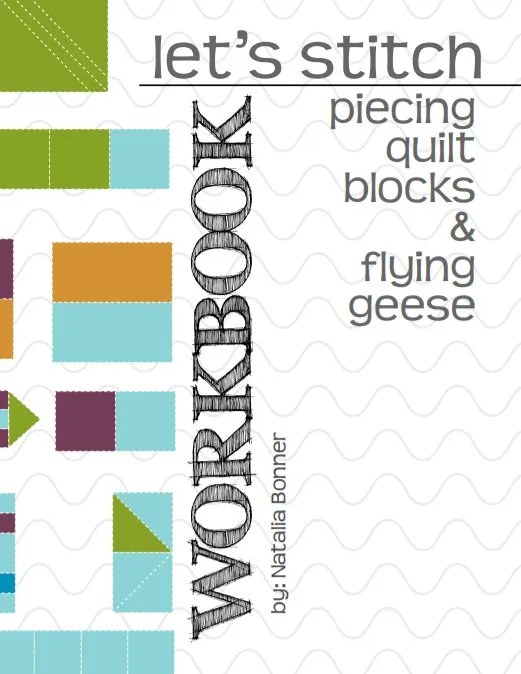
Let's Stitch Quilt Blocks & Flying Geese A Piecing Workbook
-
Let's Stitch Quilt Blocks & Flying Geese A Piecing Workbook: Contains 18 full color step-by-step block piecing instructions. Lets you compare your method against a visual sequence, which can reveal where a unit goes off track.
-
Let's Stitch Quilt Blocks & Flying Geese A Piecing Workbook: Fabric & cutting requirements are also included in the workbook. Helps you verify cutting sizes before sewing, addressing one common source of flying geese errors.
Check these three things before you resew
When a flying geese unit is misshapen, resist the urge to rip seams immediately. Work through these checks in order. Each one isolates a different variable.
- Cutting accuracy: Compare your cut pieces to the fabric and cutting requirements in your pattern or workbook. A difference of even a few threads on the small triangles can distort the finished unit.
- Seam allowance consistency: Sew a test unit with the same seam allowance you plan to use. If the unit finishes consistently small or large, adjust your seam guide rather than trimming every unit to fit.
- Pressing direction: Press seams as directed in your pattern. Inconsistent pressing can make the unit harder to square up and can affect how it joins to neighboring blocks.
Trimming flying geese blocks without losing the point
Trimming is where many quilters try to fix a unit that was already off. Trimming can correct minor size differences, but it cannot restore a lost point or a skewed angle. If the unit is significantly distorted, identify the cause first—cutting or seam allowance—before trimming.
The workbook's step-by-step block piecing instructions show the intended sequence, which helps you see where trimming fits in the process. For flying geese specifically, the workbook includes dedicated instructions for making the unit. Use those as a reference for when and how to square up, rather than inventing your own trimming sequence.
When to use a workbook instead of a free tutorial
A workbook is not the only way to learn flying geese, but it can be the right tool when you want a complete, self-contained reference.
- You want a single source for multiple blocks: The workbook contains 18 block piecing instructions, so you can practice flying geese within a larger project rather than as an isolated drill.
- You prefer visual, step-by-step guidance: Full-color step-by-step instructions can be easier to follow at the sewing machine than a text-only tutorial.
- You want cutting requirements included: Having fabric and cutting requirements in the same workbook reduces the chance of using the wrong size for a unit.
Paper or PDF: choose your format before you start
The Let's Stitch Quilt Blocks & Flying Geese A Piecing Workbook is available in Paper and PDF formats. The workbook measures 8 1/2" x 11". Choose Paper if you like a physical reference beside your machine; choose PDF if you prefer to print only the pages you need or view them on a tablet. Neither format changes the piecing instructions—only how you access them.
Workbook at a glance
- Let's Stitch Quilt Blocks & Flying Geese A Piecing Workbook: Workbook measures 8 1/2"x11". A standard letter size that fits in a binder or prints easily if you choose the PDF.
- Let's Stitch Quilt Blocks & Flying Geese A Piecing Workbook: Companion piecing workbook to Natalia Bonner's popular online classes; Let's Stitch - Quilt Blocks & Let's Stitch - Flying Geese. If you have taken the classes, the workbook reinforces the same methods in a written, step-by-step format.