Myth 1: Any food storage lid fits any food pan
This is the most expensive myth in a commercial kitchen. Lids are made for specific pan lines and sizes, and a lid that looks close enough can fail at the worst moment—during a rush, on a stacked shelf, or in transit. The supplied information for Camwear® Food Pan Lids describes them as designed for prep tables, reach-in refrigerators, and walk-in coolers, but it does not claim universal fit across all pans. That silence matters: absence of a compatibility statement is not proof of compatibility.
The practical rule is to match the lid to the pan line and size you actually own, then confirm the pairing before you buy in quantity. If a listing does not state the pan line or size it fits, treat that as an open question rather than a green light.
Myth 2: A tighter seal is always better
A tight seal sounds ideal until you need to open the lid one-handed during prep or wash it at the end of a shift. The supplied evidence for Camwear® lids emphasizes preserving freshness, flavor, and quality and minimizing cross-contamination—not maximum sealing force. Those are related but different goals. A lid that seals so aggressively that staff avoid using it, or that traps moisture in ways that complicate your workflow, is not automatically the better choice.
Judge a lid by whether it supports your actual tasks: covering pans in the prep table, protecting contents in the walk-in, and stacking without drama. Seal quality matters, but it is one variable among several.
Myth 3: Lid color is only cosmetic
Color can carry operational meaning. The supplied product details note that handled covers are available in a light-blocking black design for additional convenience. That is a functional difference, not a style preference—light-blocking can matter when contents are sensitive to light exposure during storage. Clear options, meanwhile, are described as offering at-a-glance inventory, which helps you see what is inside without lifting the lid.
The honest caveat: the supplied information does not specify which foods require light-blocking covers, so treat that as a decision point to confirm against your own storage conditions rather than a blanket rule.
Myth 4: If it survives the dishwasher, it survives anything
Dishwasher safety and temperature resistance are not the same claim. The supplied specifications for Camwear® Food Pan Lids state a temperature resistance range of -40°F to 210°F (-40°C to 99°C), and the product details state the lids are safe for commercial dishwashers. Both are useful facts, but neither proves the lid is suitable for every oven, holding cabinet, or high-heat process in your kitchen.
Before you put a lid through a new process, check that the process falls within the stated range and that the manufacturer's guidance covers that use. If the supplied information does not address a specific application, that is a gap to resolve—not a license to assume.
What the Camwear® lid evidence actually supports
-
Food Storage Lids: Designed to support HACCP guidelines and ideal for prep tables, reach-in refrigerators, and walk-in coolers. These are the storage contexts the lid is positioned for, which helps you judge fit against your own workflow instead of assuming universal use.
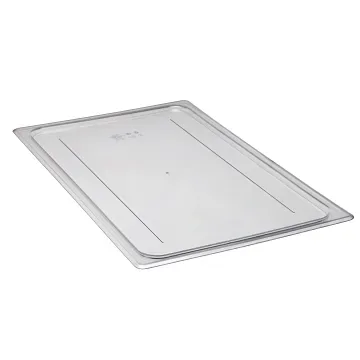
Food Storage Lids
-
Food Storage Lids: Engineered for maintaining freshness, flavor, and quality throughout the prep process, and minimizes cross-contamination. These are the performance claims you can rely on when comparing lids; note that they describe freshness and contamination control, not an airtight seal.
-
Food Storage Lids: Temperature resistance from -40°F to 210°F (-40°C to 99°C), and safe for commercial dishwashers. Gives you concrete limits for storage and washing decisions, so you can stop guessing whether a lid belongs in a given process.
-
Food Storage Lids: Space-saving when stacking food pans, with crystal-clear options for at-a-glance inventory and handled covers available in light-blocking black. These are the real trade-offs between visibility, light protection, and stacking convenience—useful when choosing among lid options.
Food storage lid sealing tips that hold up
- Match the lid to the pan line and size: Confirm the lid is intended for your specific pan before buying multiples. The supplied information does not state universal compatibility, so verify the pairing.
- Choose visibility or light-blocking deliberately: Clear lids support at-a-glance inventory; black handled covers are described as light-blocking. Pick based on what you store and how often you need to see inside.
- Respect the stated temperature range: The supplied range is -40°F to 210°F (-40°C to 99°C). If a process falls outside that, the lid is not confirmed for it.
- Treat dishwasher safety as a cleaning fact, not a heat rating: Commercial dishwasher safety is stated, but it does not extend the lid's temperature range or confirm oven use.
- Stack with the lid's design in mind: Space-saving stacking is a stated benefit, but stack height and stability depend on your pans and lids together—test your configuration rather than assuming.
Where the evidence runs out—and what to do about it
The supplied information does not include a compatibility chart mapping every lid to every pan, nor does it specify which foods need light-blocking covers or confirm oven use beyond the stated temperature range. Those are real gaps, and the right response is to ask before you buy or deploy, not to fill the gap with a guess.
If you are standardizing lids across a kitchen, start with a small trial on the pans you use most, confirm the fit and seal behavior in your own workflow, and only then scale up. That approach costs less than discovering a mismatch during service.