Quick answer
Choose the FT232RL USB-to-TTL adapter when you need a wired, plug-and-play link between a computer and a microcontroller for uploads, debugging, or serial monitoring. Choose the GT-38 433MHz wireless serial module when you need a cable-free link over longer distances, up to 1200m, between two UART devices.
Wired convenience vs wireless reach
The FT232RL adapter is a USB 2.0 to TTL bridge. It handles the USB protocol and presents a serial port to your computer, so you can upload sketches, read debug output, or talk to a device over a short cable. It supports both 5V and 3.3V logic levels, which covers most Arduino and Raspberry Pi projects without extra level shifting.
The GT-38 is a 433MHz wireless serial module built on the SI4438/4463 chip. It replaces the cable with a radio link and is rated for up to 1200m range. It also has an embedded MCU and handles 256-byte packets, so it can pass reasonably sized messages without you writing a radio driver from scratch.
When the FT232RL is the practical choice
For FTDI adapter Arduino upload workflows, the FT232RL is the standard tool. You connect it to the board's UART pins, select the port in your IDE, and upload. The same adapter works for serial debugging and for talking to modules that expect AT commands or plain serial text.
The trade-off is that it is tethered. If your project needs to move around, sit outdoors, or span more than a couple of meters, a USB cable is the wrong link. The FT232RL also does not provide wireless communication on its own; it is a bridge, not a radio.
When the GT-38 earns its place
The GT-38 is for long range serial link module use cases: remote sensors, gate or door monitors, or two boards that need to exchange data across a room, yard, or field. Because it is a 433MHz serial module with a rated 1200m range, it can cover distances that would be impractical with a USB cable.
The trade-off is that a wireless link adds configuration and failure modes. You need a module at each end, matched serial settings, and a plan for interference and antenna placement. The supplied catalog does not list antenna details or exact current draw, so check those before finalizing an enclosure or power budget. The GT-38 also does not replace the FT232RL for uploading code to a board; it is a data link between devices.
Trade-offs at a glance
- Connection type: FT232RL is a wired USB-to-TTL bridge; GT-38 is a wireless 433MHz serial link requiring a module at each end. Pick wired if the devices stay in one place; pick wireless if a cable is impractical.
- Range: GT-38 is rated for up to 1200m; FT232RL is limited by USB cable length. If your link must cross more than a few meters, the wireless module is the realistic option.
- Voltage compatibility: FT232RL supports 3.3V and 5V UART systems; GT-38 is compatible with 3.3V/5V UART systems. Both fit common 3.3V and 5V boards, so voltage is rarely the deciding factor.
- Setup effort: FT232RL is plug-and-play with a USB port; GT-38 needs two modules, matched serial settings, and attention to antenna placement. Budget extra time for the wireless link if you are new to radio modules.
- Primary role: FT232RL is for computer-to-board uploads and debugging; GT-38 is for device-to-device data transfer. They solve different problems and can be used together in one project.
Product facts
-
GT-38 433MHz Wireless Serial Module SI4438/4463 1200m Range: 433MHz wireless serial module with SI4438/4463 chip and 1200m range. It lets two UART devices talk without a cable over distances that would be impractical for wired serial.

GT-38 433MHz Wireless Serial Module SI4438/4463 1200m Range
-
FT232 FT232BL FT232RL USB 2.0 to TTL Adapter Module 5V 3.3V Debugger: USB 2.0 to TTL adapter supporting 5V and 3.3V logic levels. It connects directly to common Arduino and Raspberry Pi UART pins without extra level shifting for uploads and debugging.
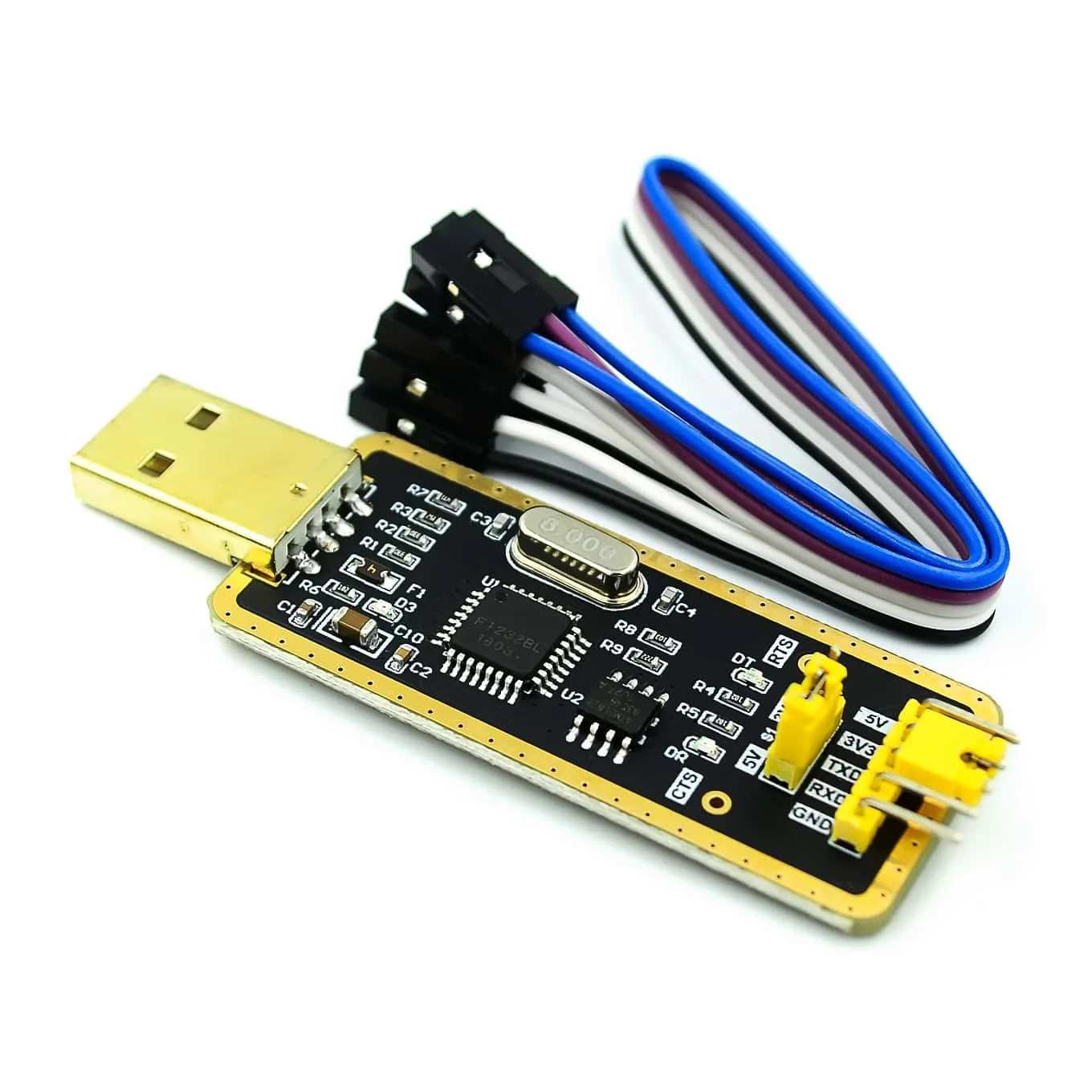
FT232 FT232BL FT232RL USB 2.0 to TTL Adapter Module 5V 3.3V Debugger
Which serial link fits your project?
Best for
- Uploading code or reading serial debug output from an Arduino or Raspberry Pi over USB
- Projects that stay on a bench or within cable reach and need a simple, plug-and-play serial connection
- Sending data between two microcontrollers across a room, yard, or field where a cable is impractical
Not for
- Wireless links or long-distance communication, which the FT232RL cannot provide
- Uploading code to a board, which the GT-38 is not designed to do
- Projects that need guaranteed antenna performance or current specifications not listed in the catalog