A Macro Lens Built for Medium Format
If you shoot with a Fujifilm GFX camera and need a lens that can capture fine detail up close while also serving as a sharp portrait optic, the Fujifilm GF 120mm f/4 Macro R LM OIS WR is a natural contender. It’s the only dedicated macro lens in Fujifilm’s G-mount lineup, and it brings features that matter for close-up work: a 1:2 maximum magnification, a 45 cm minimum focusing distance, and optical image stabilization to steady handheld shots.
This guide walks through what the lens offers, where it excels, and the trade-offs to consider before adding it to your kit.
Key Specs at a Glance
-
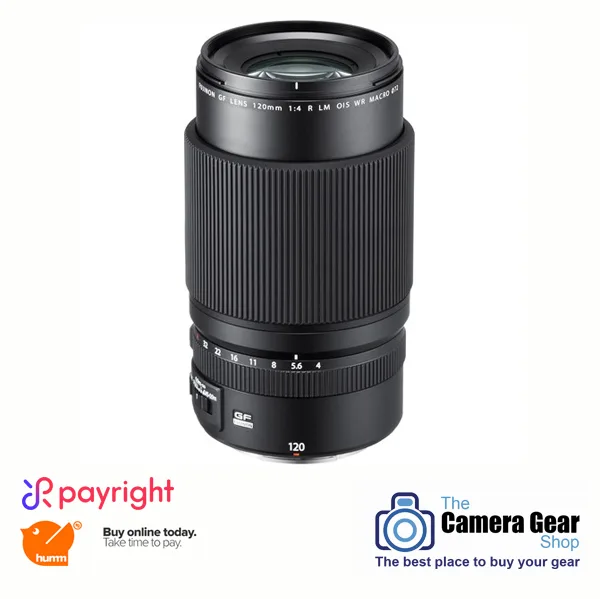
Fujifilm GF 120mm f/4 Macro R LM OIS WR Lens: Offering a 95mm equivalent focal length, along with a maximum magnification of 1:2 and a 1.5′ minimum focusing distance. The 95mm equivalent gives a natural perspective for close-ups and portraits, while 1:2 magnification means you can fill the frame with subjects about the size of a credit card — not true 1:1, but enough for most floral, product, and detail work.
Fujifilm GF 120mm f/4 Macro R LM OIS WR Lens
-
Fujifilm GF 120mm f/4 Macro R LM OIS WR Lens: Its optical design incorporates three extra-low dispersion elements to reduce color fringing and chromatic aberrations. Chromatic aberration can be especially visible in high-contrast macro shots. Three ED elements help keep edges clean and colors accurate, which is critical when you’re enlarging fine details.
-
Fujifilm GF 120mm f/4 Macro R LM OIS WR Lens: A linear AF motor provides fast and quiet focusing performance. Macro focusing often requires small adjustments. A linear motor lets the lens shift focus smoothly and quietly, which is helpful for both still subjects and the occasional moving insect or pet portrait.
Close-Up Performance and Stabilization
The 1:2 magnification ratio means you can get reasonably close to your subject without needing extension tubes or a dedicated macro rail. The 45 cm minimum focus distance (measured from the sensor plane) gives you working room to light the subject without casting shadows. For many flower, jewelry, or food photographers, that’s a practical sweet spot.
Built-in optical image stabilization (OIS) is a rare feature on macro lenses. It helps steady the viewfinder image and allows slightly slower shutter speeds when shooting handheld — useful when you’re working without a tripod in a garden or studio. Keep in mind that at 1:2 magnification, camera shake is magnified too, so a tripod is still your best friend for critical sharpness.
Portrait Versatility Beyond Macro
The 95mm equivalent focal length and f/4 maximum aperture make this lens a capable short telephoto for portraits. The optical design is optimized to render smooth out-of-focus areas, which helps isolate a subject from the background. While f/4 doesn’t give the ultra-shallow depth of field of an f/1.4 lens, on medium format it still produces pleasing background blur at typical portrait distances.
If you want one lens that can handle both close-up product shots and head-and-shoulders portraits without swapping glass, the GF 120mm f/4 covers both roles well.
Trade-Offs to Weigh
- 1:2 vs 1:1 magnification: If you need true 1:1 macro for extreme close-ups of tiny subjects like stamps or insect eyes, this lens won’t fill the frame at that scale. You’d need extension tubes or a dedicated 1:1 macro lens. For most flower, food, and detail work, 1:2 is sufficient.
- Aperture and low light: f/4 is a stop slower than typical f/2.8 macro lenses. That means less light for the viewfinder and autofocus in dim conditions. The OIS helps with handheld shots, but for moving subjects or very low light, a faster lens may be preferable.
- Weight and size: This is a substantial lens built for the GFX system. It balances well on larger GFX bodies but adds noticeable heft to your bag. If portability is your top priority, a smaller prime might be a better walkaround choice.
Build and Weather Sealing
The lens features dust- and weather-sealed construction and a fluorine-coated front element that repels water and smudges. That makes it a solid choice for outdoor macro work in damp or dusty environments — think dewy morning flowers or coastal detail shots. The supplied lens hood provides additional protection and helps reduce flare.
What’s in the Box
The Fujifilm GF 120mm f/4 Macro ships with a lens hood, front and rear lens caps, and a lens pouch. No tripod collar is included, so if you plan to mount the lens on a tripod for critical macro work, you may need a separate Arca-Swiss plate or a lens collar adapter.