Quick answer
Choose the Fujifilm GF 63mm f2.8 R WR as your first GFX lens if you want a compact, weather-resistant standard prime that behaves like a 50mm on full frame. Choose the GF 45mm instead if your work leans toward wider environmental portraits, interiors, or landscapes where a tighter view feels cramped.
Why the 50mm-equivalent view makes sense as a first lens
The GF 63mm f2.8 R WR gives an angle of view equivalent to 50mm in 35mm format. That is the classic normal focal length: wide enough for a two-person portrait or a street scene, tight enough to isolate a subject without distortion. For a first medium format lens, it keeps your framing familiar while letting you explore the larger sensor's depth and detail.
The lens is also physically compact for the GF system, which matters if you are moving from a full-frame kit and want the GFX body to feel carryable. Its front-group extension focus method is designed to subdue aberration variations as you focus, so close and far subjects should hold consistent image quality.
The GF 63mm vs 45mm decision is about working distance, not sharpness
Both lenses are standard-range primes for GF mount, but they pull you into different habits. The 63mm's 50mm-equivalent view asks you to step back slightly for groups and step closer for detail. The 45mm's wider view lets you include more context indoors and in landscapes, but it can make faces at the edge of the frame look stretched if you fill the frame.
If you shoot mostly portraits, details, and everyday scenes, the 63mm is the more natural first lens. If you shoot architecture, interiors, or wide landscapes and plan to add a longer lens later, start with the 45mm and treat the 63mm as a second purchase.
What the GF 63mm does not tell you
The catalog does not list a maximum magnification ratio, minimum focus distance, or filter thread for this lens. If macro-style close-ups or filter compatibility are essential to your first purchase, check those specifications directly before ordering rather than assuming them. The absence of those figures in the summary is a limitation of the listing, not a sign the lens lacks them.
Decision rules for your first GFX lens
- If you want one lens for portraits and daily carry: Pick the GF 63mm f2.8 R WR. Its 50mm-equivalent view and compact build make it the least disruptive first lens for photographers coming from full-frame 50mm primes. Budget for a second, wider lens only when you actually hit the 63mm's framing limit.
- If your work is mostly interiors, architecture, or wide landscapes: Start with the GF 45mm instead. The wider view saves you from backing into walls and keeps more of a scene in frame without stitching. The 63mm can follow later as a tighter portrait and detail lens.
- If you need a one-lens travel kit: The 63mm is the safer single-lens choice because it covers portraits, street scenes, and details without the edge distortion that a wider lens can introduce at close range. Pair it with a small tripod or support rather than a second lens if weight is the priority.
- If weather resistance is non-negotiable: The WR designation in the GF 63mm f2.8 R WR name indicates weather-resistant construction, which suits outdoor work in damp or dusty conditions when paired with a sealed GFX body. Confirm that your specific GFX body also carries weather sealing before relying on it in rain.
Product facts
-
Fujifilm GF 63mm f2.8 R WR Lens: The GF 63mm f2.8 R WR is built from 8 groups and 10 elements, including one extra-low dispersion element. The ED element is there to control color fringing, which helps keep high-contrast edges clean on a high-resolution medium format sensor.
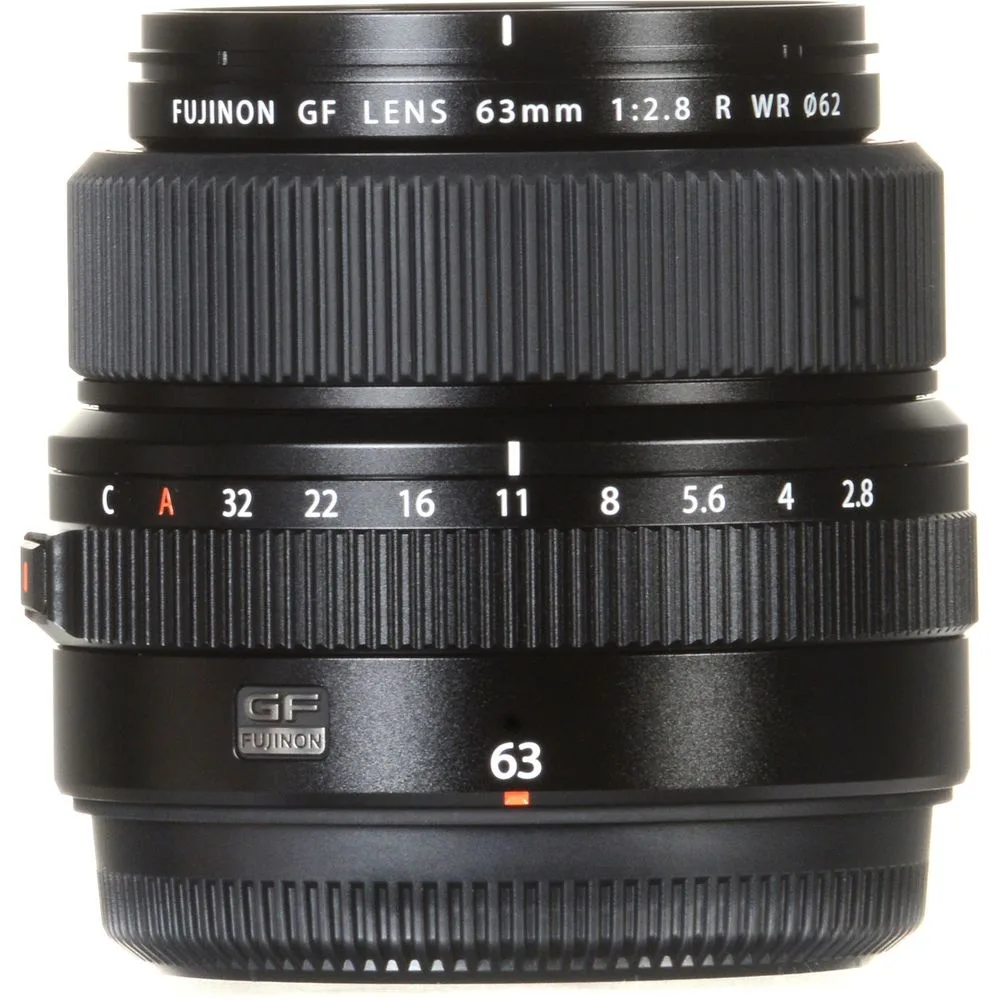
Fujifilm GF 63mm f2.8 R WR Lens
-
Fujifilm GF 63mm f2.8 R WR Lens: It is designed for the Fuji GFX 50S and offers a 50mm-equivalent angle of view in 35mm terms. If you are comfortable with a 50mm prime on full frame, you can move to GFX without relearning your framing.
Who should buy it
Best for
- Photographers moving from a full-frame 50mm prime who want a familiar first GFX lens
- Portrait and everyday-carry shooters who value a compact standard prime
- Outdoor users who want weather resistance in their first GF mount lens
Not for
- Interior, architecture, or wide-landscape shooters who need a wider field of view from day one
- Buyers who need confirmed macro magnification or filter-thread specs before ordering
- Photographers who already know they prefer a 35mm-equivalent field of view