Why this lens suits the street
The Fujifilm XF 23mm F/1.4 R gives you a 35mm-equivalent field of view, which is wide enough to include context but tight enough to keep your subject prominent. That makes it a natural fit for street photography where you want to show people in their environment without stepping back into traffic.
Its f/1.4 maximum aperture is the other half of the story. It lets you keep shooting handheld as light fades, and it gives you control over depth of field when you want to isolate a subject from a busy background. The lens also has engraved focus and depth-of-field scales on the barrel, which are useful for manual-focus techniques on the street.
The specs that shape your settings
-
Fujifilm XF 23mm F/1.4 R Lens: 35mm (35mm Equivalent) focal length This is the classic documentary angle of view—wide enough for scenes, tight enough for portraits without crowding.
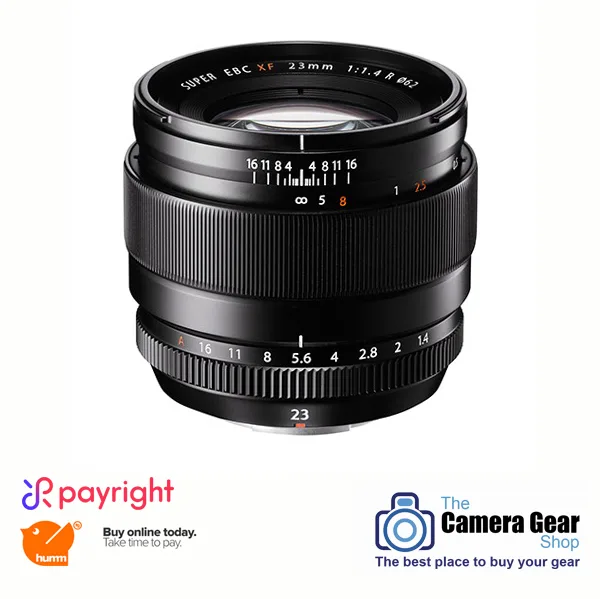
Fujifilm XF 23mm F/1.4 R Lens
-
Fujifilm XF 23mm F/1.4 R Lens: Aperture Range: f/1.4 to f/16 You can open up for low light and shallow depth of field, or stop down for greater depth when shooting architecture or group scenes.
-
Fujifilm XF 23mm F/1.4 R Lens: High-Torque DC Coreless AF Motor The autofocus is designed for high-speed performance and quiet, smooth operation, which helps when you don't want to draw attention.
-
Fujifilm XF 23mm F/1.4 R Lens: 7-Blade Rounded Diaphragm The rounded blades help produce pleasing out-of-focus highlights when you shoot wide open.
Street settings to start with
There is no single correct setting, but these starting points work well for typical street conditions. Adjust as the light changes.
- Aperture priority at f/5.6 to f/8: For general street scenes in good light, stopping down gives you a comfortable depth of field so subjects at different distances stay sharp. Use the aperture ring to set it directly.
- Auto ISO with a minimum shutter speed: Set a minimum shutter speed that suits your handholding—many street shooters use 1/250 sec or faster to freeze walking subjects. Let the camera choose ISO.
- Single-point autofocus: Place the focus point over your subject and half-press to focus. The high-torque DC motor is quick enough for most street opportunities.
- Face/eye detection when appropriate: If your camera supports it, face detection can help when photographing people, but single-point gives you more control over what is sharp in a busy scene.
Low-light technique with f/1.4
When the light drops, the f/1.4 aperture becomes your main tool. You can keep shutter speeds handholdable without pushing ISO as high as you would with a slower lens. But shooting wide open demands care: depth of field becomes very shallow, so focus accuracy matters more than ever.
For static subjects in low light, consider focusing manually using the distance scale on the barrel. The engraved scales help you set a hyperfocal distance or pre-focus on a spot where you expect action. This technique lets you shoot without waiting for autofocus, which can be useful in candid situations.
The lens's HT-EBC coating is designed to reduce flare and ghosting, which helps maintain contrast when bright light sources are in or near the frame. That said, no coating eliminates flare entirely—if you see veiling glare, adjust your angle slightly.
Using depth of field intentionally
The 23mm focal length already gives you relatively deep depth of field compared to a telephoto, but at f/1.4 you can still isolate subjects. Here is how to think about it.
- Wide open for separation: At f/1.4, focus on the subject's eye or the part of the scene you want sharp. Backgrounds will blur smoothly, especially with the 7-blade rounded diaphragm.
- Stop down for context: At f/5.6 or f/8, more of the scene is in focus, which suits environmental portraits and street scenes where you want to show the setting.
- Use the depth-of-field scale: The barrel has engraved depth-of-field scales. They let you estimate the zone of sharpness at a given aperture and focus distance, which is handy for zone focusing.
Focusing on the street
The internal focusing mechanism keeps the lens length constant, which means the front element doesn't extend as you focus. That makes the lens less conspicuous and keeps the balance consistent on the camera.
For fast-moving street scenes, prefocus on a spot and wait for a subject to enter the zone. With the depth-of-field scales, you can set a focus distance and aperture that gives you a usable sharp zone—for example, focusing at a few meters and stopping down to f/8 gives you a broad zone from foreground to background. Then you just shoot when the moment happens.
What's in the box and handling notes
- Fujifilm XF 23mm F/1.4 R Lens: In the box: lens hood, front lens cap, rear lens cap, lens cloth The included hood helps control flare and protects the front element; the cloth is useful for cleaning.
- Fujifilm XF 23mm F/1.4 R Lens: One aspherical lens element It helps minimize chromatic aberrations and contributes to sharpness, which you'll appreciate when shooting at wider apertures.
A note on compatibility
The Fujifilm XF 23mm F/1.4 R is designed for Fujifilm X-mount cameras. The supplied information does not list specific camera models, so check that your camera has an X-mount before buying. The lens does not have image stabilization, so rely on your camera's IBIS if it has it, or use faster shutter speeds when shooting handheld in low light.