Quick answer
If you demand maximum sharpness, constant F2.8 brightness, and pro-grade build, choose the FUJINON XF 16-55mm F2.8 R LM WR II. If you prioritize light weight, lower cost, and image stabilization, the XF 18-55mm remains a smart, budget-friendly standard zoom.
The flagship reborn: what the II brings
Fujifilm’s flagship F2.8 standard zoom is reborn nine years after the original. The FUJINON XF 16-55mm F2.8 R LM WR II lens features groundbreaking design updates that surpass mere evolutionary progress, plus broader video capabilities to help it excel in a wider range of scenarios.
The original XF 16-55mm was already a workhorse for event and wedding photographers. The II keeps that constant-aperture advantage while improving compactness and video performance, making it a more versatile everyday lens than its predecessor.
The 18-55mm: the lightweight alternative
The XF 18-55mm F2.8-4 is often bundled as a kit lens, but it’s no throwaway. It covers a slightly longer telephoto reach, includes optical image stabilization, and weighs significantly less—ideal for travel, street, and casual shooting where every gram counts.
Its variable aperture means less light at the long end, but for many photographers the trade-off is acceptable when they get a smaller, more affordable package.
Key trade-offs to consider
Aperture: the 16-55mm holds F2.8 across the whole range, which helps in low light and gives consistent exposure. The 18-55mm is F2.8 at wide angle but narrows to F4 at 55mm.
Size and weight: the 16-55mm II is compact for its class, but the 18-55mm is still lighter and more pocketable. If you hike or travel light, that matters.
Stabilization: the 18-55mm has optical image stabilization; the 16-55mm II does not. If you shoot handheld video or in dim conditions without a tripod, the 18-55mm may be more forgiving.
Which zoom wins for you?
- Constant F2.8 aperture: The 16-55mm II keeps F2.8 from 16mm to 55mm, letting you shoot in low light with faster shutter speeds and consistent depth of field. The 18-55mm drops to F4 at the telephoto end. If you shoot events, weddings, or indoor sports, the constant aperture is worth the extra cost.
- Portability and range: The 18-55mm is lighter and extends to 55mm, but both cover the same telephoto endpoint. The 16-55mm starts wider at 16mm, which is useful for landscapes and tight interiors. If you want a wider field of view, the 16-55mm II is the better choice.
- Video and stabilization: The 16-55mm II adds broader video capabilities, but lacks optical stabilization. The 18-55mm has built-in stabilization, which helps handheld video and low-light stills. For run-and-gun video without a gimbal, the 18-55mm may be more practical.
Product facts at a glance
-
FUJINON XF 16-55mm F2.8 R LM WR II: The FUJINON XF 16-55mm F2.8 R LM WR II is a compact and lightweight zoom that fits in the palm of your hand, yet delivers flagship-level performance. You get pro-grade image quality in a package that’s easier to carry than you’d expect from an F2.8 standard zoom.
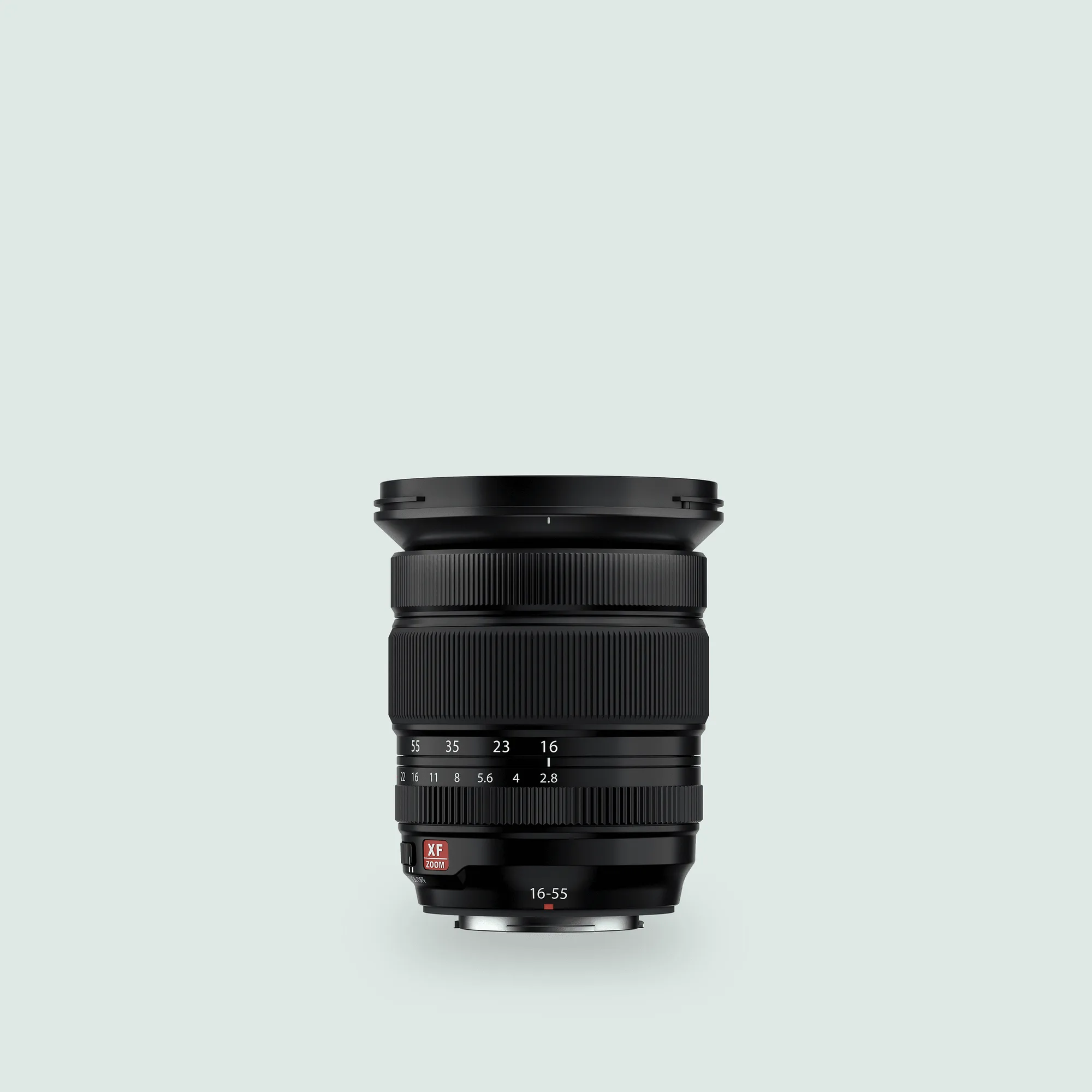
FUJINON XF 16-55mm F2.8 R LM WR II
Which lens fits you?
Best for
- Photographers who need a rugged, constant-F2.8 standard zoom for professional work
- Hybrid shooters who want improved video features and don't rely on in-lens stabilization
- Those who value the wider 16mm start for landscapes and architecture
Not for
- Budget-conscious buyers who prefer the lighter, more affordable 18-55mm kit lens
- Handheld video shooters who need optical stabilization without a gimbal