Quick answer
Start with the silhouette and the fabric, not the size number. If you want structure and a defined waist, look at gowns built on whalebone bustiers like Infinity or Satellite. If you want movement and a softer line, a crepe-based piece such as Kiss or the two-piece Navy Skirt and Sand pants route will serve you better. Order made-to-order pieces early — most need six to eight weeks before any alterations.
The same handful of questions come up in almost every bridal appointment: will it fit, how heavy is it, can I move, and how long does it take. This FAQ answers those directly, using what we actually know about the Galaxy, Cosmic and Violet family and the Rime Arodaky pieces that share their construction.
Nothing here is a substitute for trying a gown on. But if you are shortlisting before a fitting, these answers will help you ask better questions — and avoid ordering the wrong silhouette for your venue, your body or your timeline.
Fit and sizing questions
Bridal sizing rarely matches ready-to-wear sizing, so ignore the number on the label and focus on measurements. The most useful reference we have is the model data on the Navy Skirt: a size 36 worn on a model measuring 88 cm bust, 68 cm waist, 97 cm hips and 1.75 m tall. Use that as a calibration point, then compare your own bust, waist and hip measurements rather than your usual dress size.
Structured gowns are less forgiving than soft ones. A strapless mermaid with whalebones running down the bodice, like Infinity, holds its shape because the internal structure does the work — which means the fit has to be close through the ribcage, not just the waist. If you are between sizes on a structured gown, the honest answer is that alterations are almost always part of the plan.
- Measure bust, waist and hips over the undergarments you plan to wear.
- Ask whether the sample you try on is the same construction as the production piece.
- Budget for alterations on any structured or strapless gown, regardless of size.
Fabric and construction questions
The fabric decides how a gown photographs and how it feels after four hours. Calais-Caudry lace, used on Infinity and Satellite, is a fine, dense lace that reads as detail rather than texture from a distance — it catches light without looking busy. Crepe cady, used on Kiss, is smoother and heavier in the hand, which is why it drapes close to the body instead of standing away from it.
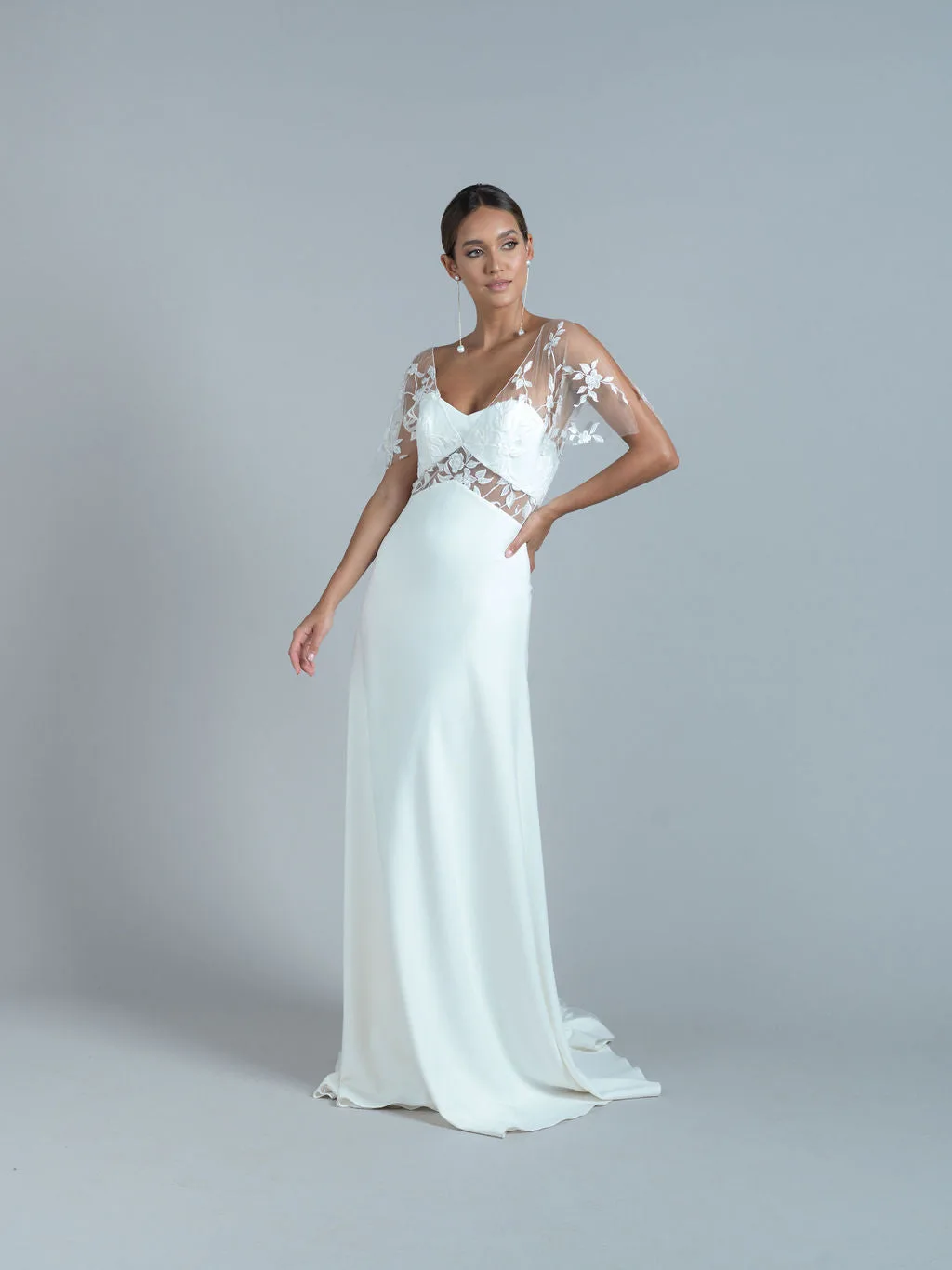
Handwork also changes what you receive. Kiss is made with Italian embroidered tulle and, because of the manual work, each dress differs slightly in where the flowers sit. That is not a defect — it is the nature of a hand-finished piece. If you need absolute symmetry and predictability, say so early so the atelier can talk you through what is realistic.
- Lace reads as detail in photos; crepe reads as line and silhouette.
- Ask how much of the gown is hand-finished so you know what variation to expect.
- Request fabric swatches if you are matching shoes, veils or a second look.
Styling and two-piece questions
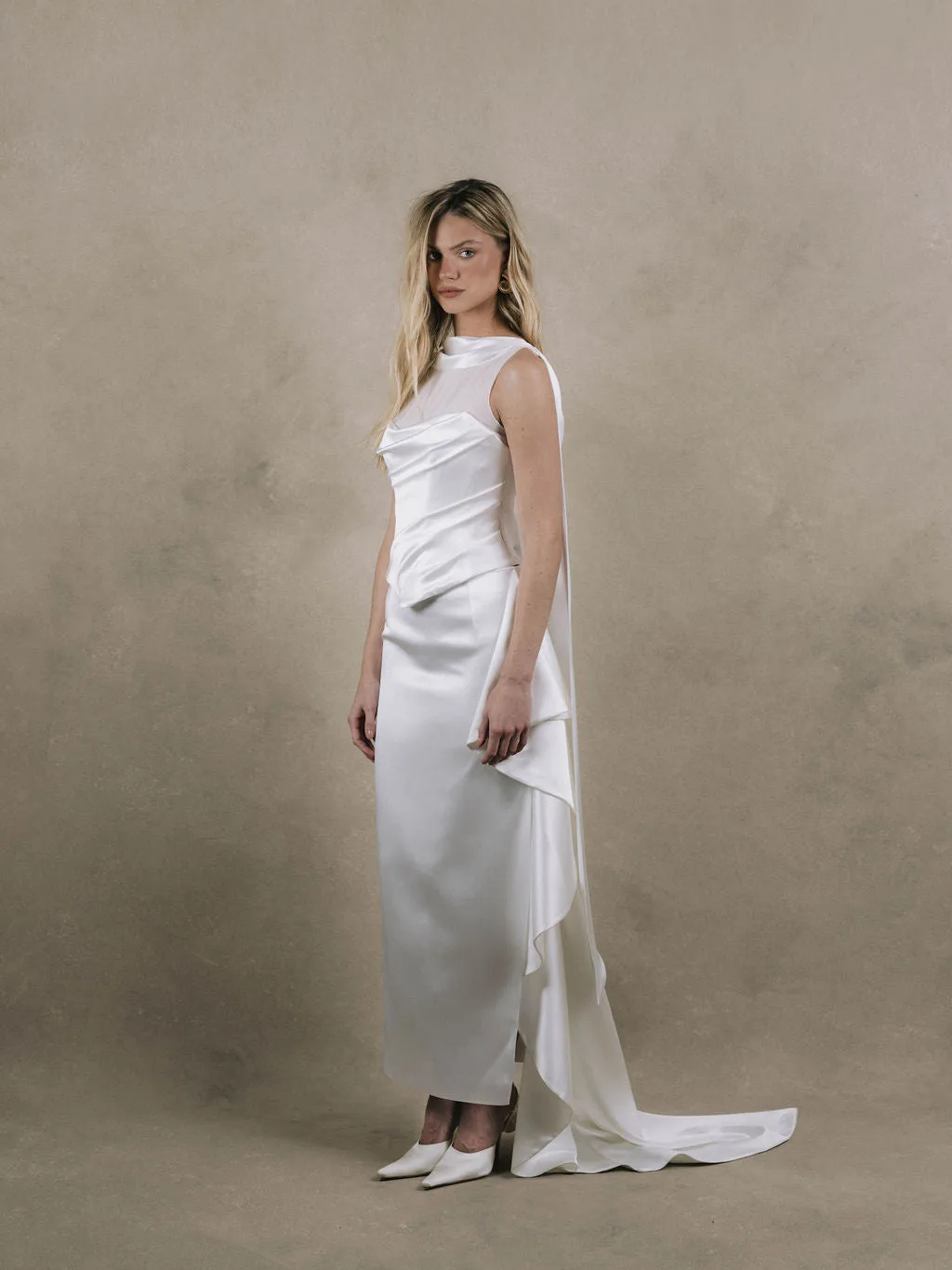
A two-piece look is often the practical answer for a long day. The Navy Skirt is a straight ankle-length skirt in heavy satin with a back zip and a structured ruffle that cascades to the floor, and it is designed to be worn with the Row top for a complete look. Sand pants take the same idea further: high-waisted, straight-leg, with a couture crepe belt finished in pleated chiffon and a lace trim along the pleated edge.
Both routes let you change the top half for the reception without changing the whole outfit. The tradeoff is that separates have their own fit logic — the waistband and belt sit on your natural waist, so the rise matters as much as the size.
- Pair the Navy Skirt with the Row top if you want one coordinated silhouette.
- Sand pants are listed as a standard fit; check the rise against your natural waist.
- Separates make sense if you plan to change looks between ceremony and reception.
Timing, ordering and care questions
Made-to-order means the clock starts when you order, not when you enquire. The Navy Skirt is listed with a production time of six to eight weeks, and that is production only — it does not include shipping or alterations. Work backwards from your date and add a buffer for the final fitting, because a gown that arrives two weeks before the wedding leaves no room to correct anything.
Care depends on the fabric and the handwork. Anything with embroidered lace or a structured ruffle should be handled by a specialist cleaner rather than a standard dry cleaner, and it should be stored flat or on a padded hanger away from direct light. If you are unsure, ask before you clean, not after.
- Count production time, shipping and alterations as three separate blocks.
- Book your first fitting as soon as the gown arrives, not the week before.
- Ask the atelier for care instructions specific to your fabric before cleaning.
What brides get wrong most often
The most common mistake is choosing a gown for the photo rather than the day. A heavily structured strapless gown looks extraordinary standing still and feels very different after an hour of standing, greeting and dancing. The second most common mistake is ordering the size you wear in street clothes — bridal sizing is its own system, and the model measurements on the Navy Skirt listing are a better reference than your usual label.
The third is leaving alterations out of the budget. Almost every bridal gown is adjusted, and structured gowns usually need more adjustment, not less. Plan for it financially and in your calendar, and the process stays calm.
- Choose for how you will spend the day, not just for the first photograph.
- Use garment measurements, not street size, when selecting.
- Set aside both money and time for alterations before you order.
Quick answers to the three questions that decide everything
Which silhouette should I pick?
Structured and strapless if you want a defined waist and a held shape — Infinity and Satellite both build on whalebone bustiers. Softer and closer to the body if you want movement — Kiss in crepe cady, or separates like the Navy Skirt and Sand pants. Decide structure versus movement first; everything else follows.
How far ahead do I need to order?
Made-to-order pieces such as the Navy Skirt carry a six-to-eight-week production time before shipping and alterations. Add shipping, a first fitting and any adjustment work on top of that. Work backwards from your date and add a buffer for the final fitting.
Will I need alterations?
Assume yes, especially on structured or strapless gowns where the bodice has to sit close through the ribcage. Use the model measurements as a reference and get measured in the undergarments you plan to wear. Budget for alterations in both money and calendar time before you commit.
What the catalog actually tells you
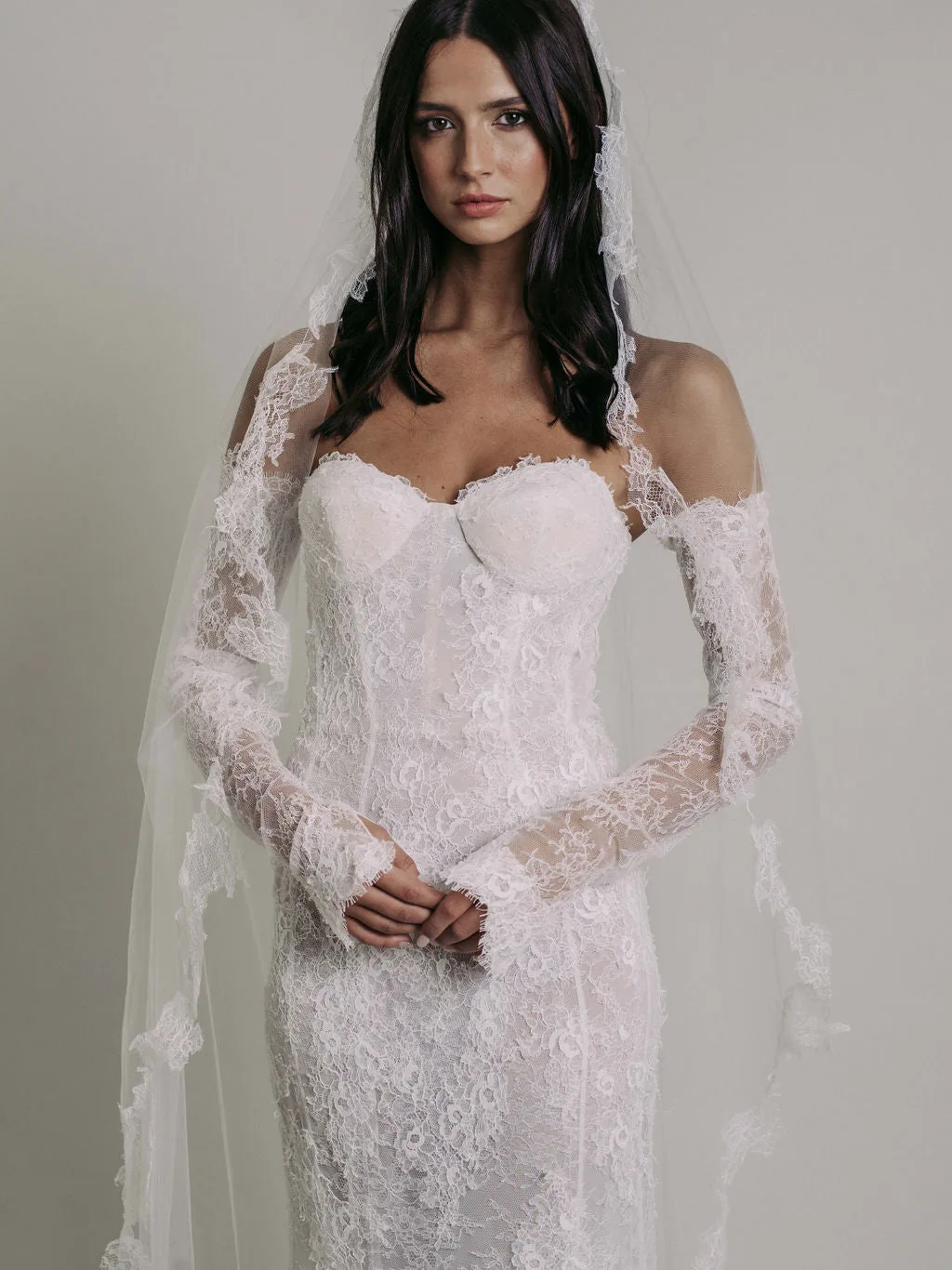
- Infinity: A strapless mermaid gown with structured whalebones extending down the bodice, embroidered flowers on a delicate tulle base, made with Calais-Caudry lace and handcrafted in the Paris atelier. The internal structure is what holds the silhouette, so fit through the ribcage matters more than the waist measurement alone.
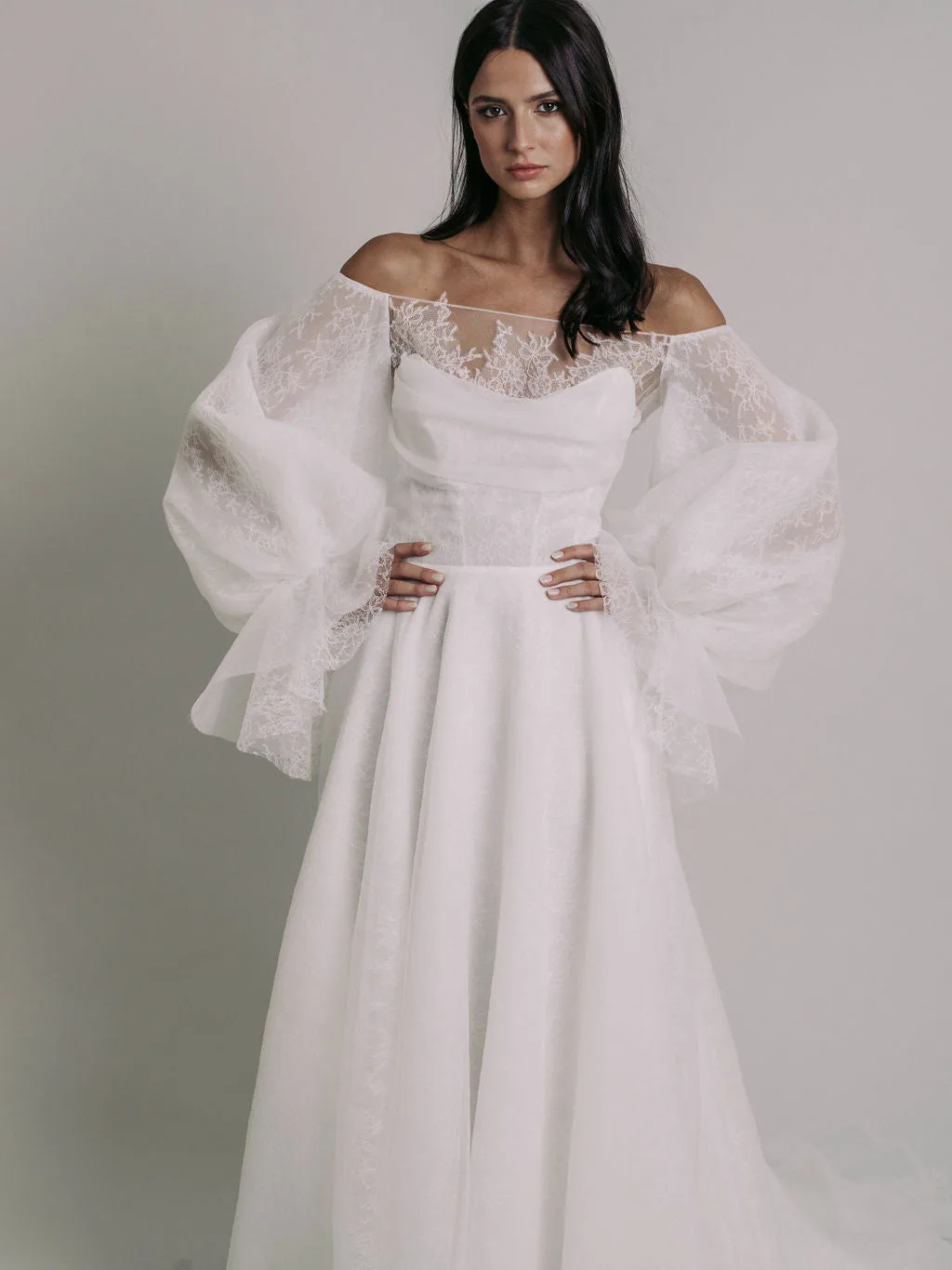
- Satellite: A bustier built from multi-layered tulle and Chantilly Calais-Caudry lace with whalebones extending to the waist, an asymmetrical textured organza drape at the bust, and over a week of embroidery work. The layered bustier and organza drape add visual volume at the bust, which changes how the gown balances on different frames.
- Navy Skirt: A straight ankle-length heavy satin skirt with a back zip and a structured ruffle cascading to the floor, made to order with a six-to-eight-week production time, shown on a size 36 model measuring 88 cm bust, 68 cm waist, 97 cm hips and 1.75 m. The model measurements give you a real calibration point for sizing, and the production window tells you exactly how far ahead to order.
- Kiss: A dress in crepe cady with transparency effects in Italian embroidered tulle, where the manual work means each piece differs slightly in the placement of the flowers. If you want a soft, body-skimming line rather than a structured one, this is the fabric direction to look at — and you should expect small hand-finished variations.
If you take one thing from this: pick the construction that matches your day, then let the size follow. Bring your measurements, ask about production timing before you fall in love with a gown, and leave room in the plan for alterations. That is what turns a beautiful dress into a dress you can actually wear from morning to last dance.