What the Dual-Wavelength Design Means for Your Practice
The Gemini EVO laser combines two diode wavelengths—810 nm and 980 nm—in a single unit, giving you the flexibility to choose the wavelength that matches the tissue you are working on. The catalog notes that this laser offers "the benefits of higher 100-watt peak power with the versatility of dual wavelength design."
While both wavelengths are absorbed by pigmented tissue, they behave differently in soft tissue procedures. Understanding these differences helps you decide when to reach for one wavelength over the other, or when to use both in the same treatment.
810 nm vs 980 nm: Key Differences in Soft Tissue Interaction
Both wavelengths are effective for soft tissue surgery, but they differ in absorption depth and hemostatic capability. The 810 nm wavelength is more strongly absorbed by melanin and hemoglobin, making it a good choice for precise incisions with less thermal spread. The 980 nm wavelength is absorbed more by water and has a higher affinity for hemoglobin, which can provide better hemostasis and faster cutting in vascular tissues.
- 810 nm diode wavelength: Strongly absorbed by melanin and hemoglobin. Provides precise cutting with a shallower penetration depth, which may reduce thermal damage to surrounding tissues. Often preferred for gingival recontouring, frenectomies, and other procedures where tissue sparing is a priority.
- 980 nm diode wavelength: Higher absorption in water and hemoglobin. Offers deeper tissue penetration and enhanced hemostasis, making it useful for procedures involving more vascular tissue or when you need faster coagulation. Commonly chosen for soft tissue ablation, crown lengthening, and hemostatic control.
Product Evidence: Gemini EVO Laser
-
Gemini EVO™ Laser-810 + 980 Diode Laser: The Gemini EVO laser combines the benefits of higher 100-watt peak power with the versatility of dual wavelength design. The dual-wavelength design means you have both 810 nm and 980 nm in one laser, so you can select the wavelength that best matches the tissue and procedure without switching devices.
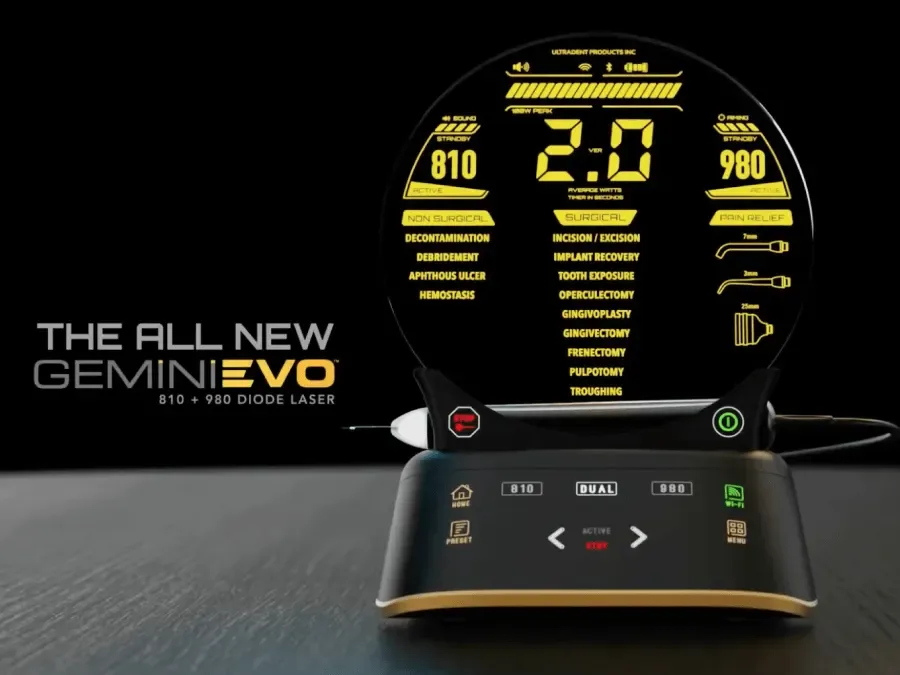
Gemini EVO™ Laser-810 + 980 Diode Laser
Choosing the Right Wavelength for Your Procedure
There is no universal "best" wavelength; the choice depends on the tissue type, desired cutting speed, and hemostasis needs. For fine, precise incisions on gingiva with minimal bleeding, the 810 nm wavelength is often favored. For bulk tissue removal or when you need rapid coagulation, the 980 nm wavelength may be more efficient.
Many clinicians use both wavelengths in the same session—for example, starting with 810 nm for initial incision and switching to 980 nm for deeper ablation or hemostasis. The Gemini EVO laser's dual-wavelength design supports this kind of tailored approach.
What the Catalog Does Not Cover
The supplied product information does not include specific power settings, recommended pulse modes, or clinical protocols for each wavelength. The 100-watt peak power figure is mentioned, but how that translates to continuous or pulsed delivery is not detailed. As with any dental laser, your clinical judgment and training are essential for safe and effective use.
For procedure-specific parameters, refer to the manufacturer's full instructions and any hands-on training you have received. The catalog is a starting point for understanding the laser's capabilities, not a substitute for comprehensive education.