Quick answer
Start with a simple invitation: lay out the 32 slats and tray, then follow your child’s lead through stacking, sorting, and building. These steps help you set up open-ended block play that grows with them.
Why these slats suit open-ended play
The Gluckskafer Wooden Blocks - Rainbow Building Slats in Tray 32pcs are intentionally simple: 32 slats in varying sizes, finished with non-toxic, water-based colour stains that highlight the natural wood grain. That simplicity is what makes them versatile—there’s no single ‘right’ way to play, so the same set can become a tower, a pattern, a bridge, or a sorting game.
The set pairs well with Grimm’s Large Stepped Pyramid blocks, but it works just as well on its own. The tray keeps the pieces contained, which makes cleanup and travel easier.
What to expect from the set
Because the slats are 1cm thick and come in varying sizes, they’re easy for small hands to grasp and stack. The water-based paint means the wood grain remains visible, giving each piece a natural look. The set is made in Bosnia and Herzegovina from sustainably harvested lime wood, and it’s built to be passed down—so it’s an investment that can last through siblings.
One honest trade-off: the slats are not interlocking, so tall towers can topple easily. That’s part of the open-ended fun, but it means younger toddlers may need a helper to build successfully.
Step-by-step open-ended play ideas
- Set up an invitation to play: Place the tray on a low surface and arrange a few slats upright and a few flat, leaving space for your child to explore. Avoid setting out all 32 at once—too many pieces can overwhelm and lead to scattering rather than building. Start with 8–10 slats to keep focus; add more as interest grows.
- Sort and classify: Ask your child to group slats by colour or size. Use descriptive language: ‘Can you find all the long red ones?’ This builds vocabulary and early maths skills. A common mistake is to quiz too much—keep it playful and follow their lead. Sorting is play, not a test; stop when they lose interest.
- Stack a simple tower: Show how to place a slat flat, then balance another on top. Encourage your child to try. If the tower falls, say ‘Oops! Let’s try again’ to model resilience. Avoid building it for them—let them experiment with balance. Celebrate the fall as part of learning, not a failure.
- Create patterns and sequences: Lay slats in a row in a repeating colour pattern (red, blue, red, blue) and invite your child to continue it. For older children, try a more complex pattern. A common mistake is to make the pattern too long—start with two or three repeats. Patterns build early maths; keep them short and achievable.
- Build a bridge or enclosure: Use two blocks as pillars and a long slat as a bridge. Or arrange slats in a circle to make a pen for toy animals. This encourages storytelling and spatial reasoning. Avoid directing the story—ask ‘What lives in your enclosure?’ Let the child name and narrate; the slats are props, not the script.
- Combine with other blocks: Pair the slats with Grimm’s Large Stepped Pyramid blocks or other wooden blocks to extend building possibilities. The slats can become roofs, ramps, or fences. A common mistake is to mix too many sets at once—start with one additional material. Introduce one new material at a time to keep play focused.
- Reset and store in the tray: At the end, count the slats together as you put them back in the tray. This reinforces tidy-up routines and early counting. Avoid making cleanup a punishment—frame it as ‘helping the blocks go home’. Make cleanup part of the play, not a chore.
Product facts
-
Gluckskafer Wooden Blocks - Rainbow Building Slats in Tray 32pcs: Set includes 32 building slats plus a tray; slats are 1cm thick and made from sustainably harvested lime wood. The tray keeps pieces organised, and the 1cm thickness makes the slats easy for small hands to pick up and stack.
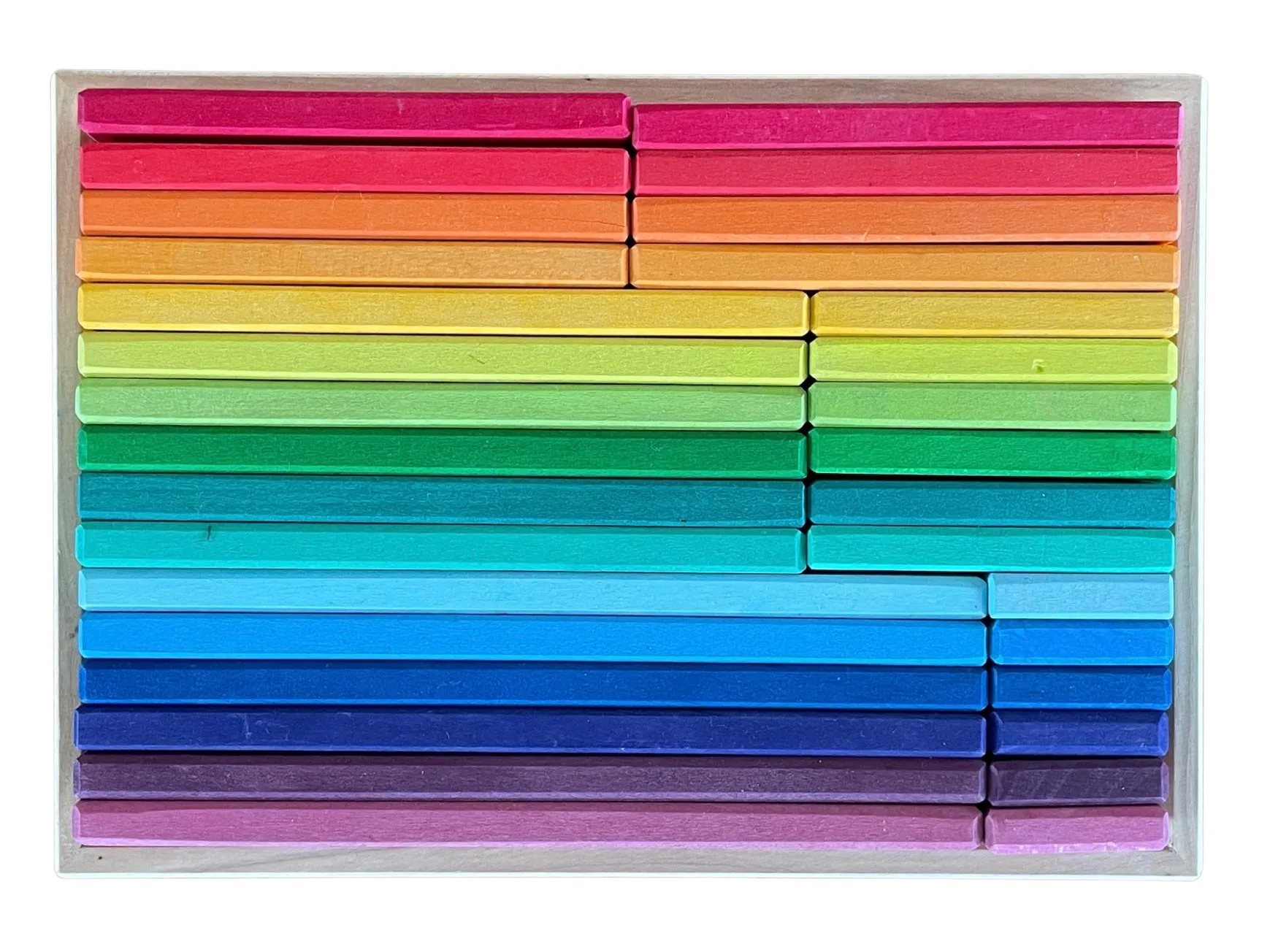
Gluckskafer Wooden Blocks - Rainbow Building Slats in Tray 32pcs