What a GND16 1.2 filter does for your landscape shots
A graduated neutral density filter is one of the most direct ways to handle a bright sky next to a darker foreground. The GND16 1.2 darkens the upper portion of the frame by four stops, letting you expose for the land without blowing out the clouds. Instead of merging exposures later, you can capture the scene in a single frame with smoother tonal transitions.
The NiSi GND16 1.2 is a circular screw-on filter, so it attaches directly to the lens thread. That makes it a simpler alternative to a square filter holder for photographers who want a quick setup. The main decision is which thread size matches your lens: the 77mm version (product ID 1943337) or the 82mm version (product ID 1943338).
77mm or 82mm: match the filter to your lens thread
The filter size you need is determined by the filter thread diameter of your lens, which is usually marked on the lens barrel or lens cap (for example, Ø77mm or Ø82mm). A 77mm filter fits lenses with a 77mm thread, while an 82mm filter is for lenses with an 82mm thread. If you own lenses with different thread sizes, you could buy the larger filter and use a step-down ring for smaller lenses, but this adds weight and can cause vignetting on wider angles. The cleaner approach is to choose the size that matches your most-used landscape lens.
The NiSi GND16 1.2 is available in both 77mm and 82mm, so you can match your primary lens without compromise. If you are unsure, check the lens cap or the barrel marking before ordering.
Optical quality and gradient control
-
NiSi 77mm Nano Coating Graduated Neutral Density Filter GND16 1.2: The NiSi GND16 1.2 filter showcases optical glass (H-K9L) of uncompromising quality, resulting in minimal color cast and ultra-low reflection. Low color cast and reflection matter for landscape work where you want accurate colors and clean skies without extra flare.
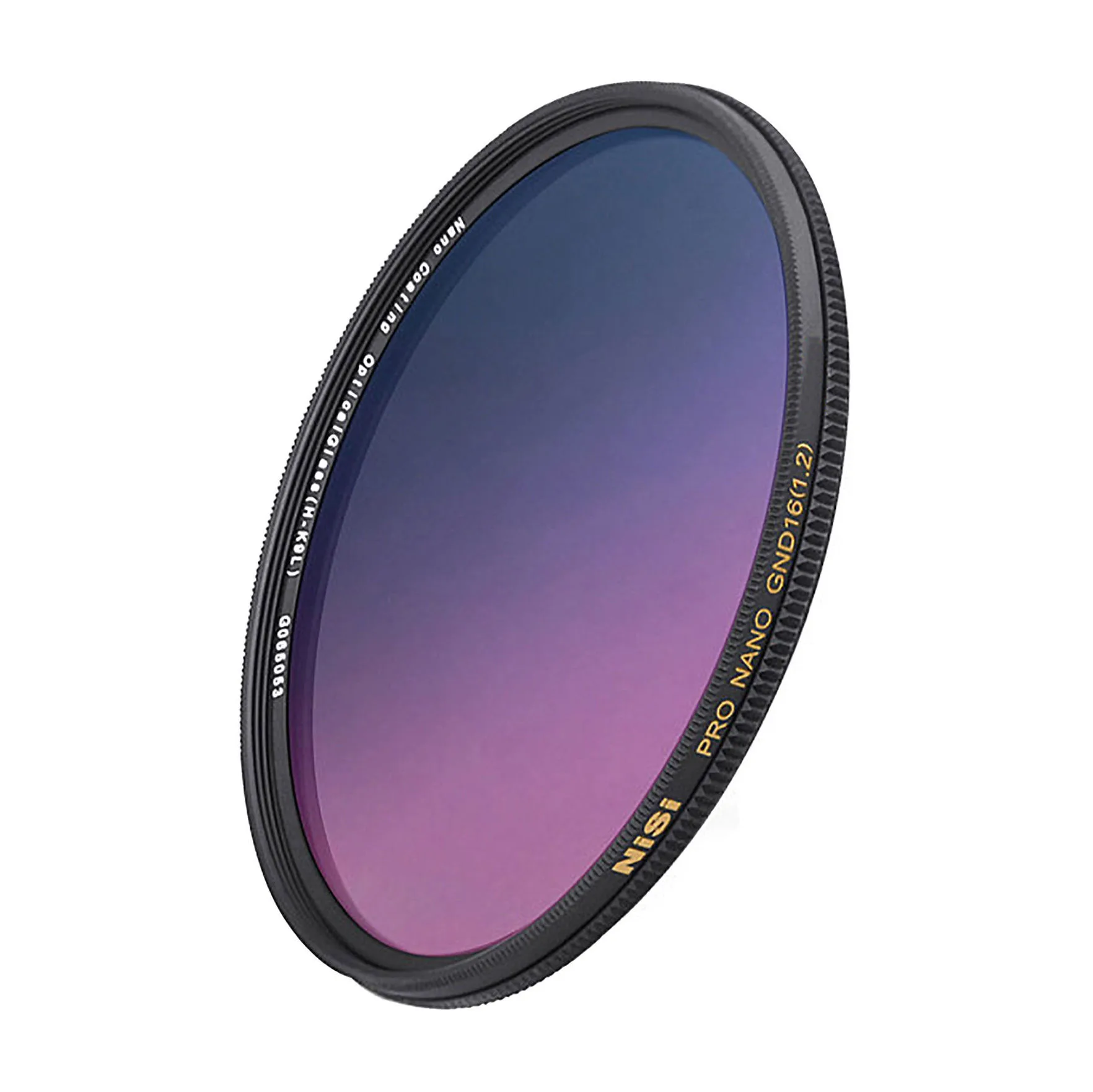
NiSi 77mm Nano Coating Graduated Neutral Density Filter GND16 1.2
-
NiSi 82mm Nano Coating Graduated Neutral Density Filter GND16 1.2: The filter's high-definition construction transforms every shot into a work of art, revealing subtle textures and intricate details like never before. High-definition glass helps preserve fine detail in clouds, rock textures, and distant mountains, which is key for large prints.
NiSi 82mm Nano Coating Graduated Neutral Density Filter GND16 1.2
Rotational adjustability and gradient placement
A circular GND filter lets you rotate the glass to align the transition with your horizon. The NiSi GND16 1.2 includes rotational adjustability, so you can set the dark portion exactly where you need it. This is especially useful when the horizon is not perfectly level or when you want to place the gradient across a mountain ridge rather than a flat line.
Because the gradient is fixed in the glass, you cannot move it up or down within the frame like you can with a square filter and holder. That is a trade-off of circular GNDs: they are compact and quick, but they give you less positional control. For most landscape scenes, rotating the filter to match the horizon is enough.
Key trade-offs to weigh before buying
Here are the practical trade-offs between the 77mm and 82mm NiSi GND16 1.2 filters.
- Compatibility vs. versatility: The 77mm filter is lighter and often less expensive, but it only works with 77mm threads without an adapter. The 82mm filter covers larger lenses and can be used on smaller threads with a step-down ring, but it adds bulk and may vignette on ultra-wide angles.
- Price difference: The 82mm version costs more (USD 140.03 vs. USD 113.40 for the 77mm). If your main lens is 77mm, you could save money and weight by choosing that size.
- Gradient position: Unlike a square GND, you cannot slide the gradient up or down. Rotational adjustability helps, but you must compose with the gradient position in mind.
How to choose the right size for your kit
Start by listing the lenses you use for landscape photography. Note their filter thread sizes. If you have a single go-to lens, buy the filter that matches it exactly. If you have two lenses with different threads, decide which one you use most often for scenes with bright skies. That lens should get the filter size that fits it natively.
If you often rent or borrow lenses, the 82mm version is a more flexible option because you can step it down to 77mm. But remember that step-down rings can reduce the effective aperture area and may cause vignetting on wide-angle lenses. For most photographers, the cleanest solution is to match the filter to the lens you use most.
What the nano coating adds
- NiSi 77mm Nano Coating Graduated Neutral Density Filter GND16 1.2: The NiSi GND16 1.2 filter's unparalleled optical precision and nano coating deliver stunning image quality. A nano coating reduces flare and ghosting when shooting into the light, which is common in landscape photography at sunrise or sunset.
- NiSi 82mm Nano Coating Graduated Neutral Density Filter GND16 1.2: Seamless transitions from neutral density to clear glass allow for captivating landscapes. A smooth gradient transition avoids a visible line across the sky, keeping the image natural.
Final decision: which GND16 1.2 should you pick?
If your main landscape lens has a 77mm thread, the NiSi 77mm GND16 1.2 is the lighter and more affordable choice. If you own a larger lens with an 82mm thread, or you want the flexibility to use the filter on multiple lenses with a step-down ring, the 82mm version is worth the extra cost. Both filters use the same optical glass and nano coating, so the image quality is identical—the decision comes down to fit and budget.
Before you order, double-check the filter thread size on your lens. A quick look at the lens cap or barrel marking will save you from a return. With the right size in hand, you can start balancing skies and foregrounds in a single exposure.