Quick Answer
You need both, but for different jobs: a griddle scoop is the better tool for moving, portioning, and clearing loose food, while a spatula is the better tool for flipping, pressing, and scraping the flat top. If you only buy one first, buy a spatula. If you cook breakfast, fried rice, or hash, add a scoop next.
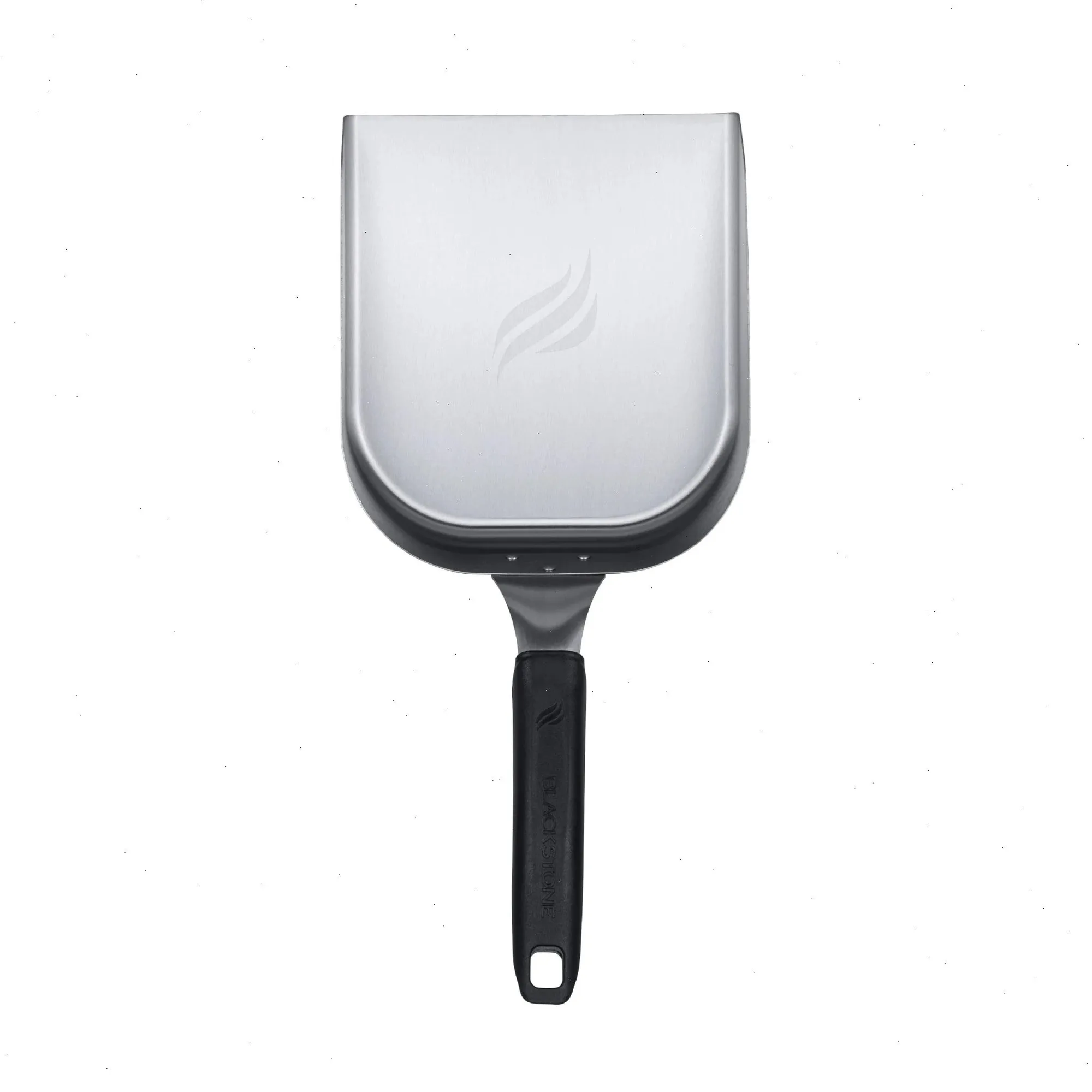
griddle scoop
What a Griddle Scoop Actually Does Best
A griddle scoop is built like a shallow shovel with a straight edge. That shape makes it the right tool for lifting and transferring loose or diced food without chasing it around the griddle. Think diced potatoes, onions, peppers, fried rice, scrambled eggs, and crumbled sausage. The straight edge also lets you push a pile of food to the side or scrape it into a bin when you are done.
The trade-off is control. A scoop is not designed to slide under a delicate pancake or a smash burger patty the way a thin spatula is. If you try to flip with a scoop, you will usually tear the food or lose the crust. Use it for volume and movement, not for precision flipping.
What a Spatula Does That a Scoop Cannot
A flat-top spatula has a thin, flexible or rigid blade with a straight front edge. That thin edge is what slides under eggs, pancakes, burgers, and fish without shredding them. The wide blade also gives you a flat surface for pressing bacon, smash burgers, or grilled sandwiches. Many griddle spatulas include a bottle opener or a beveled edge, but the core job is flip, press, and scrape.
The trade-off is capacity. A spatula is poor at moving a large pile of diced food. It will drop pieces off the sides, and you will make several trips instead of one. For bulk transfer, a scoop wins. For anything that needs a clean lift and flip, the spatula wins.
How to Choose Based on What You Cook
If your griddle routine is pancakes, eggs, burgers, and grilled cheese, a spatula is the priority. If you cook fried rice, breakfast hash, fajitas, or diced vegetables, a scoop will save you time and reduce mess. If you cook both, keep both within reach and treat them as a pair, not as competitors.
For most people, the practical path is to start with a spatula, then add a scoop when you notice yourself pushing food into a pile or struggling to transfer diced ingredients. A griddle accessory kit can cover both at once, which is often cheaper than buying each tool separately.
What to Look For in Either Tool
For a spatula, check the blade thickness and the front edge. A thin, slightly flexible edge slides under food better; a thick edge is stronger for pressing but harder to slide. For a scoop, check the edge sharpness and the handle angle. A sharp straight edge cuts into a pile of food; a rounded or dull edge just pushes it around.
Stainless steel is the common choice for both because it is durable and easy to clean. Avoid tools with painted or coated edges that can chip. If you cook on a seasoned griddle, you do not need nonstick coatings, and bare metal is fine.
Trade-Offs at a Glance
- Scoop: better for volume: A scoop moves diced food, hash, and fried rice in one pass, but it tears delicate items and cannot press or flip cleanly. Choose a scoop when your cooking involves piles of small pieces.
- Spatula: better for precision: A spatula slides under eggs, pancakes, and burgers and presses bacon or smash patties, but it drops food when you try to move a large pile. Choose a spatula when flipping and pressing are your main tasks.
- Kit: better for coverage: A kit like the Breakfast Kit bundles a batter dispenser and bacon press, covering pour, press, and flip jobs without buying each piece separately. Choose a kit when you want the common jobs covered in one purchase.
Tools That Cover Both Jobs
- Breakfast Kit: The Blackstone Breakfast Kit includes a batter dispenser that holds up to 4 cups of batter and a pre-seasoned cast iron bacon press. If you cook pancakes and bacon, this kit pairs the scoop-and-pour job with the press-and-flip job, so you are not buying tools one at a time.
- 22" Tabletop Griddle: The 22-inch tabletop griddle offers 361 square inches of cooking space and a large heat shield to keep your countertop safe from the heat. A smaller cooking surface means less room for a big scoop and a wide spatula at the same time, so tool size and handle length matter more on a tabletop model.
- 22" Tabletop Griddle Carry Bag: The 22-inch tabletop griddle carry bag fits Blackstone 22-inch tabletop griddles and is not compatible with the 1969 griddle model. If you transport your griddle, a bag keeps the surface clean and protected, but you still need a separate way to carry loose tools.
Which Tool Fits Your Cooking?
Best for
- Cooks who make pancakes, eggs, burgers, and grilled sandwiches regularly
- Anyone who wants one tool that flips, presses, and scrapes
- Beginners building a first flat-top tool set
Not for
- Cooks who mainly make fried rice, hash, or diced vegetable dishes and need bulk transfer
- Anyone who wants a single tool to do every job without compromise
- People who already own a scoop and only need flipping capability