Quick answer
For most gathered-end hammocks, a small pillow about the size of your two hands placed under your neck and upper shoulder gives the best support without pushing your head forward. If you sleep on your side, choose a slightly thicker pillow or add a second layer under your knees. Pack it inside your top quilt or sleeping bag stuff sack so it takes up no extra room.
A pillow is one of the smallest pieces of hammock gear and one of the most argued about. Some campers swear they need nothing under their head; others cannot sleep without one. The difference usually comes down to how you lie in the hammock and how much your neck needs to stay neutral.
These answers cover the questions we hear most often about hammock pillows: how much support is enough, what size actually fits, how to keep it from sliding around, and how to pack one without giving up space for the things that keep you warm.
How much support does a hammock pillow actually give?
A hammock pillow is not meant to hold your head up the way a bed pillow does. In a gathered-end hammock you lie on a diagonal, so your head rests slightly lower than your torso. The pillow fills the small gap under your neck and shoulder, keeping your head from tipping back or rolling to one side. That is why a thin, small pillow often works better than a thick one. A pillow that is too tall pushes your chin toward your chest and can leave you waking up with a stiff neck.
If you sleep on your back, start with a low pillow and add height only if your neck feels unsupported. Side sleepers often need a bit more loft to keep the spine aligned, and stomach sleepers usually need the least. Test your setup at home before a trip so you are not adjusting in the dark.
- Place the pillow under your neck and upper shoulder, not directly under the crown of your head.
- A pillow that slides around is usually too smooth or too thick; a slightly textured or smaller pillow stays put better.
What size pillow fits a hammock?
Most hammock sleepers do best with a pillow roughly 10 to 14 inches wide and 6 to 10 inches deep. Anything larger starts to crowd the hammock and can push your head into an awkward angle. A small camping pillow or a stuff sack filled with a soft layer works well because you can shape it to the space you have.
If you already own a full-size pillow, try it at home first. Many people find a standard pillow is too wide for a gathered-end hammock and ends up wedged against the fabric, which changes how the hammock lies. A dedicated hammock pillow or a compressible travel pillow gives you more control over height and position.
- Measure your hammock's usable width at the head end before buying a wide pillow.
- If you sleep with a partner in a double hammock, bring two small pillows instead of one large one.
Can I use a regular camping pillow in a hammock?
Yes. Any compressible camping pillow can work in a hammock as long as you can adjust its height. The main drawback is shape: many camping pillows are designed to be wide and flat for tent floors, and that shape can feel bulky in a hammock. Look for one with a curved or tapered edge, or simply under-inflate it so it molds to your neck.
If you use an inflatable pillow, let out some air before you settle in. A fully inflated pillow feels firm and tends to slide. A partially deflated one stays in place and gives you the small amount of support a hammock actually needs.
- Test your camping pillow at home with the hammock at its normal hang angle.
- A pillowcase or a soft shirt over the pillow can reduce slipping and feels better against your face.
How do I keep a hammock pillow from sliding around?
Sliding happens because hammock fabric is smooth and the pillow has nothing to grip. The simplest fix is to tuck the pillow slightly under your shoulder or inside the hood of your sleeping bag or top quilt. That creates a pocket that holds it in place while you move. Another option is to attach a small loop of cord or a clip to the pillow and hook it to your hammock's ridgeline or suspension point.
If you use an underquilt or a hammock with an integrated sleeping bag, the pillow can often be pushed into the fabric folds at the head end. That keeps it from wandering without adding any hardware.
- Tuck the pillow into the hood of your sleeping bag for a no-slip fit.
- A ridgeline organizer or small clip can anchor a pillow if you move a lot in your sleep.
How should I pack a pillow for hammock camping?
The best place for a hammock pillow is inside the stuff sack of your top quilt or sleeping bag. It fills the empty space around the insulation and adds no separate item to your pack. If you use an inflatable pillow, deflate it completely and roll it rather than folding it, which helps it pack smaller and last longer.
For trips where every ounce counts, a pillowcase stuffed with a spare fleece or puffy jacket works as a pillow at night and as insulation during the day. That way you are not carrying a single-purpose item. If you bring a dedicated pillow, choose one that compresses to the size of a grapefruit or smaller.
- Pack the pillow in the top quilt stuff sack to save space.
- Roll inflatable pillows instead of folding them to avoid creases that can turn into leaks.
Do I need a pillow if my hammock has an integrated sleeping bag?
Not always. Hammocks with integrated sleeping bags, like the Evolution 20 Down Sleeping Bag Hammock, are designed to reduce the gear you carry. The integrated design keeps insulation in place, but it does not include a pillow. Many users still add a small pillow for neck support, especially side sleepers. If you sleep on your back and the hammock's fabric supports your head comfortably, you may not need one at all.
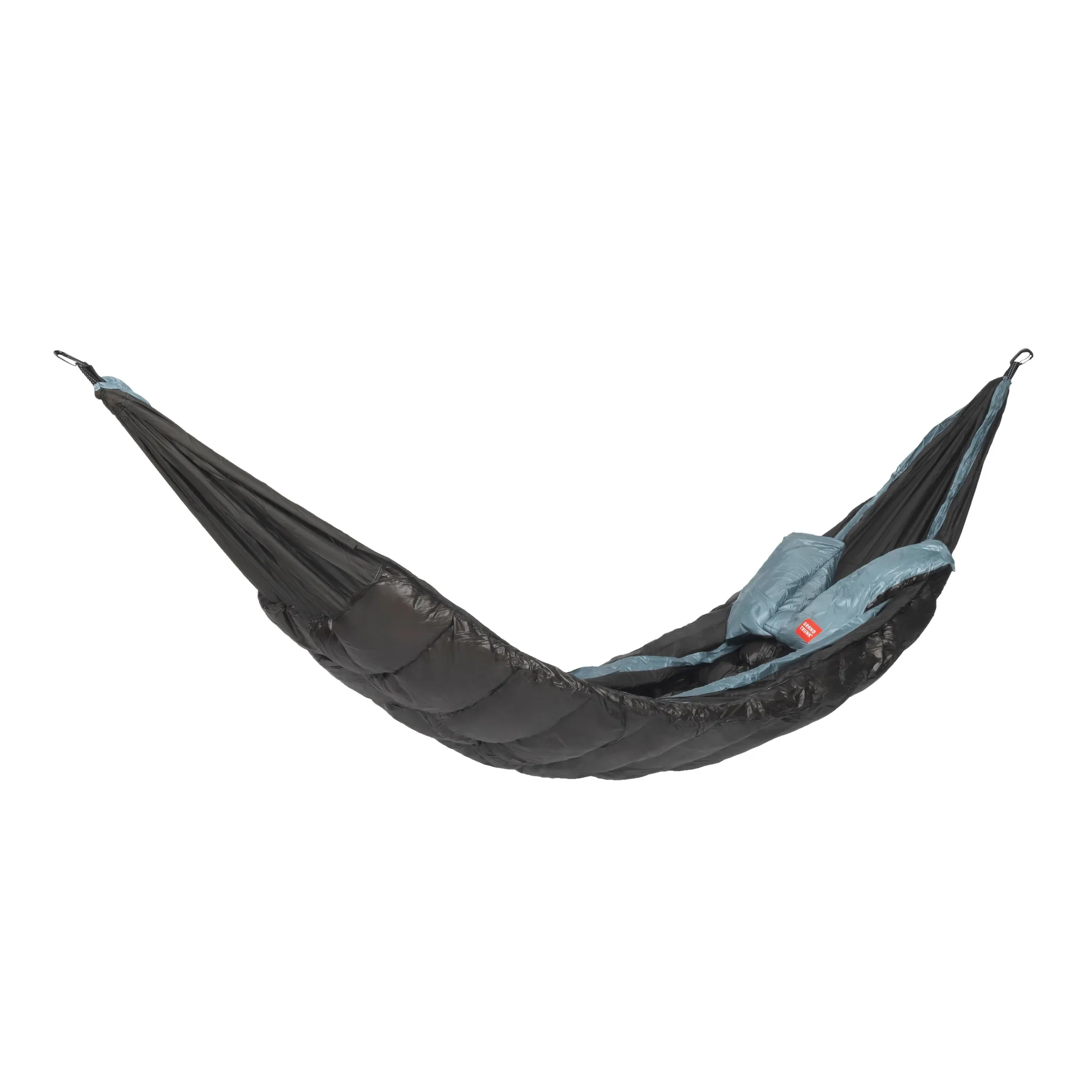
Evolution 20 Down Sleeping Bag Hammock
The same goes for hammock underquilts and top quilts. They keep you warm but do not replace a pillow. A small pillow or a stuffed stuff sack is still the easiest way to fine-tune your head position.
- Try your first night without a pillow to see if the hammock shape alone supports your neck.
- If you wake with a stiff neck, add a low pillow before changing your whole sleep system.
Hammock pillow quick checks
Support height
Lie in your hammock at home and slide a hand under your neck. If there is a gap, add a low pillow. If your chin tucks down, remove height. Aim for a neutral neck, not a propped-up head.
Size fit
A pillow wider than your shoulder span will press against the hammock fabric and change the lay. Keep it small enough to sit under your neck and shoulder only. Small and shaped beats large and flat in a gathered-end hammock.
Packing plan
Stuff your pillow into the top quilt or sleeping bag sack before you close your pack. If it does not fit there, it is probably larger than you need. If it needs its own stuff sack, consider a smaller pillow or a stuff sack filled with spare clothing.
Gear that works with a hammock pillow
- 360° ThermaQuilt 3-in-1 Blanket, Sleeping Bag & Hammock Underquilt: The ThermaQuilt wraps completely around any hammock and cinches at the ends, or lays flat as a blanket or sleeping bag. When it is cinched around the hammock, the fabric creates a natural pocket at the head end where a small pillow stays put without clips.
- Evolution 20 Down Sleeping Bag Hammock: The Evolution integrates a down sleeping bag with a hammock and is designed to eliminate a bunched-up sleeping bag or separate under/over quilt. Because the insulation is built in, you can pack lighter and use a very small pillow, or none at all, depending on how you sleep.
- Trunk Straps - Hammock Suspension Straps: Trunk Straps have 36 adjustment points (18 on each side) for micro adjustments to your hang. A small change in hang angle changes how your head rests, so fine-tuning the suspension can reduce how much pillow support you need.
A hammock pillow is a small piece of gear with an outsized effect on how well you sleep. Start with a low, small pillow under your neck, test it at home, and pack it inside your top quilt. If you wake up comfortable, you have found your setup. If not, adjust the height before you change anything else.