Quick answer
For most home gardeners, choose hedge shears with a branch notch, serrated blades, and a handle length that matches your reach—compound action is worth it if you have dense growth or limited arm strength.
Why the branch notch matters
A branch notch is a small gap near the base of the blades designed to grip and cut thicker stems that would otherwise jam regular blades. If you regularly trim shrubs with woody growth, this feature saves you from switching to loppers or a pruning saw for every stubborn branch.
Without a branch notch, you may find yourself fighting to cut through stems over 1/4 inch thick, which can bend the blades or leave ragged cuts. For light trimming of soft new growth, though, a notch is less critical.
Serrated vs. straight blades
Serrated blades grip the branch as they cut, reducing the chance of slipping and making it easier to slice through fibrous stems. They are especially helpful when trimming hedges with dense, tangled growth or when you need a cleaner cut on slightly thicker wood.
Straight blades are easier to sharpen and give a smoother cut on soft growth, but they require more force and can slide off thicker branches. If you value low maintenance and have mostly fine foliage, straight blades might be a better fit.
Handle length and leverage
Longer handles give you more reach and leverage, reducing the effort needed for each cut. They are ideal for tall hedges or if you want to avoid bending. However, they add weight and can be unwieldy in tight spaces.
Shorter handles are lighter and easier to control for detailed shaping, but they put more strain on your wrists and arms when cutting thicker growth. Consider the height of your hedges and your physical strength when choosing.
Decision rules for choosing hedge shears
- If you trim hedges more than twice a season: Choose shears with a branch notch and serrated blades. The notch handles occasional thick stems, and serrations grip the wood to prevent slipping. Look for a model that includes both features to avoid buying a second tool.
- If you have tall hedges or limited arm strength: Opt for long handled shears with compound action. The extra leverage and mechanical advantage reduce the effort per cut, making the job less tiring. Test the weight in-store if possible; longer handles add heft that can offset the leverage benefit.
- If you mainly trim soft new growth: A basic straight-blade shear without a notch is sufficient and easier to sharpen. Save money and avoid unnecessary features that add weight. Consider how often you actually encounter thick branches before paying extra for a notch.
Product spotlight
-
Yeoman Compound Action Hedge Shears Serrated Blade Branch Cutting Notch: The Yeoman Compound Action Hedge Shears feature serrated blades, a branch-cutting notch, and an angled design to reduce arm strain. This combination lets you cut through thicker branches without switching tools, while the compound action and angled head help prevent fatigue during longer trimming sessions.
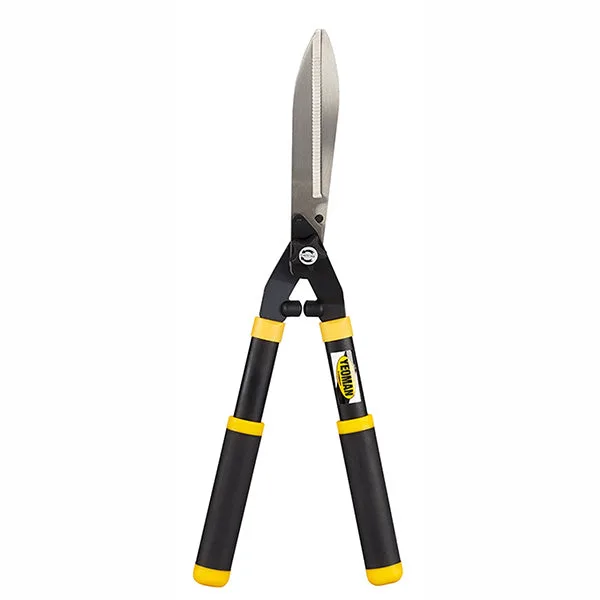
Yeoman Compound Action Hedge Shears Serrated Blade Branch Cutting Notch
Who should choose what
Best for
- Home gardeners with mixed hedges that include some woody stems
- People who want to minimize tool switching and arm fatigue during longer trimming sessions
Not for
- Those who only trim soft, fine foliage and prefer a lightweight, simple tool
- Professionals who need heavy-duty cutting beyond what manual shears can handle; consider powered trimmers or loppers