Quick answer
Choose adjustable hog-tie straps if you want one piece that links wrists and ankles with customizable tension; choose a separate cuff set if you prefer independent limb control and simpler quick release. For most beginners, the Adjustable Hog-Tie Straps with Cuffs offer the easiest entry because the hook-and-loop cuffs and adjustable straps let you set limits before play.
Why adjustability changes the safety conversation
Hog-tie straps and cuff sets differ most in how much adjustment you get before and during play. A hog-tie system connects limbs, so any slack or tightness affects the whole position. Adjustable straps let you shorten or lengthen the link without swapping hardware, which matters when you are learning what your body tolerates.
Separate cuffs give you independent control over each wrist or ankle, but they usually rely on a connector you add yourself. That extra step can be a plus for experienced users who want modular setups, and a drawback for beginners who want fewer variables.
The trade-off: connection versus independence
A connected hog-tie design limits how far apart your limbs can move, which creates the restrained feeling many people seek. The trade-off is that a single adjustment affects the entire position, so you need to check circulation and comfort more often.
A cuff set without a built-in connector keeps each limb independent. That is easier to release quickly and simpler to size, but it does not create the same linked restraint unless you add your own connection. Neither option is universally better; the right choice depends on whether you want the connection built in or added later.
When a cuff set is the smarter first purchase
If you are unsure about restraint play at all, start with cuffs alone. You can test fit, comfort, and release speed without committing to a connected position. Cuff sets also work for standing or seated play where a hog-tie link would be unnecessary or awkward.
The limitation is that a basic cuff set does not include the strap that makes a hog-tie position possible. If you later want that linked feeling, you will need to add a connector or upgrade to a set that includes one.
Key trade-offs at a glance
- Adjustability: Adjustable hog-tie straps let you change the distance between wrists and ankles in one system; separate cuffs adjust per limb but need a connector for linked restraint. Decide whether you want one adjustment point or several before you buy.
- Release speed: Hook-and-loop cuff closures are fast to open; strap-and-buckle systems may take longer. Practice release before you rely on either. Test release with the product on your wrist before any partner play.
- Fit range: The Adjustable Hog-Tie Straps with Cuffs fit wrists or ankles up to 12.5 inches; check your measurement against that limit rather than assuming one size works. Measure the widest part of the wrist or ankle, not the narrowest.
- Safety check: Any linked position requires frequent checks for tingling, numbness, or color change. Keep safety shears within reach and agree on a stop word before you begin. Set a timer to check circulation every few minutes during linked play.
Product facts
-
Adjustable Hog-Tie Straps with Cuffs: Soft cuffs secure with hook-and-loop closures and fit wrists or ankles up to 12.5 inches. Hook-and-loop closures let you open the cuffs quickly and adjust fit without buckles, which is helpful when you are still learning your comfort range.
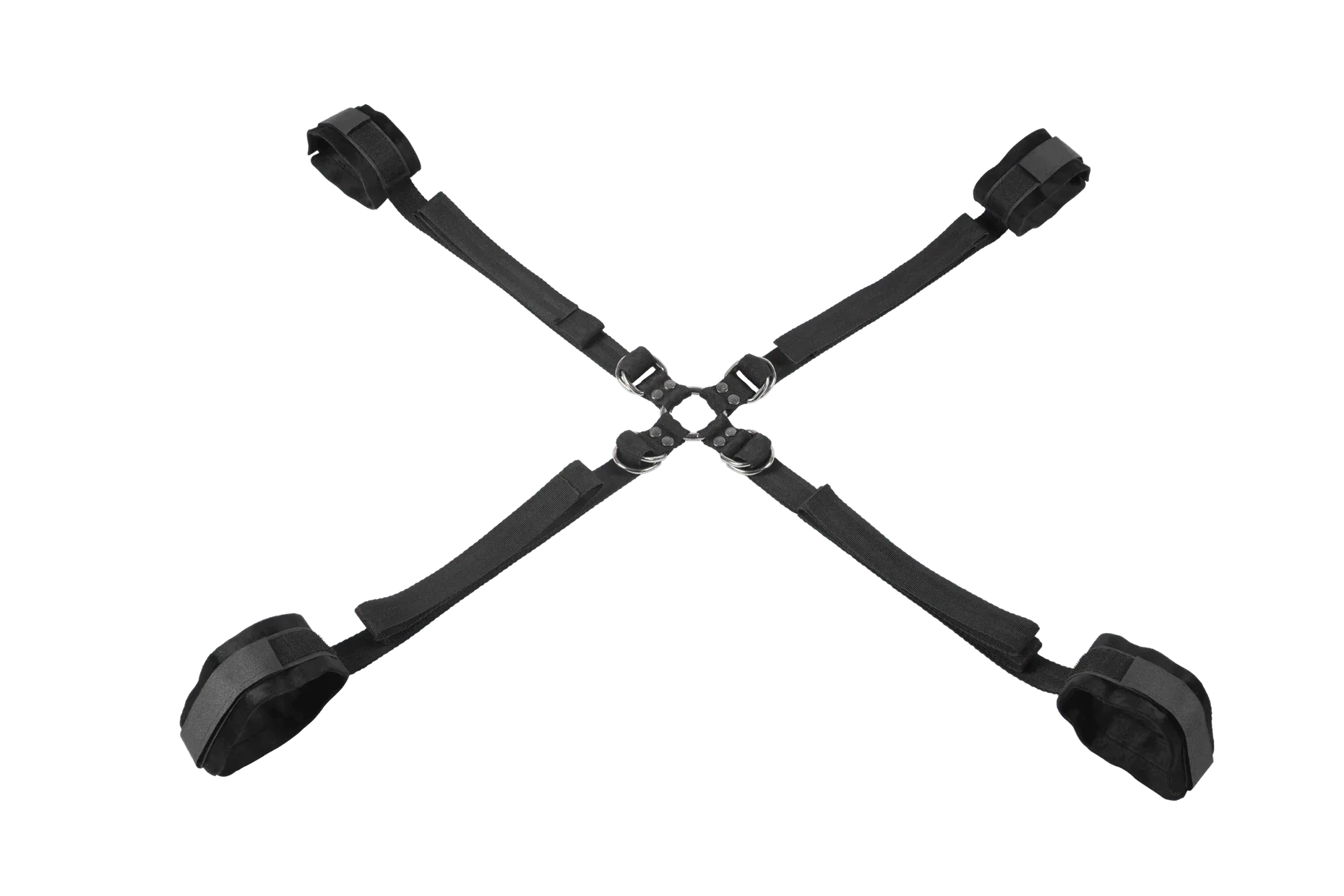
Adjustable Hog-Tie Straps with Cuffs
Who should choose which
Best for
- Beginners who want one adjustable set with built-in cuffs and straps
- Couples who want to customize tension without buying separate connectors
- Users with wrist or ankle measurements up to 12.5 inches
Not for
- People who want fully independent limb control with no linked strap
- Users whose wrist or ankle measurement exceeds 12.5 inches
- Anyone who has not yet practiced quick release and safety checks