Which J-Series Fuel Rail Fits Your Engine?
If you're building or upgrading a Honda or Acura with a J-series V6, the fuel rail is a key piece of the puzzle. The J32, J35, and J37 engines share a common architecture, but fuel rail fitment changes with model year and intake design. Choosing the right rail means matching your specific engine code and chassis, not just the displacement.
The DeatschWerks Honda J-Series Fuel Rail with Crossover (Late) covers a wide range of 2003–2018 applications, including the Accord, TL, MDX, RDX, RL, and TSX. But 'Late' refers to a specific generation of J-series engines—those with the updated intake manifold and fuel injector orientation. If your car falls outside that window, you'll need to verify compatibility before buying.
What the Catalog Confirms
-
Honda J-Series Fuel Rails with Crossover (Late): Honda J-Series Fuel Rail with Crossover (Late) - fits 2007-13 Acura MDX J37A1, 2013-18 Acura RDX J35Z2, 2005-12 Acura RL J35A8/J37A2, 2004-14 Acura TL J32A3/J35A8/J35Z6/J37A4, 2010-14 TSX J35Z6, 2003-17 Accord J30A4/J30A5/J35Z2/J35Z3/J35Y1/J35Y2 This list tells you exactly which engine codes and model years are confirmed to work. If your car isn't here, the rail may not bolt up without modification.
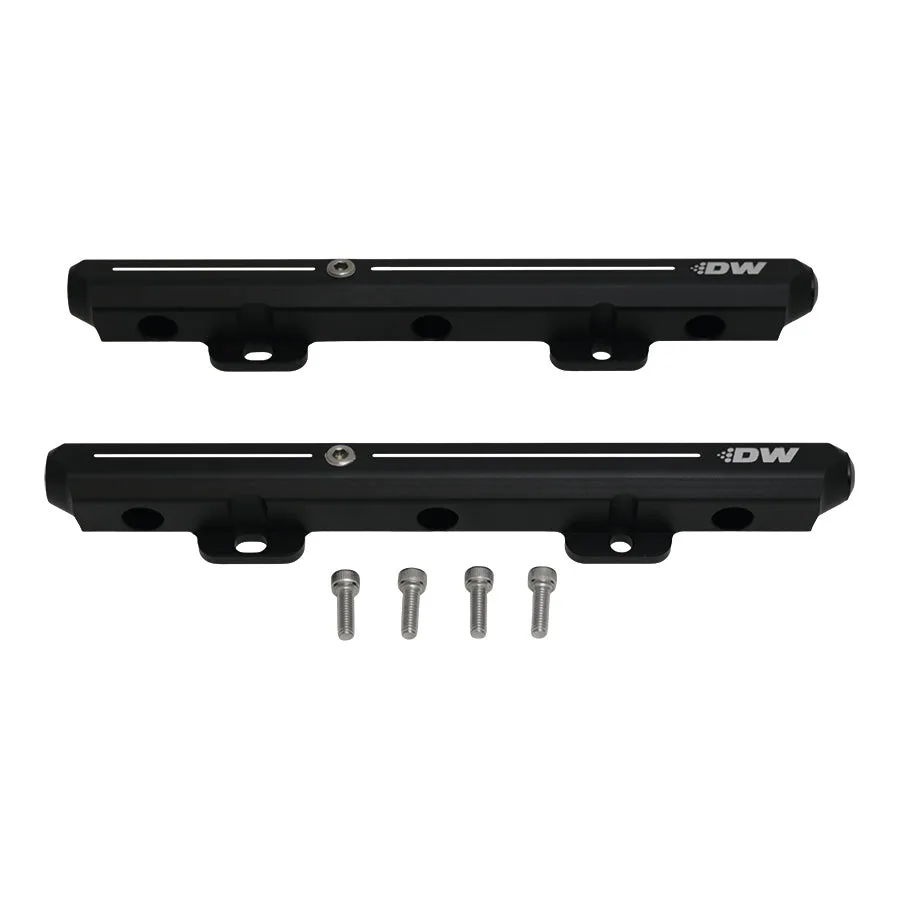
Honda J-Series Fuel Rails with Crossover (Late)
The Crossover Difference
A crossover tube connects the two fuel rails, balancing pressure between the front and rear banks. This is especially useful for high-flow applications like boosted builds or E85 conversions, where even fuel distribution matters. The DeatschWerks rail includes a crossover, so you don't need to source one separately.
If your stock rail uses a different crossover design or no crossover at all, this upgrade simplifies plumbing and reduces the number of fittings. Just be aware that the crossover adds length, so check clearance against your intake manifold and throttle body before installation.
How to Verify Fitment Before You Buy
- Identify your engine code: Look for the stamp on the front of the engine block near the timing cover. Common codes include J35Z2, J37A4, J32A3, and J35Y1. Match it to the catalog list.
- Check the model year: The 'Late' rail fits 2003–2017 Accord and 2004–2014 TL, but only specific sub-models and years. For example, a 2005 TL with a J35A8 is covered, but a 2002 TL is not.
- Inspect your intake manifold: If your car uses a drive-by-wire throttle body or a plastic intake manifold, the crossover clearance may be tight. Measure the gap between the stock rail and the manifold to confirm.
What the Catalog Doesn't Settle
The catalog confirms engine codes and years, but it doesn't specify injector size or fuel line fitting type. You'll need to know whether your injectors use a standard O-ring size or a specific connector style. The rail accepts common aftermarket injectors, but the supplied information doesn't guarantee every brand or flow rate.
Similarly, the fuel line inlet and outlet sizes are not listed in the available evidence. If you're adapting to an existing fuel system, plan to measure your current fittings or use a flexible hose kit that can accommodate variations.
Stock Rail vs. DeatschWerks Rail
- Material and construction: Stock rails are often steel or aluminum with crimped fittings. The DeatschWerks rail uses billet aluminum with a crossover, which resists corrosion and handles higher fuel pressure better.
- Flow capacity: Stock rails are designed for factory fuel pressure and injector flow. The DeatschWerks rail supports higher flow rates, making it suitable for forced induction or E85 without bottlenecking.
- Fitment window: Stock rails are model-specific and may not swap between J32 and J35 engines. The DeatschWerks rail covers multiple J-series variants, but only the 'Late' generation.
Honest Trade-Offs to Keep in Mind
The DeatschWerks J-Series fuel rail is a solid upgrade for late-model J32, J35, and J37 engines, but it's not a universal fit for every J-series. If your build uses an early J30A1 or J35A1, look elsewhere. The crossover adds complexity in tight engine bays, especially on transverse-mounted V6s like the Accord and TL.
Also, the price is $149.40 (compared to a catalog price of $249.00), which is competitive for a billet rail with crossover. But if your stock rail is already adequate for your power goals, the upgrade may not be necessary. Focus on your fuel system's weakest link—injectors, pump, or regulator—before swapping the rail.