The short answer: frequency isn't on the label here
If you're searching for how often to use T/Sal shampoo, the honest answer is that the supplied product information doesn't specify a frequency. What it does tell you is the job the shampoo is formulated for: controlling scalp build-up and clearing visible flakes associated with dandruff, psoriasis, and seborrheic dermatitis. The active ingredient is 3% salicylic acid, and the formula is fragrance-free.
That means the right cadence depends on your scalp and on guidance from a clinician, especially if you're managing psoriasis or seborrheic dermatitis rather than ordinary flaking. Rather than inventing a schedule, this guide shows you how to build a routine around what the label actually supports, what to confirm before you start, and how to tell whether the routine is working.
What the T/Sal label supports
-
Neutrogena T/Sal Therapeutic Dandruff Shampoo,Scalp Build-Up Control,3% Salicylic Acid,Psoriasis Treatment,Seborrheic Dermatitis Shampoo,Clears Flakes,Fragrance Free,4.5 fl oz,(Pack of 4): Neutrogena T/Sal Therapeutic Dandruff Shampoo contains 3% salicylic acid to help treat dandruff, psoriasis, and seborrheic dermatitis. This is the core claim to build your routine around: the shampoo is positioned for three specific scalp conditions, not general cleansing.
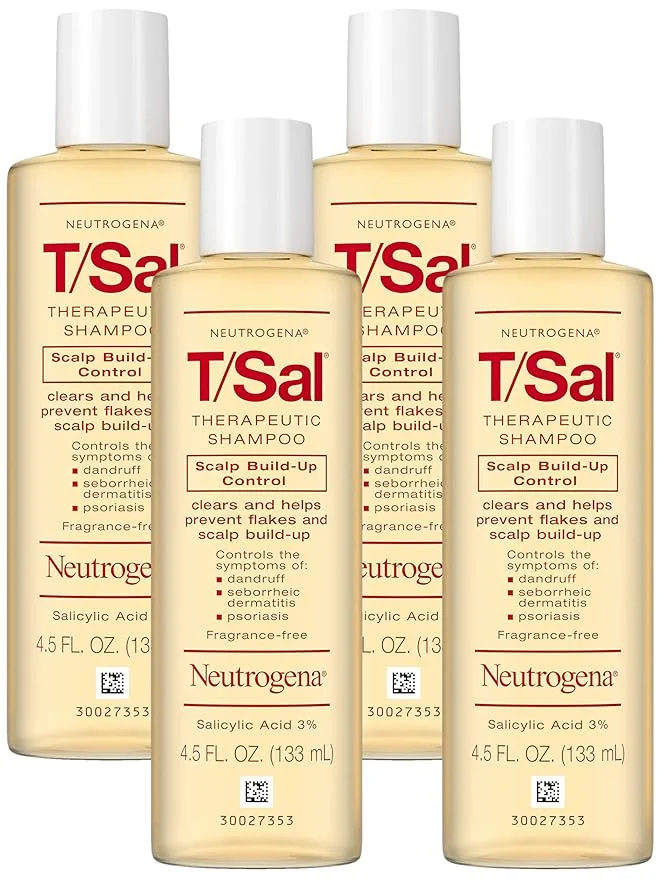
Neutrogena T/Sal Therapeutic Dandruff Shampoo,Scalp Build-Up Control,3% Salicylic Acid,Psoriasis Treatment,Seborrheic Dermatitis Shampoo,Clears Flakes,Fragrance Free,4.5 fl oz,(Pack of 4)
-
Neutrogena T/Sal Therapeutic Dandruff Shampoo,Scalp Build-Up Control,3% Salicylic Acid,Psoriasis Treatment,Seborrheic Dermatitis Shampoo,Clears Flakes,Fragrance Free,4.5 fl oz,(Pack of 4): It helps control scalp build-up and clear visible flakes. These are the outcomes to watch for when judging whether your cadence is working.
-
Neutrogena T/Sal Therapeutic Dandruff Shampoo,Scalp Build-Up Control,3% Salicylic Acid,Psoriasis Treatment,Seborrheic Dermatitis Shampoo,Clears Flakes,Fragrance Free,4.5 fl oz,(Pack of 4): The formula is fragrance-free. Useful if you're assembling a fragrance-free routine and want to avoid adding scented products around it.
-
Neutrogena T/Sal Therapeutic Dandruff Shampoo,Scalp Build-Up Control,3% Salicylic Acid,Psoriasis Treatment,Seborrheic Dermatitis Shampoo,Clears Flakes,Fragrance Free,4.5 fl oz,(Pack of 4): It is available as a 4.5 fl oz pack of 4 bottles. A multi-bottle pack suits a recurring routine better than a single bottle if you plan to use it regularly.
How to build a salicylic acid shampoo routine without guessing
The supplied information doesn't include preparation steps, contact time, or frequency, so treat the sequence below as a framework for organizing your own routine — not as manufacturer instructions.
- 1. Confirm the fit before you start: The label names dandruff, psoriasis, and seborrheic dermatitis. If your flaking is persistent, painful, or spreading, or if you're unsure which of these you're dealing with, check with a clinician before building a routine around a therapeutic shampoo.
- 2. Set a baseline you can compare against: Note how much visible flaking and build-up you see before you begin. Because the label doesn't state a frequency, your own baseline is the reference point for judging whether a given cadence helps.
- 3. Start conservatively and observe: Without a labeled frequency, the sensible approach is to begin with a modest cadence and watch how your scalp responds over a few weeks. Increase or reduce only based on what you observe, not on a number pulled from a blog.
- 4. Keep the rest of your routine simple: If you want a fragrance-free dandruff shampoo routine, pair T/Sal with unscented products elsewhere so you can tell what's actually affecting your scalp.
- 5. Reassess rather than escalate indefinitely: If visible flakes and build-up aren't improving, or if your scalp becomes uncomfortable, stop adjusting on your own and get professional advice.
Checkpoints that tell you the routine needs adjusting
These are observation points, not labeled milestones. The supplied information doesn't define how quickly results should appear.
- Visible flakes are decreasing: The label's stated job is clearing visible flakes. If you're not seeing that change over a reasonable trial period, the cadence or the product may not be the right fit.
- Build-up feels controlled: Scalp build-up control is the other stated benefit. Judge it by how your scalp feels and looks between washes, not by a fixed schedule.
- Your scalp stays comfortable: Discomfort is a signal to stop self-adjusting and seek advice. The supplied information doesn't describe expected reactions, so treat any irritation as a reason to pause.
- You're not layering competing scented products: If you chose this shampoo partly for its fragrance-free formula, keep the surrounding routine consistent so the variable stays controlled.
What the supplied information doesn't settle
The product record doesn't include a recommended frequency, contact time, or instructions for combining T/Sal with other medicated shampoos. It also doesn't address use on color-treated hair, children, or during pregnancy. Those aren't gaps you should fill with guesswork — they're questions for the label's full directions or for a clinician.
What you can rely on is narrower but solid: a 3% salicylic acid, fragrance-free shampoo formulated to help treat dandruff, psoriasis, and seborrheic dermatitis by controlling build-up and clearing visible flakes. Build your routine around that, measure against your own baseline, and get professional input when the label runs out of answers.