Quick Answer
The Extendo Grabber uses a rack and pinion mechanism to convert rotational motion into linear motion, letting kids extend and retract the grabber arms while learning how gears and racks work together.
Why Rack and Pinion Matters for Young Engineers
Rack and pinion is one of the simplest mechanical systems that turns circular motion into straight-line motion. It's the same mechanism found in car steering racks, some elevators, and even 3D printers. Understanding it early gives kids a foundation for how many everyday machines operate.
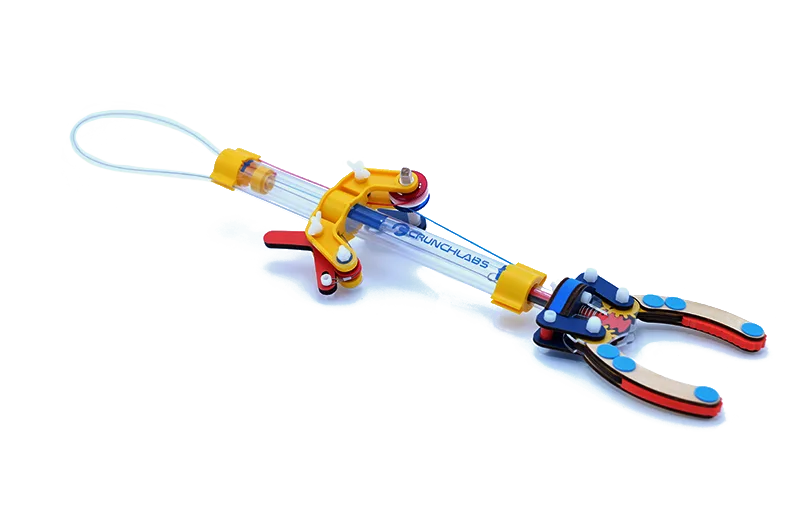
The Extendo Grabber makes this concept tangible: when the child turns the handle, a small gear (the pinion) rotates along a flat toothed bar (the rack), pushing the grabber open or closed. This direct feedback helps kids connect the cause (turning) to the effect (grabbing).
What the Extendo Grabber Does Well
The toy is built for hands-on experimentation, not just passive play. Kids can see the teeth of the rack and pinion engage as they crank the handle, making the mechanism visible and understandable. The price point is accessible, and the design encourages repeated use — grabbing objects around the house reinforces the mechanical lesson.
Trade-Offs to Keep in Mind
Because the mechanism is exposed, small parts like the gear teeth can be a choking hazard for very young children. Also, the rack and pinion system works best with the toy held in a certain orientation — if the grabber is tilted too much, the gear may slip slightly. This isn't a flaw but a realistic constraint that teaches kids about alignment and friction.
How to Explore Rack and Pinion with the Extendo Grabber
- 1. Turn the Handle Slowly: Hold the Extendo Grabber with one hand and turn the crank handle with the other. Watch the small gear (pinion) rotate and move along the toothed bar (rack). Common mistake: turning too fast can cause the gear to skip a tooth. Slow, steady rotation gives the best view of the mechanism.
- 2. Observe the Direction Change: Turn the handle clockwise to extend the grabber arms outward; turn counterclockwise to retract them. Notice how the direction of rotation changes the direction of linear motion. Checkpoint: if the grabber doesn't move, check that the gear teeth are fully engaged with the rack — they can slip out if the toy is twisted.
- 3. Try Grabbing Different Objects: Use the grabber to pick up lightweight items like a pencil, a small ball, or a toy car. Feel how the force needed to grip changes with the object's shape and weight. Common mistake: grabbing something too heavy may cause the gear to jam or slip. The rack and pinion works best with light to moderate loads.
- 4. Compare with Other Simple Machines: If you have other CrunchLabs toys or simple machines at home, compare the rack and pinion with a lever or pulley. How is the motion different? Checkpoint: this comparison helps kids see that different mechanisms solve different movement problems — no single machine is 'best' for everything.
Product Fact
-
Extendo Grabber - Rack and Pinion: The Extendo Grabber uses a rack-and-pinion mechanism for hands-on grabbing play and engineering-style exploration. Children can directly observe the gear teeth meshing with the rack, making the mechanical principle visible and repeatable during play.
Extendo Grabber - Rack and Pinion